
• Changing brandscapes

    Recently, I was part of an interesting round table discussion organised by afaqs and IBM around “Technology in Marketing“. While we did stick to the subject, in my mind, I was also wondering about the impact this (topic) was  having on the idea of brand. It has been only 4 years since I had last held a brand job, (I left TOI in 2010) but I can safely say that the landscape has changed massively. A few thoughts –

    Time: The cycles of brand building have been massively reduced. This is not a 2010 phenomenon, but to give you some perspective, in that year Flipkart was just venturing beyond books and hardly the well known brand it is now. Zomato was a ‘promising startup’ according to a list made by the Smart Techie magazine and had just expanded beyond a single city. The flip side is that some of the other startups in that list no longer exist. AlooTechie, which reported this, also does not exist. I had a Nokia E series phone then, and they are pretty much a non entity now. In short, that word – change, and it’s faster than ever! It is said that brands get built over time, but do business cycles allow that liberty now?

    Geography: A cliche used frequently is “Geography is history”, but a little incident reminded me that it may not altogether be true. One of the regular conversations these days is around taxi rentals and Uber is a favourite among many of my friends. I casually asked them whether they knew of the heavy rap Uber was getting in the US for remarks allegedly made by a senior VP. (alternate perspective) They didn’t, and it isn’t as though they don’t consume news online. They missed it amidst all the ‘noise’. While a brand may be global, how much does its international stature impact regional preferences, even in this hyper connected era?
    (more…)

  • Napoli Bistro

    First published in Bangalore Mirror

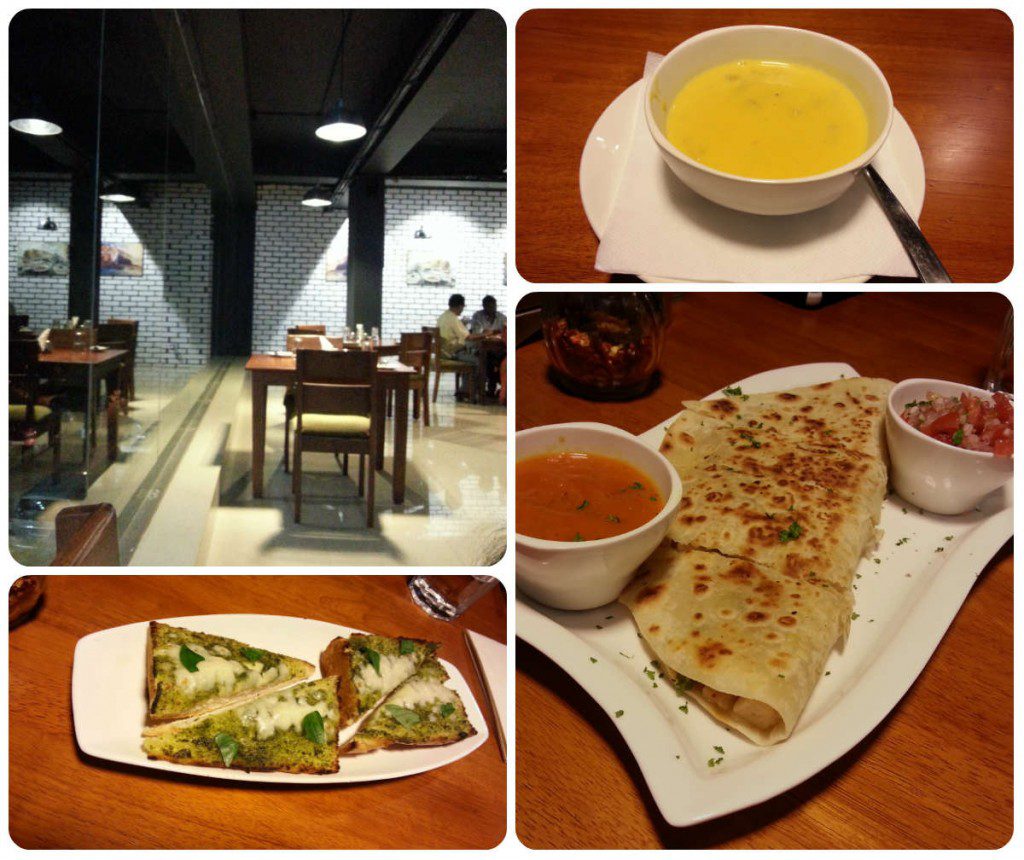
    After the World Cup, a bite of Italian could mean a lot of things, but in HSR Layout, there aren’t really a lot many options. That probably explains the crowd on a Saturday night at Napoli Bistro. ( Having said that, HSR continues to surprise me each time with its growth spurts!) Street parking and a flight of stairs take you to a well-lit floor with views to the busy 27th Main road. (map) The faux brick wall, the framed art and the functional, elegant furniture all add a semblance of character to the place. We got there just in time before the place filled up. The menu is all Italian and seemingly extensive.

    There is no dearth of starter options – soup, appetisers and a host of salads – though there is a clear skew towards vegetarian. On a chilly Bangalore night, a soup is a great way to begin a meal, and that’s exactly what we did. The description doesn’t offer a lot of explanation and simply states ‘Non Veg’. The risk turned out to be worth it and we got a delicious, creamy yellow soup (pumpkin was the guess, but turned out to be carrot) with chicken sausage slices. The Napoli Pesto was a tasty dish too – toasted bread with a tasteful signature pesto. The Chicken Quesadilla – standard tortillas stuffed with diced chicken – wasn’t really the best we have had. Quite savourless and a bit too greasy.

    collage1

    (more…)

  • Natural Law

    After a couple of years of Samsung, I bought a Moto X (2nd gen) phone, the Droid Turbo and Nexus 6 also being considerations. In the first few days of use, the automation that Moto’s Assist, Actions and Voice allows has impressed upon me the potential of such technologies and the dependency we could have on them.  As Karen Landis states in the Pew Internet Project’s Killer Apps in the Gigabit Age, “Implants and wearables will replace tools we carry or purchase…It will also redefine what a ‘thought’ is, as we won’t ‘think’ unassisted.

    It reminded me of an article I’d read in Vanity Fair titled ‘The Human Factor“, and a particular observation in it – To put it briefly, automation has made it more and more unlikely that ordinary airline pilots will ever have to face a raw crisis in flight—but also more and more unlikely that they will be able to cope with such a crisis if one arises. This thought is elaborated in ‘Automation Makes Us Dumb‘, drawing the difference between two design philosophies – “technology – centred automation” and “human- centred automation”. The former is dominant now and if one were to extrapolate this , a scary thought emerges.

    I think the best articulation of that scary thought is by George Dyson in Darwin Among the Machines – “In the game of life and evolution there are three players at the table: human beings, nature, and machines. I am firmly on the side of nature. But nature, I suspect, is on the side of the machines.” I had seen this in Bill Joy’s amazing 2000 Wired article “Why the Future doesn’t need us“, which itself discusses the idea that Our most powerful 21st-century technologies – robotics, genetic engineering, and nanotech – are threatening to make humans an endangered species. (more…)

  • The Other Side of Light

    Mishi Saran

    I completely loved Mishi Saran’s earlier work “Chasing the Monk’s Shadow”, an inner journey as much as an actual one. In some ways I could associate it a little with Asha’s journey in ‘The Other Side of Light’, a work of fiction. The blurb says she has written short stories earlier, but I have to wonder whether this contains autobiographical elements, like many first time works of fiction do. (just a thought)

    The book is written in flashback mode as we get the current status of Asha’s life in the first few pages. We follow Asha’s life right from the time she was born – with a harelip. Childhood is zoomed through but college is an important part of the story – friendships and first love and the camera that, in many ways, defines Asha’s life later. The narrative is fairly linear, with Asha’s friends, love interests, parents and teacher playing important roles. History and events pop up every once in a while in the background and it’s almost as though the protagonist and the nation are being moulded by their experiences in parallel. (more…)

  • The circle of nothingness

    During a recent trip to Cochin, Dad pointed to a newly constructed building and asked me if I remembered what had been there before it, since he couldn’t. Neither could I, though I might have walked/cycled/ridden/driven past it many, many times. I get quite disappointed on such occasions, because when a memory is removed, it’s almost as though a slice of my life, thin though it may be, has been taken away forever. Strange though it may seem, I feel a sense of guilt, towards myself for not retaining a complete picture of my own life, and towards the object itself. A few days later, we passed a plot on 12th Main, Indiranagar, where a commercial building is being constructed. This place will ‘always’ remain in my memory as my uncle’s house, though they moved away quite a few years ago.

    All of this reminded me of Schopenhauer’s “The world is my idea“, and a post I had written more than four years ago, the last paragraph in particular. From nothingness comes an idea, it then takes a tangible shape in a mind, and then probably manifests itself in words, deeds, objects and so on. Beyond its physical life, it exists in the minds of the people with whom it has been shared, maybe in forms massively different from its original, until the minds themselves are no more, and no connection exists between the current form and the original. “Soon you will have forgotten the world, and soon the world will have forgotten you.” ~ Marcus Aurelius  (more…)