• Rajinikanth: The Definitive Biography

    Naman Ramachandran

    The definitive biography of perhaps the biggest star that India has seen – THE superstar Rajinikanth – is quite a big thing to bite off. At 255 pages, I’m not too sure it does complete justice. This is not to say that the author hasn’t tried, but to me, the contents just didn’t seem enough. In fact, it was in the second half that I felt he was warming up to the task at hand.

    The first half includes the early years of Rajinikanth, his entry into movies, and the first decade and a half of his movies. The author does try hard to remain objective and not be in awe of the object of his attention, but that’s obviously not an easy task. What results is a mix of two things – a kind of retrofit applied to his formative years which tries to show that he was always meant to be the Superstar, and an almost bare factual filmography. It’s probably not the author’s fault because he might have found it difficult to find anecdotal material from that era, or people might have altered their memory to fit the image of the superstar who exists now. Either way, the first half swings between these two, and does not really make a great read in terms of narrative. You’ll love it if you’re a Rajini facts junkie and it also shows the amount of research the author has done, as he tries to explain the milieu and the context of life, culture, movies and politics of the era, mostly in Tamil Nadu, but sometimes even beyond that. (this was really done well, I thought) We do get glimpses of Rajini the person, and his life outside cinema, but never really enough. It almost seems as though the author was in a hurry to start with the contemporary era. [To be noted that this part also manages to show how big a star and talented an actor Kamal Hassan was in that era] (more…)

  • Time, Chaos, and Organisational Change

    The first chapter of The Age of Spiritual Machines, by Ray Kurzweil, is titled The Law of Time and Chaos. The law has two strands- The Law of Increasing Chaos and The Law of Increasing Returns, and together they dictate that in a process, the time interval between salient events (i.e. events that change the nature of the process, or significantly affect the future of the process) expands or contracts along with the amount of chaos.  In the book, this is used to explain evolution. Evolution draws upon the chaos in the larger system in which it takes place for its options for diversity, and evolution builds on its own increasing order. Therefore, in an evolutionary process, order increases exponentially, time speeds up, and the returns accelerate.

    It becomes very interesting when I put this in the context of organisations and the business environment they operate in. The business environment consists of various other organisations (exactly like life forms in evolution) and therefore the time interval between salient events (a new ‘disruption’) is becoming shorter. On the flip side, the organisation (akin to evolution of a single organism) is becoming more complex, and thus the time interval between salient events (their own breakthrough developments/innovations) increases. (more…)

  • Mamagoto

    In the war of cuisines on Indiranagar 12th Main, Asian is very close to complete domination! I chanced upon Mamagoto when I visited that part of the world and decided to drop in for dinner the same day. We reserved a table and that turned out to be a good idea, judging by the waiting crowd. It’s on the ground floor of the same building as The Humming Tree. (map) I think they have valet parking.

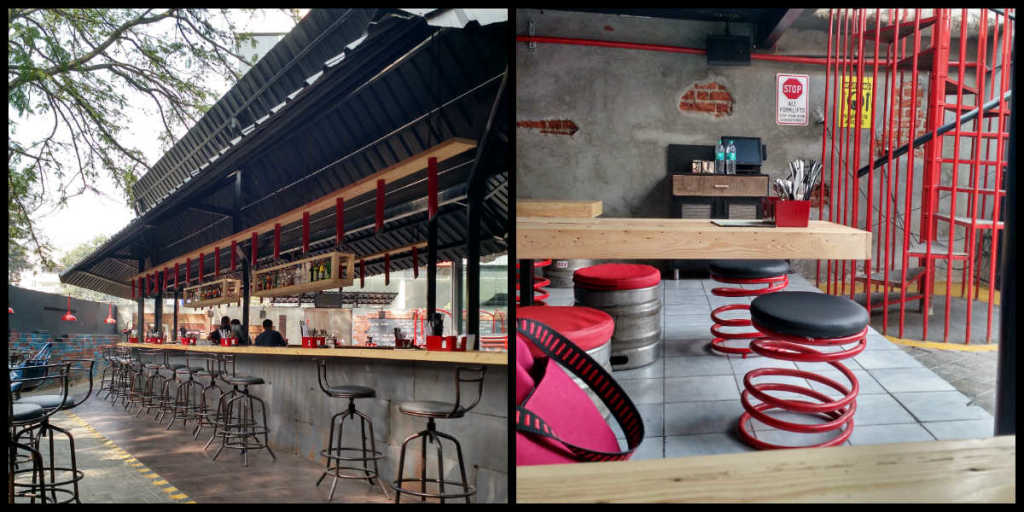
    Apparently, the conspicuous yellow door, (which seemed a little resistant to push) is a sort of signature across its outlets in Delhi and Mumbai. The decor inside is bohemian hangout meets underground pub. I quite liked the graphic art that adorned the brick walls, especially a tiny one that I think was a take on The Last Supper. The chairs we sat on reminded me of the ones in government offices – Breuer chairs, though there are some plush sofa options as well. I could smell lemon grass, though I also caught a whiff of sea food, probably because I am extra sensitive to that! (more…)

  • Loneliness and the AI evolution

    In a post that I found extremely poignant and true, the Guardian calls it out as The Age of Loneliness. It lists out the structural shifts causing this social collapse. “The war of every man against every man – competition and individualism, in other words – is the religion of our timeWhat counts is to win. The rest is collateral damage.” Seems we are but slaves of a ‘hedonic treadmill’, in denial.

    In earlier posts (The Art of Live In, Emotion as a Service) I’d written on how (IMO) even the micro-unit of society – the family- is ripe for disruption. At both societal and familial levels, I think the related fallout is an increasing lack of compassion and empathy, something that I notice a lot on Twitter, for example. Irony that the more connected we are, the more disconnected we are from each others’ emotions, and what impact our actions/inactions have. But guess who is coming to the rescue? Quite possibly, robots, that care! (12) (more…)

  • Empire of the Moghul: The Tainted Throne

    Alex Rutherford 

    The fourth and (I think) penultimate installment of the ‘Empire of the Moghul’. The book begins with Jahangir quelling Khusrau’s rebellion and ascending the throne. This episode, as well as his machinations to get back Mehrunissa, give us a sense of the ruthlessness in him.

    The book also brings out the chequered relationship between him and Khurram, who was also a favourite of Akbar. Though the main protagonists appear to be these two, the book is brought to life by Mehrunissa, portrayed as an intelligent and shrewd queen who will stop at nothing to make sure that she is a relevant force in the scheme of things. As Jahangir succumbs increasingly to opium and alcohol (possibly encouraged by the queen) she takes control of the running of the empire and then tries to ensure that Jahangir’s successor would also be her puppet. The narrative also features Europeans in fairly prominent roles and is a representation of their increasing presence in the subcontinent. (more…)