• The redefinition of life

    This article about the man who was one-upping Darwin interested me a lot, because of the question he asked – What qualifies something as alive or not. His paper, currently under peer review, explains theoretically how, under certain physical circumstances, life could emerge from nonlife. Arguably, consciousness is the factor that separates life from non life. However, there’s also a new theory that proposes that consciousness is far less powerful than people believe, serving as a passive conduit rather than an active force that exerts control. The article compares it to the internet, and says that just like the internet can be used to discover, share, buy etc, it’s actually the person on the web/mobile who is actually deciding. It even argues that consciousness is not made to study itself.  (more…)

  • My Bar

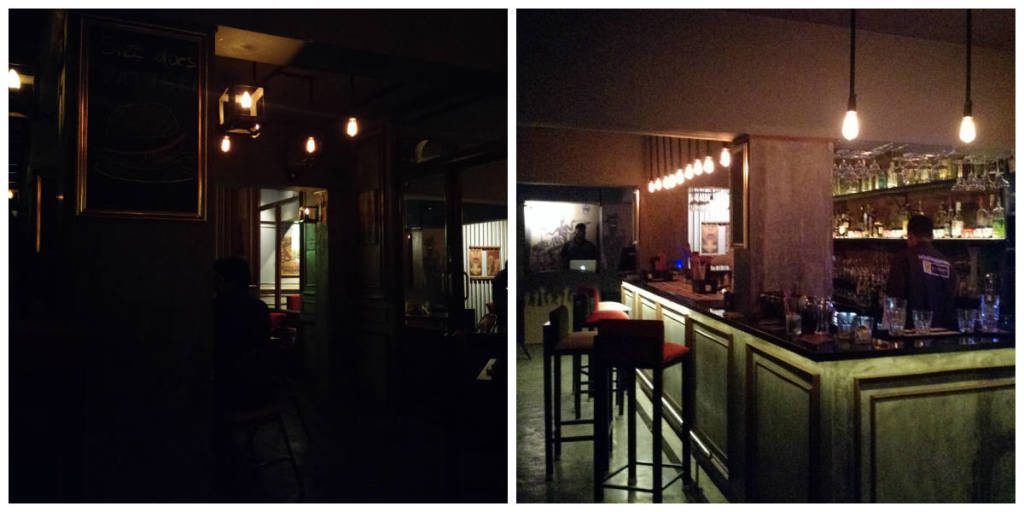
    No, not mine, it’s just a name. Located above Kobe in Koramangala, (map) it occupies a couple of floors, both offering my favourite kind of road-view seating. That’s probably what prompted a second visit. The place has a lot of knickknacks – lanterns hanging from the roof, and everything from compasses to framed Someecards adorning the walls. While the first visit was on a night when D and I were not really hungry, the second was a Sunday afternoon when the bellies were mostly empty! Their bar menu has quite a few interesting cocktails. On our first visit, we tried a Kala Khatta – a mix of vodka, black salt, chaat masala and raw mango mix, with mint, and a green chilli. Quite good, with multiple flavour pops, the only spoiler being the extended presence of crushed ice. We also tried a couple of starters – Beef Pepper Fry and Coorgi Pork. The first was (mostly) well cooked beef with the pepper corn adding a spicy touch. The braised pork was served with Kadamputtu, the pork itself was mildly spicy and juicy, but the accompaniment could have done better for itself.

    collage1 (more…)

  • Dignity Gritty

    Amongst stories of soaring e-commerce valuations, this Mint story on Indiaplaza, and how it ran out of cash, was quite a sobering read. But it wasn’t the business angle that stuck with me long after I finished reading it. I somehow felt that all Mr.Vaitheeswaran was seeking, was a little dignity. I have no idea of what really happened, so I cannot comment on whether that is deserved or not.

    A few weekends ago, we were visited by someone who is a consultant for some work we needed done at home. She charged us Rs.2000 for a couple of hours, and after business was concluded, she spoke about how, a few years ago,  she had been a VP at a well known consultancy firm. Her current business, born out of her passion, was not doing well. She wanted to get back to work but was finding it extremely difficult to land a job. After she left, I wondered aloud to D, how she must feel, having to go to strangers’ houses on Sundays, and working for a compensation far below what she might have been earning. What would this experience be doing to her sense of dignity? (more…)

  • And the Mountains Echoed

    Khaled Hosseini 

    Before I write about “And The Mountains Echoed”, I think a disclaimer that I haven’t read the earlier books by the author is necessary. Reviews tell me that there are patterns easily discernible in Khaled Hosseini’s works, so it’s probably good that I was introduced to the author with “And the Mountains Echoed”.

    It’s been about five minutes since I finished the book, and my eyes are no longer moist. The thing is, I knew the ending. Pretty much everyone who reads the book and realises the intent of the story (within the story) that’s narrated by the siblings’ father at the very beginning of the novel- of a div who visits a village and takes away a child, of the father who braved odds in an attempt to win him back, and its ending, memories like ‘the tail end of a sad dream’ – can picture the frame in which the novel will end, or almost. Yet, like many other points in the novel, it did not fail to move me. That’s probably the defining character of this book – an unbearable sadness. (more…)

  • Re: Org

    Timehop, which takes me on a nostalgia trip everyday, reminded me recently that it has been a year since I wrote The Change Imperative. The opening slide features a quote – “If you don’t like change, you’re going to like irrelevance even less“- attributed to Gen. Eric Shinseki. In the times we work in, I believe this cannot be overstated, not just for individuals but for organisations as well. Even as business dynamics force changes on the external manifestation of an organisation – the brand – any organisation that faces a client/consumer will also be forced to adapt its internal structure and practices to suit changing needs.

    For a long while now, I have been ambivalent about processes. I have worked in an era, and in organisations, where processes had a way of getting things done. But in parallel, I have also felt that many a time, processes have a way of forgetting what they were made for. The output overshadows the outcome. Over the last few months, my surmisal has been that, to use a Taleb classification, processes can make an organisation robust, but not anti-fragile. This very informative post by Aaron Dignan of Undercurrent – The Last Re-Org You’ll Ever Do -highlights many ways that organisations have tried to change standard structures and practices, and even suggests a six step path to reorganisation. (more…)