• Maize & Malt

    There is a reason why I have a particular dislike for breweries on Sarjapur Road and ORR – they follow a fixed template of a hugeness, a dirty pool, bad beer, and barely-teen young adults posing for Insta reels. Just to be clear I don’t have a problem with the last one, it’s actually quite hilarious.

    But it’s my unfortunate duty to inform you that our hamlet of Whitefield is now being invaded by these kind of breweries. BLR Brewing Co being another recent example. Maize and Malt follows the same template as you can see from the image below, and to add insult to injury, they even claim to have an Anglo Indian theme to their menu. A misconceived hat-tip to Whitefield, I guess.

    Maize & Malt

    And now for the second bit of bad news. We tried all the beers available, and in what is truly a tragic scenario, had to choose the least worst because they were all bad! Belgian Wit and Hefeweizen.

    Maize & Malt

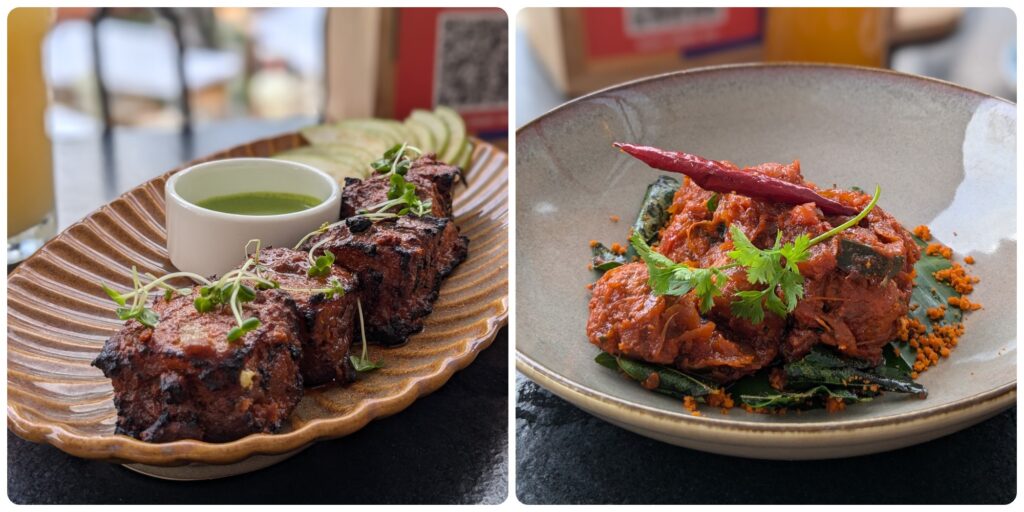
    The only reason to cheer turned out to be the starters. Their Mama’s Special Tangy Pork is excellent, though I wonder who decided to tandoorise (yes, they do write Anglo Indian Tandoor in the menu!) it with a mint chutney. The Mutton Kaima Unde Fry is also very good, though they took the ‘small plate’ very literally.

    Maize & Malt

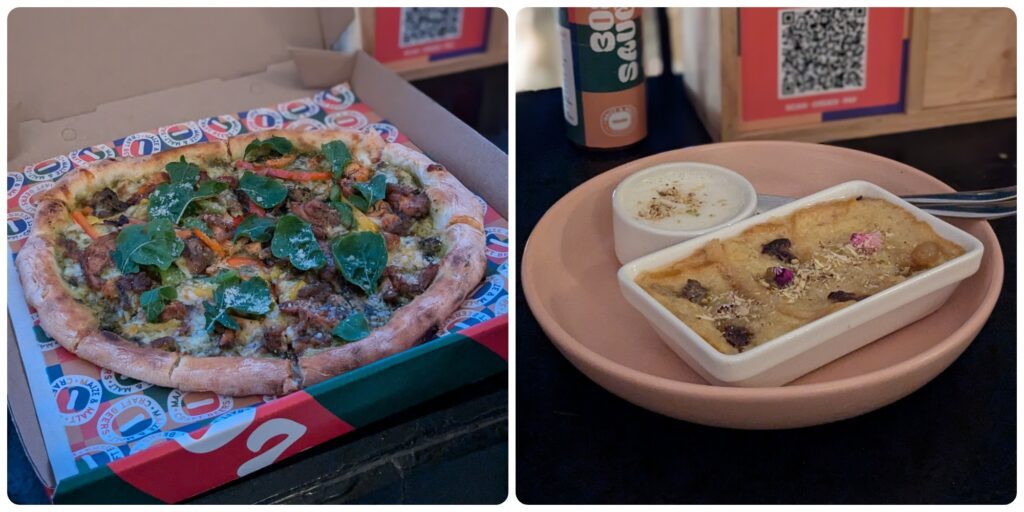
    We then tried the Wild West Chicken Flatbread with caramelised onions. It wasn’t as bad as it sounded though they decided to serve it in a takeaway box. And finally, the easy test for any semblance of Anglo Indian expertise is the Bread Pudding. But don’t even bother.

    Maize & Malt

    The service was par for the course, though thanks to people moving around chairs and their table system being not very agile, we had our food taken to others and vice versa. I even considered taking things if they looked good, but didn’t really see anything worth that effort. We deeply felt the loss of a little over Rs.2600 thanks to this misadventure.

    Maize & Malt, 3, 4th Cross Rd, Vigneshwar Nagar, Kaveri Nagar, Krishnarajapuram (it’s behind Decathlon)

  • #Bibliofiles : 2024 favourites

    Bibliofiles 2024

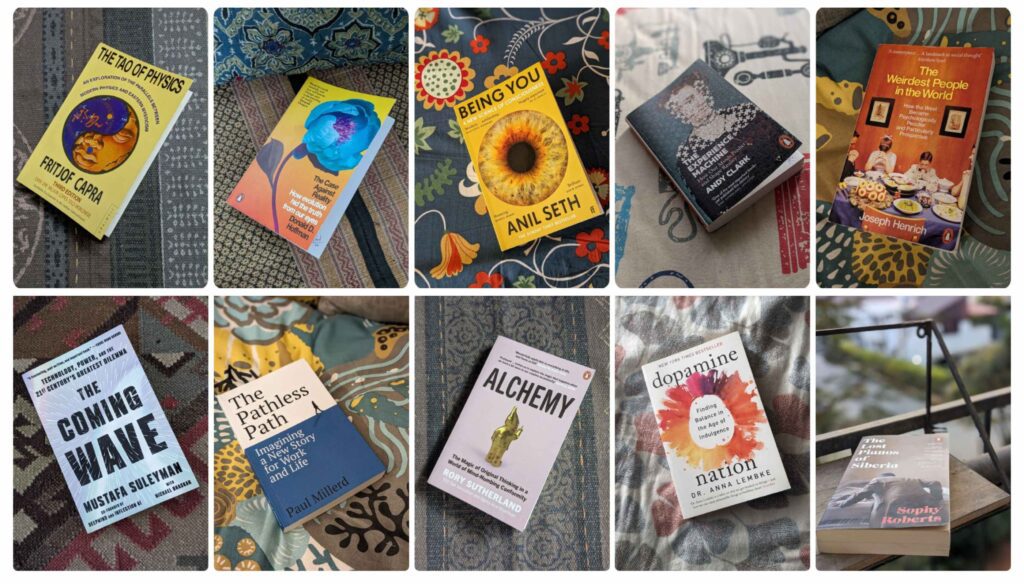
    In 2024, the mind seemed to be obsessed with the mind and the reality it perceives, and that’s a good thing because I was able to take a shot at some synthesis on why I am the way I am. When you see the books, you’ll know why/how. And so, as per tradition – from 2019202020212022 and 2023 – we have this year’s list of ten (plus a few extras 🙈). From the 63 books I read in 2024…

    (more…)
  • The Pathless Path: Imagining a New Story For Work and Life

    Paul Millerd

    I have to admit a little bias here – I started my own journey only a few months ago, and a bunch of things that Paul Millerd has written about in The Pathless Path resonates very well and mimics the thoughts and paths that I have experienced recently. I also share some of his influences in terms of thinkers – Erich Fromm, David Graeber – both of who have had a lot to say about the human condition in the context of work.

    The book is divided into two very broad sections. The first, with six chapters, focuses on the default path. The default is what most of the world does – predictable incomes, predictable lives, “life’s existential fears are traded for certainty”. Paul also quotes Keynes – “it is better for reputation to fail conventionally than to succeed unconventionally.” And it provides prestige, which as Paul Graham says, is “a powerful magnet that warps even your beliefs about what you enjoy.” However the story is cracking. “You work hard, but get laid off anyway. You have the perfect life on paper, but no time to enjoy it. You retire with millions in the bank, but no idea what to do with your time.”

    He introduces us to his own journey from the default to the pathless across his academic and professional lives, how he figured out the hacks to grow fast, his health crisis, and how he then started thinking about his life and work differently.

    At this point, he goes back in history to understand where our current beliefs and structure about work came from, how work took the space religion vacated, and how the larger narrative of defining and judging people by their profession became a part of culture. He then continues to take us through his own struggles in the default path as values clashed and the lure subsided, but the pressure of making a living continued. He stresses how moving to the pathless path is not a simple story of sudden glory, but rather a series of experiments, deliberate changes, and iterative learning towards a journey that fulfils the self.

    In the second section – the pathless path, the focus is on how one can reimagine one’s life, and address the many barriers that a part of our self comes up with to discourage us – narratives around (lack of) money, creativity, to name the most common ones. He also notes the importance of finding one’s tribe, and designing work in such a way that you love it. His perspective is that ultimately what we want is to be useful to others. In the final chapter, he writes about a couple of things I have spent a lot of time thinking about – the abundance mindset, and playing the long game. Both have the potential to radically change the way one interacts with the world at large.

    From what I understand, Paul went off the default in his 30s, so this is not a midlife crisis-management book. Rather, it’s for anyone who has that little ‘pebble in the shoe’ which tells them that there is a better way of living, and working. The pathless path is exactly that – it is deeply personal, a blueprint doesn’t really exist – you have to arrive at your version yourself. It’s uncomfortable, uncertain, and a movement away from conformity. But you’ll know when the shift happens, and when it does, it’s quite liberating. As per Andrew Taggart, crisis moments lead to “existential openings” which forces us to deal with existential questions. These could be of two kinds – a “way of loss” (loved ones, health job) or a “way of wonderment” (moments of undeniable awe and inspiration). But you don’t necessarily need to wait. It’s never too early, or late.

    Notes
    1. People who face crises often experience ‘post-traumatic’ growth and this manifests as “an appreciation for life in general, more meaningful interpersonal relationships, an increased sense of personal strength, changed priorities, and a richer existential and spiritual life”
    2. “But under the hardness of that armor there is the tenderness of genuine sadness.” ~ Pema Chödrön
    3. Uncertain discomfort < certain discomfort + coping mechanism. Given sufficient coping strategies, people will be willing to tolerate consistent levels of misery for long stretches of time.
    4. Tim Ferriss “fear setting” reflection – what is the change, what are the worst possible outcomes, how can you mitigate them, possible steps/actions to get back to where you are now, what are the benefits, what are the costs of inaction 3/12/months few years
    5. “Misery tax” – the spending an unhappy worker allocates to things that “keep you going and keep you functioning in the job”. e.g. alcohol, expensive food and vacations (Thomas J. Bevan)
    6.”Belief clings, but faith lets go” ~ Alan Watts
    7. There is a kind of status we get from doing impressive things or having impressive traits or skills. In some domains like sports, this works. In the business world, talent is harder to assess, and we tend to use proxies like credentials to determine quality and prestige.
    8. “The problem is that our culture has engaged in a Faustian bargain in which we trade our genius and artistry for apparent stability” ~ Seth Godin
    9. “Critical thinking without hope is cynicism. But hope without critical thinking is naïveté” ~ Krista Tippett

    The Pathless Path
  • Marshmellowing

    “When the student is ready, the teacher will appear.” That played out well in this context. I remember seeing this (image below) in a Farnam Street newsletter a while back and it validated something I had been doing for a while. In any situation, can I place myself such that circumstance/environment doesn’t cause a decision I’ll regret? Because, to quote from Ozark, “People make choices. Choices have consequences.

    Optionality

    Optimising for this is the reason behind almost everything I had built as a muscle – planning, granular detailing, specific scenario planning, constantly aiming for predictability (or at least optionality), the people I let in and how much, and deliberation on what I do. And that mindset, I told D recently, is probably coming in the way of the life I want to lead.

    A little more of context setting before we address that. This is where the master appears – in the form of this post. If we go by the image below (from the post), I am successful and on that line dividing miserable and happy. Just to clarify, there is no ‘reaching the top’ in my case. I define (my) success as being able to say ‘I have enough’ on wealth, health and relationships, and can still retain my curiosity.

    Successful-Happy

    At this point, I have the Marshmallow mind (context), and the post accurately describes my conundrum.

    So you do the work. You sacrifice. And because you’re sacrificing while others are out having fun, success becomes more and more important to your identity. You slowly forge the chains that can keep you up there, in that top left quadrant, in which you thought only other people could get stuck. But that pivot to living a fulfilled life doesn’t happen. Marshmallow Mind has become too powerful. And Marshmallow Mind lives in the future...Marshmallow Mind tricks us into believing that the rewards for delayed gratification compound forever. They don’t. Eventually, they turn into a trap whose escape requires a radical break with our old identity. As Buffett put it, “the chains of habit are too light to be felt until they are too heavy to be broken.”

    The Marshmallow mindset affects the way I react to things, because the muscles are a habit now. And layered on that is a self image. It’s time for some mellowing. As Tim Ferriss says in this phenomenally good conversation with Gabor Mate, sometimes, you need life to save you from what you want to give you what you need. I think life has done its bit in terms of multiple kinds of losses, gains, and lessons.

    But the challenge is that my system will resist the learning! More about that in another post, citing another fantastic podcast. For now, the plan is something that I heard in that podcast, where the guest’s daughter’s karate teacher says, “Get your butterflies in flying formation”, because what I seek is “the rapture of being alive“.

    P.S. Seems I caught this a couple of years ago, I now need to take some concrete actions 🙂

  • Dopamine Nation: Why our Addiction to Pleasure is Causing us Pain

    Anna Lembke

    A book that made it into my recommendations list in 2022 was ‘The Molecule of More‘ by Daniel Z. Lieberman & Michael E. Long. That book, as I wrote in my review then, made a complex subject very accessible and even entertaining, with interesting experiments, real-life scenarios and very less jargon. And it got me interested in the subject. I discovered Dopamine Nation thanks to a podcast, where Dr. Anna Lembke gave a very lucid explanation of the relationship between pleasure and pain.

    Dopamine Nation is divided into three sections – The Pursuit of Pleasure, Self-Binding, and The Pursuit of Pain. Each of these is further divided into three chapters giving the book a structure that is easy to follow. In her introduction, she writes about the overwhelming amount of stimuli around us and calls the smartphone ‘the modern-day hypodermic needle delivering digital dopamine for a wired generation.’ So how does one find balance in this age of indulgence? A big risk-factor in addiction is ease of access and across digital and reality, that has very less mediation. ” I was struck by how much hotel rooms are like latter-day Skinner boxes: a bed, a TV, and a minibar. Nothing to do but press the lever for a drug”. A dopamine economy or ‘limbic capitalism’ (David Courtwright).

    Continuing this thought, she writes about how we run from pain. She throws light on how “the pursuit of personal happiness has become a modern maxim, crowding out other definitions of the “good life”. Even acts of kindness towards others are framed as a strategy for personal happiness. Altruism, no longer merely a good in itself, has become a vehicle for our own ‘well-being’”.

    To illustrate the pleasure-pain balance, she imagines our brain having a balance – a scale with a fulcrum. When we experience pleasure, dopamine is released in our reward pathway and the balance tips to the side of pleasure. (the first in a packet of chips) But the problem is that the system wants homeostasis. The self-regulating system now starts functioning. Meanwhile, with repeated exposure to the pleasure, the initial deviation of the scale towards pleasure becomes weaker and shorter, and the response from the self regulation gets stronger and longer. This is neuroadaptation. Now you need the second chip from the packet, and the more you eat, the bigger the craving and more the irritation if you don’t get it. You consume the chips though it no longer gives you pleasure, just to avoid the pain. It doesn’t end there. The biggest paradox is that hedonism leads to anhedonia, the inability to enjoy pleasure of any kind. The good news is that abstinence can lead to a natural homeostasis.

    In short, “science teaches us that every pleasure extracts a price, and the pain that follows is longer and lasting and more intense than the pleasure that gave rise to it. With prolonged and repeated exposure to pleasurable stimuli, our capacity to tolerate pain decreases, and our threshold for experiencing pleasure increases.”

    In the Self-Binding section, she charts out the escape path with an acronym for dopamine – data, objectives, problems, abstinence, mindfulness, insight, next steps, experiment. Broadly, abstinence can be aided by space (physically creating barriers to access, or even reminders), time (restricting consumption to a certain time, or only as a reward) and by finding meaning in something, to replace the pull of the craving. In the last chapter of this section, she points out how anti-depressants can actually go beyond their call of duty and limit the ability to experience the full range of emotions. Making us a person different from our natural self. A difficult trade-off.

    I found the third section of Dopamine Nation very interesting on two counts. One, a new idea in the first chapter of this section. What if we reverse the pain-pleasure balance by pushing on the side of pain? “With intermittent exposure to pain, our natural (self regulating) hedonic set point gets weighted to the side of pleasure, such that we become less vulnerable to pain and more able to feel pleasure over time”. Cold water baths is an example used. So are extreme sports. Obviously too much of anything will result in addiction.

    Two, some excellent connections in the second chapter of this section, titled Radical Honesty, which also touches upon the trend of ‘disclosure p0rn’. The connection is on a favourite topic of mine – scarcity and abundance mindsets. The author’s hypothesis is that truth-telling engenders an abundance mindset, and lies, a scarcity mindset. She explains this both in terms of us feeling more confident about the world when people around us tell the truth, as well as how when resources are (perceived to be) scarce, people are more invested in immediate gains. I connected this to something I read in The molecule of more – the two kinds of activities we do. Agentic, formed for the purpose of accomplishing a goal and orchestrated by dopamine, vs affiliative, formed for the pleasure of interaction, driven by oxytocin, vasopressin and others more interested in the here and now. The connection I made? Scarcity mindset – Lies – Agentic activities – Dopamine pathways for quick rewards. I am still thinking of direction and causality, but I intuitively sense a thread.

    In essence, I found Dopamine Nation a very interesting read. And if you’re intrigued by behaviour – yours or others’ – I think this will be an engaging read for you as well. Best paired with the book I mentioned in the beginning.

    Dopamine Nation