
• March of the Aryans

    Bhagwan S Gidwani

    I feel a little conflicted about this book – on one side, it is wonderful to read a perspective on the dawn of civilisation and the kind of denizens our land had, but on the other, this is clearly a work of fiction, and the author himself states that his sources are not any written ones, but oral traditional memory from different parts of the world. It is clearly aimed at debunking the Aryan invasion theory, and tries to show that the Aryans had merely returned to their place of origin after traveling to many parts of the world.

    In addition to demolishing the invasion theory, the author also tries to show that the Dravidian culture was not really independent in origin, but that civilisations on the Ganga, Sindhu-Saraswati, and other regions all had a common point from which they all emanated. (more…)
  • Star Farce

    The whole thought originated from Guess Who’s Kochi Biennale work. Classic Banksy style graffiti, but the fantastic Malayali touch is what really drew me to it. (no pun intended!) For instance, you wouldn’t be able to appreciate this, if you didn’t know this. A bunch of ideas immediately popped up in my head, and I chose the pop culture phenomenon that’s among the favourites. The timing was good, since we were in the process of finalising a home. But though I had begun the process long before we shifted, (in April) I just couldn’t find someone who could visualise what I had thought up. That was until late last year, when L introduced me to the folks who run Cupick, who in turn found me KRACK’N.

    Agni and Gaurav immediately got what I had in mind, and in fact, made it much better. The result is this 6′ x 4′. 🙂 (Click on the image for a larger size) (more…)

  • Whitefield Social

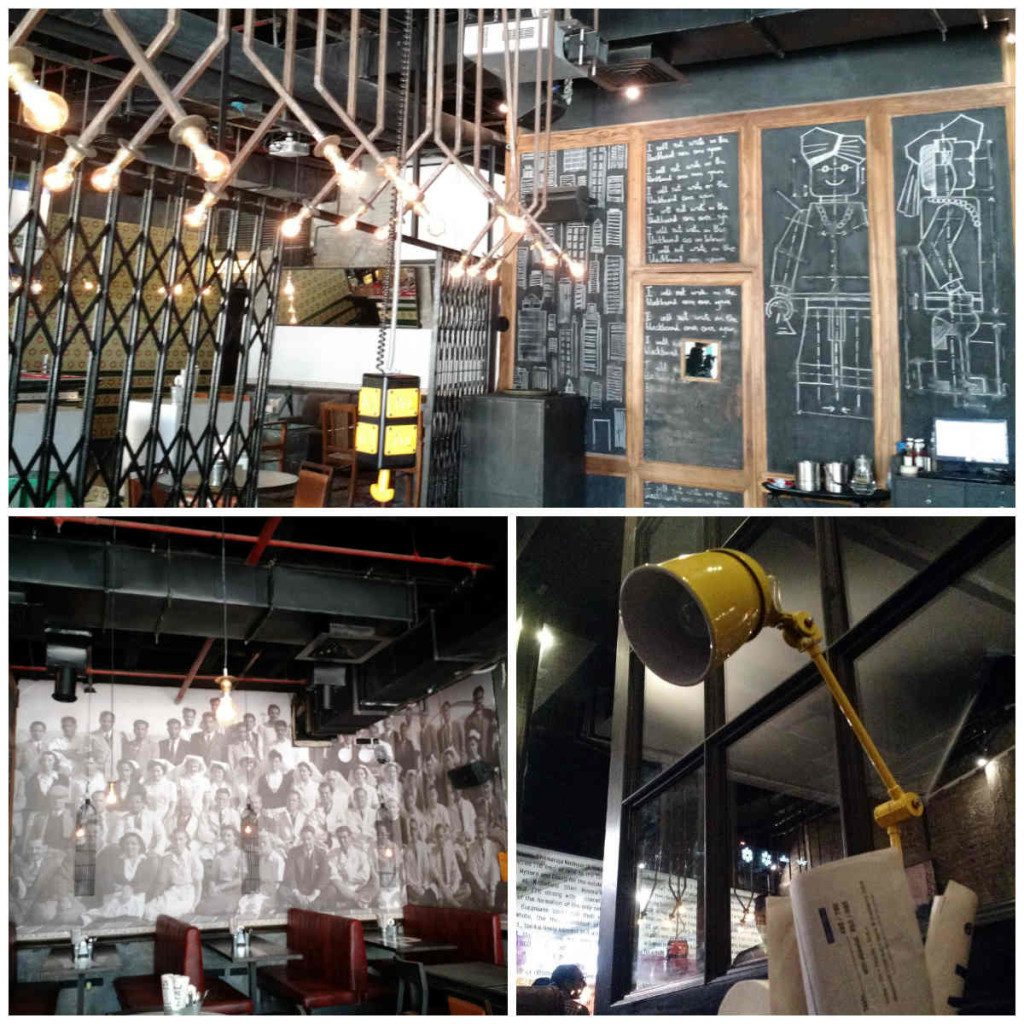
    We heard about its opening (in Phoenix Market City) in the first week itself, courtesy Instagram and the ” 2 Beers for Rs.2” promotion, but could drop in only a day after the promo ended. It was a Saturday night, and that meant we had to wait for more than an hour to get a table! The open area in the mall made that quite easy, and we sat gawking at people, and watching movie trailers on the giant screen outside PVR.

    When we finally did get a table, it was a community table! Thankfully, our request for a different table was soon granted. The plush, comfortable seating in the outdoor section, was most definitely better. The place was quite crowded that night, so I couldn’t really get a good look inside. But a visit later, on Christmas day morning, gave me the chance to look around, since the place was almost empty. Pravesh, who seemed to be in charge of the outlet, gave me a little guided tour when he saw me snooping around. One of the walls has a history of Whitefield (wiki-like) and another has a huge blow-up of Whitefield’s first citizens. The  bar decor includes tiles like the ones found in Irani cafes, there are some antique chairs and in essence, the place has a uniqueness even while somehow retaining the standard ‘social DNA’.

    collage1 (more…)

  • A divided existence

    A phrase I came across recently captured my ‘mood’ in both work and life spheres (links to my most recent posts) very crisply – nostalgia for the absolute. Coined by the philosopher George Steiner, it isn’t a coincidence that it reached me courtesy a Breaking Smart essay.

    As I have mentioned earlier, the entire series has given me a lot of perspective, and it’s heartening to know that the kind of thought bubbles I have are more common than I thought. There exists a dichotomy however. My perspectives are largely ‘Promethean’ when it comes to tech (and the implications of its disruptive power) in the work context. However, in the larger life scenario, I think I am quite the ‘pastoralist’, more comfortable with sustaining changes to the prevailing social order(more…)

  • The Kite Runner

    Khaled Hosseini

    My perspectives are a bit skewed because I have read the author’s works in reverse chronology. I think that probably explains why I found this a little underwhelming compared to “And the Mountains Echoed“. But if I move that out of the equation, then this is a good book, not just from the point of a universal human story, but for the fact that it is a window into life in Afghanistan.

    The book covers the time frame from a few years before the Soviet occupation to the post-Taliban era and covers three generations.
    The characters are really fleshed out and this is what works for the book. Amir’s loneliness living as a motherless child, his friendship with Hassan, his complicated relationship with Baba that continues even in adulthood, and his guilt stemming from what he let happen and made happen have all been well captured. Hassan is immediately lovable and the author is able to convince us that such a genuinely noble character can exist. All the others – Amir’s Baba, a complex character who never stops being a proud Afghan despite a massive change in fortunes, his wife Soraya who has her own relatively minor demons to conquer, her parents who probably fit Afghan stereotypes of an older generation couple, and Rahim Khan, who serves as a father figure to Amir and finally shows him the path to redemption – serve as perfect foils. (more…)