I chose pre-tirement a year and a half ago, in my mid-40s. Yep, it’s a thing – the space between full-time work and retirement – a reduced workload in return for $ that meet my needs and some wants. Monika Halan’s recent column reminded me of the real question I grappled with: “Will I outlive my money or will my money outlive me?”
I agree with her take on the learn-earn-burn model and sketchy finfluencers, but I don’t think the classic career peak-in-your-50s idea will last. Here’s why.
1. Short-termism is now baked into most companies. Layoffs, shrinking business cycles, and the fast pace of disruption mean you’re constantly solving new problems with new tools. That’s largely fluid intelligence, which peaks around 40. Until now, we’ve extended careers beyond 40 largely with crystallised intelligence (experience, wisdom), but AI is catching up with both. Soon, someone younger, faster, and AI-enabled might do the same work cheaper.
2. That also means even a decade-long career may be a stretch. Once humans turn knowledge into rules, rules become algorithms, automation happens and jobs disappear. Damn AI learns!
3. This shift is especially brutal for Gen X and Millennials who weren’t prepared for it. Add subpar savings, unhealthy lifestyles, and rising stress, and mental and physical health issues are inevitable. And no, companies won’t support you.
Since I’m aged enough to offer unsolicited advice: if you’re in your 30s/40s, aim for pre-tirement by 50. Think of it as a Pascal’s wager. Better to have financial freedom so you can grow on your terms, and are not forced to make money-driven choices.
The path? Good old compounding – of intelligence, wealth, health, and relationships.
1. Stay curious. Keep learning. Solve new problems to keep your mind sharp.
2. Spend and invest consciously. Don’t finance today’s wants at the cost of tomorrow’s needs.
3. Stay healthy, not just fit – body and mind. Saves you meds money and lets you enjoy your freedom.
4. Find people in whose company you can be yourself. It aids the above three too.
In the near and mid-term, AI’s quick evolution will question not just work’s efficacy as an income provider, but also its ability to deliver a sense of purpose. On an existential scale, I think the second will cause more damage.
-
Glucose Revolution: The life-changing power of balancing your blood sugar
Jessie Inchauspé
Glucose Revolution is another one of those books that I wasn’t even aware of, but came in via a referral, and I believe will actually make a difference in my life. Jessie Inchauspé, also known as Glucose Goddess, does a fantastic job of showing a way out of the clutches of glucose imbalances which are an underlying cause of many health issues – from cardiovascular diseases to PCOS to acne and even mood swings.
The reason why I loved this book are many. One, it’s not just a lot of theory. She combines lived experiences (of herself and others in the community), scientific research, and experiments (to validate) to show how it works. Two, she layers that with the overall science behind why they work that way. Three, she does so in the most accessible manner. And finally, she doesn’t just point out the problems, she also provides solutions and paths to address them.
The book is divided into three parts. The first explains the origins of glucose and why it is important. While we colloquially call them all carbs, glucose, fructose, sucrose, starch, fibre are all varied forms and have different impact.
The second describes how dysregulated glucose levels and glucose spikes affects us in the short-term and the long-term. From hunger pangs at one end to worsened cognitive function at the other. During glucose spikes, the mitochondria quickly get more glucose than they need, some glucose gets converted into fat, and more importantly, molecules called free radicals are released into our system. When there are too many of these, it results in oxidative stress, a driver of heart disease, Type 2 diabetes etc. Glucose also glycates other molecules, damaging them forever. Wrinkles, cataracts etc.
The combination of all these result in inflammation, and chronic inflammation is the source of most chronic illnesses we get.When we have excess glucose in our body, the pancreas sends out insulin to store it and keep it out of circulation. Liver, muscles and conversion into fat are the three ways it is done. That last bit is how we gain weight. The stored glucose is used when mitochondria needs it, and when glycogen (the glucose in the liver and muscles) gets diminished, our fat reserves come into play. But this cannot happen when insulin is high. (read notes for more on this) There are explanations for why and how each kind of disease related to this happens.
Part 3 is a set of ten (simple) hacks to flatten the glucose curves (reducing glycaemic variability). The first and most useful hack is the order of eating your meal. Veggies (fibre) first, proteins and fats next, and starch/carbs last. Fibre reduces the action of alpha amylase, the enzyme that breaks starch into glucose, it slows down gastric emptying, and creates a mesh which makes it difficult for glucose to get into the bloodstream. My second favourite hack was #7 – drinking apple cider vinegar before eating sweets. Acetic acid in vinegar temporarily inactivates alpha amylase.
Glucose Revolution is a fantastic book because of its actionable insights and the accessibility. Highly recommended. Having said that, I have also recently read some critique which you might want to consider before picking it up.
P.S. My own experience after nearly a year of trying this is that first, I got an immediate reduction of HbA1c from 6.3 to 5.9 and was able to sustain it for about 8 months. Since then, it has gotten back to 6.3 but there are many variables and I am still trying to eliminate them one by one.
Notes
1. Any food made from flour has starch
2. We like sweetness because back in the Stone Age the taste of sweetness signalled foods were safe (there are no foods that are sweet and poisonous). It gives us a dopamine hit.
3. Mitochondrial stress causes cells to lose their smooth shape. The lining becomes bumpy and fat particles get stuck more easily. LDL (B) does exactly this. If an when cholesterol gets oxidised (happens when more glucose, fructose, insulin are present), it creates plaque. Triglycerides become LDL (B). A good measurement is triglycerides/HDL. If it’s less than 2, great
4. Insulin treatment brings down glucose temporarily but is harmful in the long run.
5. Sugar is sugar, whether it comes from fruit or table sugar. Relatively the first is better.
6. Similar story with whole grains. Dark bread/ seed breads are relatively better.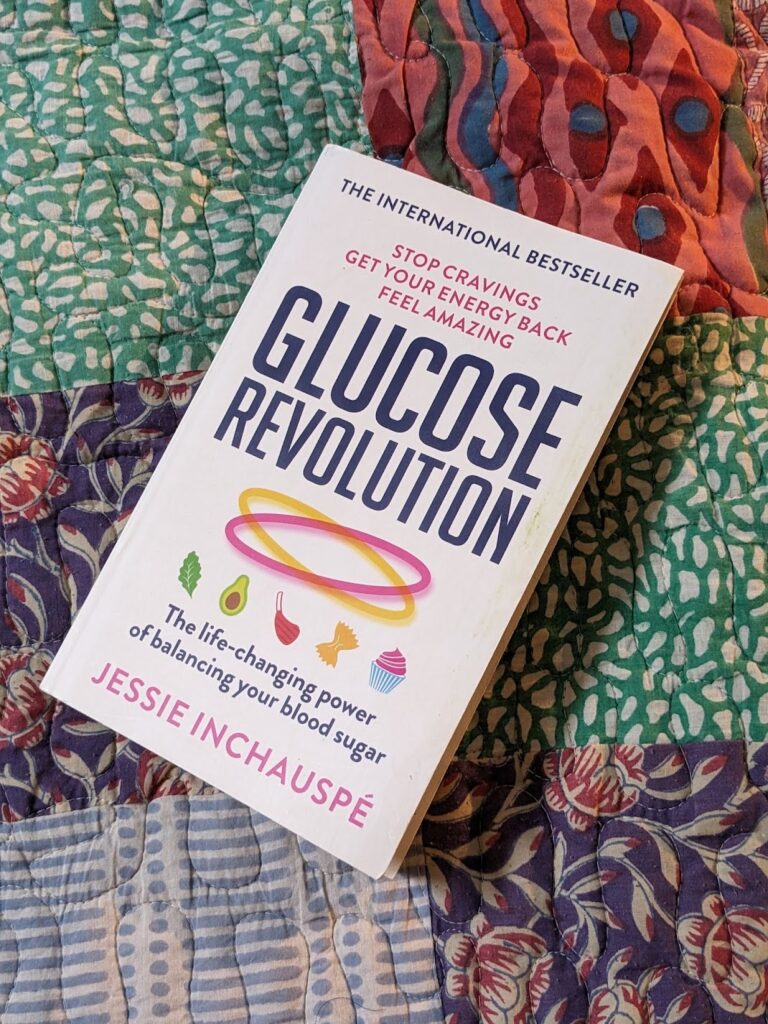
-
Kampot
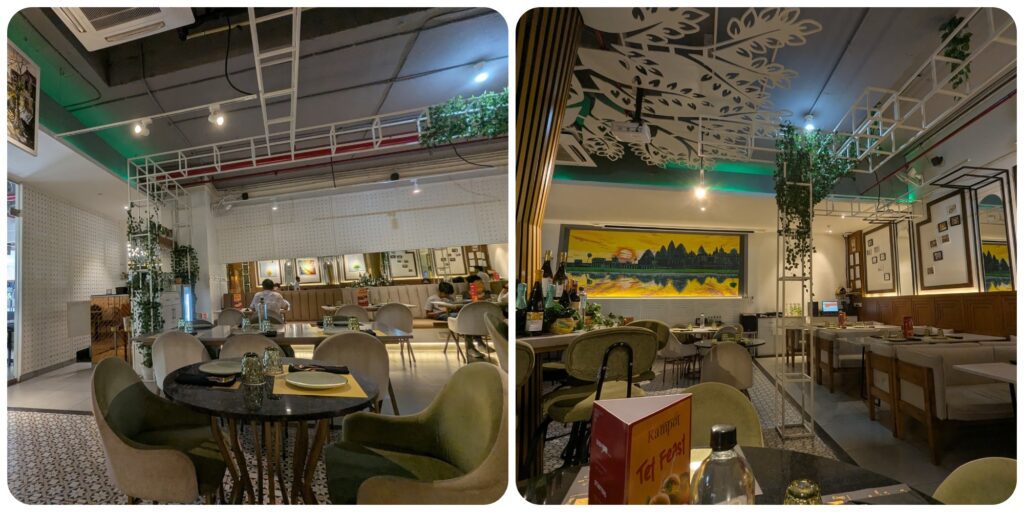
We came across Kampot when we visited Mannheim. The name itself was alluring, since Cambodia is one of our earliest and most cherished travels, and home to one of D’s all-time favourite dishes – Fish Amok. Given the constraints on the things you can do inside Ecoworld, they have done a fair job with the ambience. The menu turned out to be a lot more Asian, which I am guessing is a smarter choice if the idea is to get a crowd.

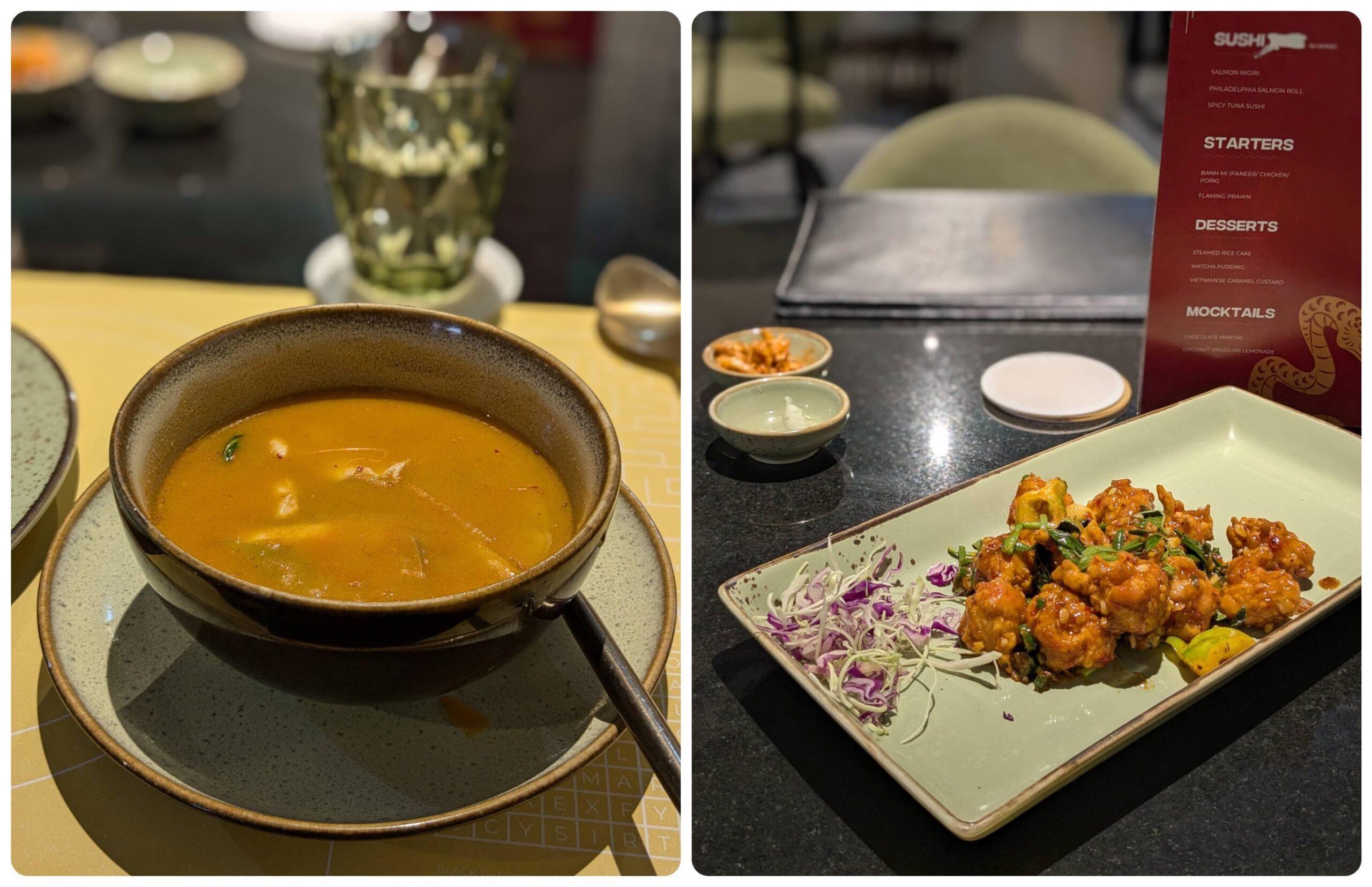
We started with a Tom Kha Head Soup. The flavours and texture were totally off with this one, which we might have guessed anyway given the colour. Closer to the other Tom – yum that is, than what we expected. Next up was the Holy Basil Sambal Chicken, and again, the memories of sambal in Indonesia are strong enough for me to recognise non-sambal. That fiery bite was completely missing in the dish. The soup actually was spicier!
For mains, D went with the Miso Ramen with Soba Noodles and Chicken, and I thought going Vietnamese might be a good idea after Thailand and Indonesia had failed. Of the two, D’s Miso was easily better in terms of flavour but definitely not the best we have had. The Pho was a disaster, and I didn’t even bother to finish it.
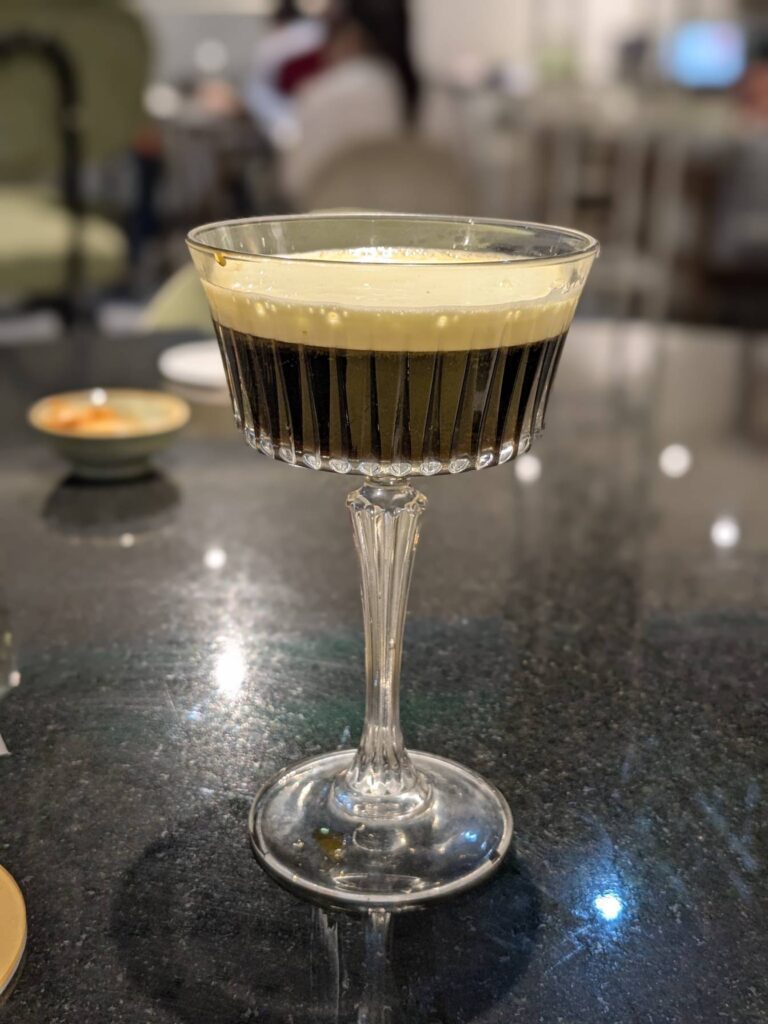
On hindsight, this was stupid given everything that had transpired, but we decided to try a Kampot Coffee. Since this is their own concoction, I don’t really have a benchmark to compare against. So all I’ll say is that I regretted it soon as I took the first sip.
We paid close to Rs.2700 for this mistake. The service was pleasant but tardy. After having sampled multiple eateries in The Bay, Ecoworld, I think the building has found a way to decrease the quality of dining experience. For instance, Irish House and Punjab Grill. I’ll soon be able to update with Mannheim too. For now, I’d avoid.
Kampot, The Bay @ Ecoworld, ORR Ph: 9606025113
-
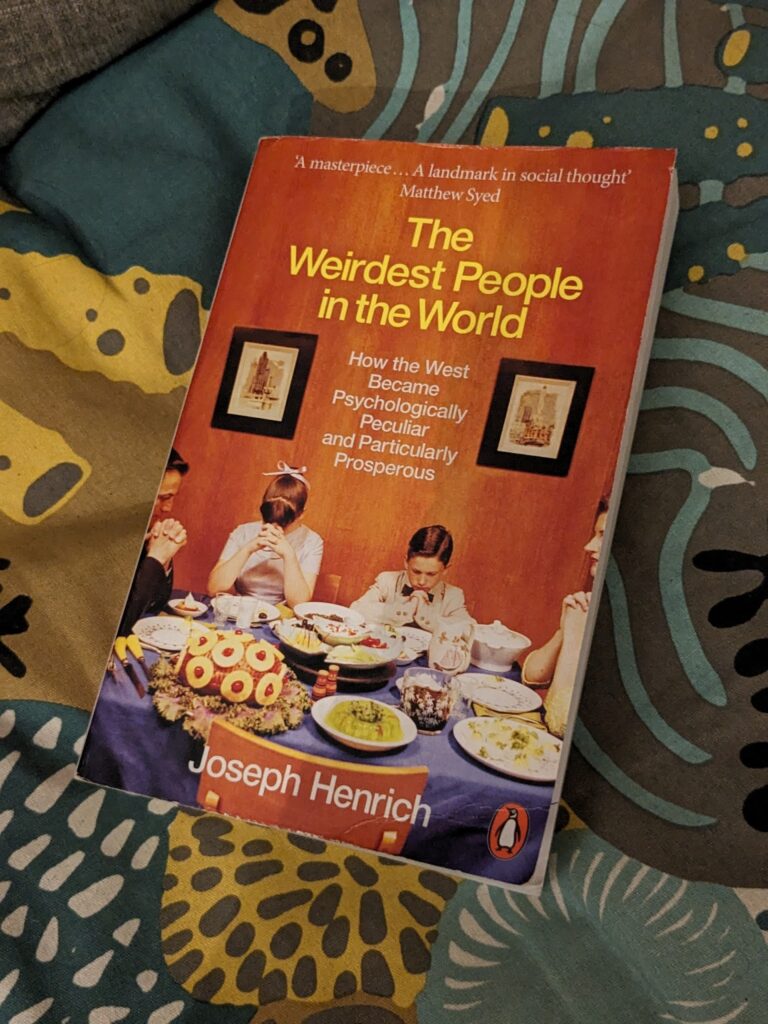
The Weirdest People in the World: How the West Became Psychologically Peculiar and Particularly Prosperous
Joseph Henrich
As an anthropologist, Joseph Henrich realised that much of the published work (and hence commentary) on human psychology (and social sciences at large) were based on work with experimental subjects who were based in or around Western universities. And when attempts were made to replicate these results with people in Africa/Asia, some of them even elites, it came to light that the subject pool was biased. They were WEIRD – Western, educated, industrialised, rich, democratic – and though only a small part of the species, are disproportionately represented in culture and thinking. How did this happen? That’s what The Weirdest People in the World is all about.
He sets the stage with the influence of Protestantism in this. Its credo of the individual’s personal relationship with God spurred the belief that a person should read the Bible (sola scriptura), increasing literacy in the process. But beyond this, he points out that religious convictions shape decision-making, psychology, society and culture at large.
But what is the WEIRD psychology? Broadly individualism and personal motivation (self focus, guilt over shame, dispositional thinking – based on intent not context, low conformity, self regulation and control and patience, time thrift, value of labour, desire for control and choice); impersonal pro-sociality (impartial principles, trust, honesty and cooperation with strangers and impersonal institutions, emphasising mental states in moral judgment, not revengeful but willing to punish third parties for not sticking to principles, reduced in-group favouritism, free will, belief in moral truths like physics principles, linear time), and perceptual and cognitive abilities and biases (analytical over holistic thinking, attention to foreground and not surroundings, endowment effect, overconfidence on own abilities)
To understand how people became WEIRD, he brings up the importance of cultural learning in evolutionary psychology. “Unlike other animals, we have evolved genetically to rely on learning from others to acquire an immense amount of behavioural information, including motivations, heuristics, and beliefs that are central to our survival and reproduction.” From our own motor patterns to projectile technology and food processing to grammar and social norms. Cultural learning adaptively rewires our brains and biology to calibrate them for navigating our culturally constructed worlds. This is cumulative cultural evolution.
It started off with kinship altruism, which other primates too possess, and extended to pair bonding and marriage, which is the most primeval of the institutions we have created. Preferred sexual access and a guarantee of paternity in return for protection and providing for the family. This paternity certainty and norms to cement it is where we start differing from most other primates. This also creates in-laws (affines) forming connections with more people who are not genetically related. From there on, basic communal rituals like dance, drills etc also bind people together with “mind hacks” through mimicry and a suggestion that others are like us and have an affection for us.
The next big shift was agriculture, which necessitated securing and holding lands. This needed co-operation and gave an edge to those communities with more social norms – rituals, beliefs etc. Fierce competition between groups generated a coevolutionary interaction between agriculture and societal complexity. And so, though farming was less productive and even less nutritious than hunting and gathering at an individual level, between sedentism and productivity of the unskilled (young) labour, farmer communities just reproduced more quickly and removed/assimilated hunter-gatherers.
Further inter-group competition led to clans which were kin-based institutions. These then became chiefdoms and premodern states. Built on norms and beliefs. And then non-kin based institutions developed between the elites and others to create stratified societies. e.g armies, tax collection.
In the meanwhile, religion, based on our supernatural beliefs and worldviews, started scaling cultural evolution by creating ‘doctrinal’ rituals – prayers, hymns, parables etc and being transmitted by successful people – prophets and community leaders. These gave people a sense of unified commitment (conforming) and further evolved with identity markers- dresses, ornaments, taboos etc. By powerfully shaping behaviour and psychology, religion played a key role in forming higher-level political and economic institutions.Thus begins another central point in the book – the role of the Church (and its MFP – Marriage and Family Program) in creating WEIRD people. The Church systematically started breaking the foundational kin-based societies using prohibitions and canon laws (marriage, adoption, divorce, polygamy, wills etc) over many centuries in Europe, ‘threatening’ people with divine retribution (in the afterlife) and excommunication (immediate). By allowing rich patrons to ‘pay’ with money and church-building, the Church continued to grow at the expense of the kin networks.
With more and more people marrying and working outside the kin network, cultural evolution started favouring a psychology that was more individualistic, analytically-oriented, guilt-ridden (as opposed to shame – guilt depends on one’s own standards and self-evaluation while shame depends on societal standards and public judgement) and intention focused (in judging others) as opposed to being bound by tradition, elder authority, and general conformity.
An important part is how monogamy became a norm though logically polygynous works for both men and women (because women could be second wife to the best hunter rather than only wife to an average hunter). It evolved because it can give religious groups and societies an advantage in intergroup competition. By suppressing male-male competition an altering family structure, monogamous marriage shifts men’s psychology in ways that tend to reduce crime, violence, and zero-sum thinking while promoting broader trust, long term investments and steady economic accumulation. Basically a testosterone-suppression system to reduce intra group competition. Between this and suppressed fertility (increased age of marriage, no pressure from kin, education for women) nuclear families started to focus on investing in their child – nutrition and education.
These changes also led to urbanisation as people travelled to places where they could find mates, vocation etc and expanded impersonal networks (trust in strangers as opposed to interpersonal kin networks) based on interests and worldviews, leading to universities, guilds and charter towns, who competed with each other to attract people. A pre cursor to the transition to political parties in later centuries. Another factor at play was wars. Though intuitively, one might think it derails progress, it actually builds intra group bonding and spurs technological advancements.
A rising middle class started demanding more rights, freedoms and privileges, leading to refinement of ideas, and acceptance of concepts like ownership and laws. Between this, impersonal networks and commerce, attributes like patience, time thrift (fascinating how clocks developed and changed the notion of time – wages per hour, need for efficiency, common market hours, contracts), self-regulation and positive-sum thinking (everyone can gain by advancements, I don’t need to be selfish or envious) began being appreciated as qualities one would want in self and other people, in order to distinguish themselves and prosper. These mindsets explains the kind of representative governments, laws, and the innovation and economic growth since then. The Industrial Revolution, for example, was fuelled by the expanding size and interconnectedness of Europe’s collective brain. In the political sphere, Protestantism, also a part of the larger religious cultural evolution, encouraged democratic institutions. Unlike the hierarchical Church, it requires communities to develop self-governing religious organisations using democratic principles. The cultural evolution can also explain things like patent concentration (in countries and regions) and economic characteristics at large in the contemporary era.
I can now easily see how the same principles apply to even India in the last say, five decades – better connectivity, educational institutions, urbanisation, reduction of kin bonds, and how that makes the 1% in the country closer to WEIRD than their own ancestors. This is a fascinating book supported by a ton of data and studies, and my only complaint is that like many other academics, Henrich too succumbs to the tendency of extensive usage of the latter at the risk of the narrative flow (instead of an appendix). But I’d still recommend it and between this, “Being You” (reality as a controlled hallucination and the brain only seeking to survive/control), and “The Master and His Emissary” (the hijacking of the narrative by the left brain especially since the Industrial Revolution), there emerges a phenomenally insightful view of the brain, its motivations and the interaction with cultural evolution. I really must repeat all these three soonest!
The Weirdest People in the World is a fascinating read and is in my favourite reads of 2024.
-
In considerate mode
Delivery guys riding on the wrong side of the road, kids behind you kicking your seat on a flight, speaking on the phone loudly in a public space – these are a few of my favourite peeves. I am sure you have yours too. That’s why this post on LinkedIn caught my attention – “things pissing me off” in situations where people aren’t following rules is something I could relate to.
Barring a few exceptions where I am absolutely not able to tolerate what I believe is ‘inconsiderate behaviour’, I don’t engage. But engage or not, these instances also reveal my snap judgements. e.g. what an inconsiderate idiot, speaking loudly during a movie. I judge myself the most, but also try to intellectually understand my motivations.
That’s why I found this particular episode of The Knowledge Project – in which Shane Parrish speaks to Todd Herman – fascinating. Around the 49th min mark, Shane asks Todd if he has a hard time relating to average people, people who just didn’t want to be the best at what they do. I could relate to it in my professional context – another pet peeve. Todd admits how despite having matured, he still has to watch out as his ego still tries to stack them as ‘average’. Todd explains that he does this because he over-indexes what he personally finds important. e.g. a career-driven person might judge someone who prioritises being a parent.
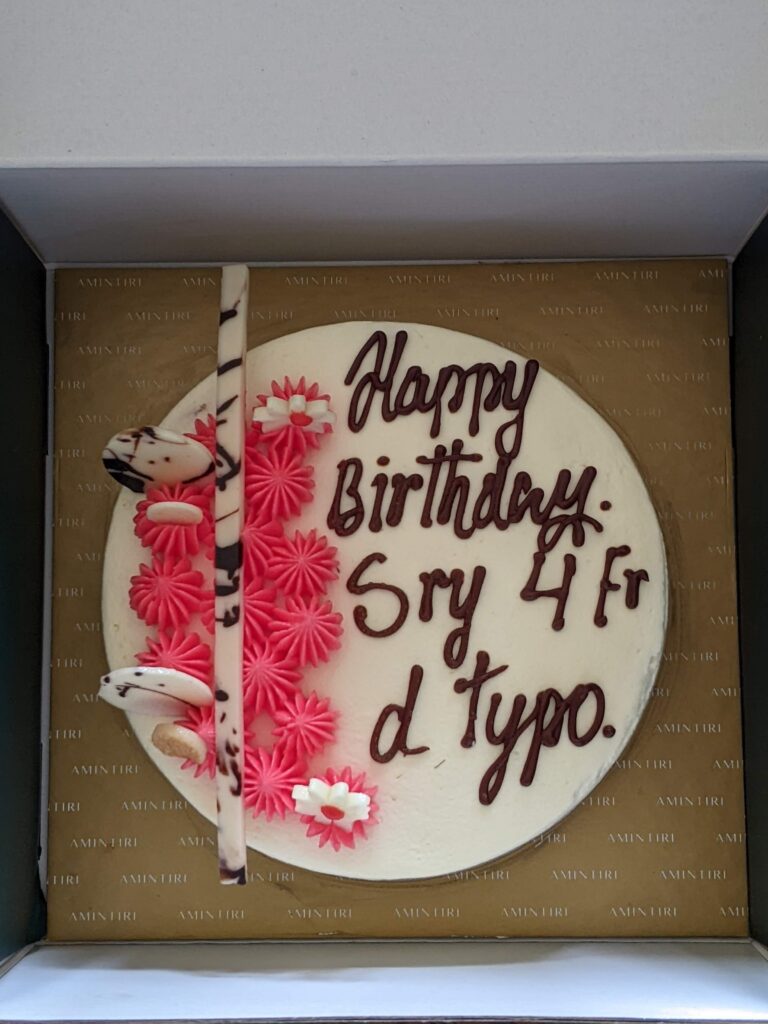
I battle my own bugbears – punctuality, work ethic, grammar and spelling errors etc. That image below is my team taking revenge on my birthday cake. Cheapos! 😂
The point is that others are not average/ inconsiderate people, they are at best average/inconsiderate in the thing I am over-indexing for! There are many contexts and reasons why they don’t behave in a way I think they should . As I commented on LinkedIn, I have realised that being able to afford consideration (or applying oneself) is a privilege.
But that was level 1. When I dug deeper, I saw my real problem. When that ‘idiot’ is not following my worldview (‘ideology’) – whether it is ‘considerate behaviour’ or being conscious of spelling mistakes – it raises (in my own mind) doubts on the objective correctness of my ‘ideology’. Will Storr has a brilliant insight – “for humans, ideology is territory”. We fight for ideas like animals fight for land.
At this point, we have evolved to an extent where we hold hundreds of “shoulds” and “shouldn’ts” in our heads. And we expect the world to comply – from nationalism to having pets/kids to the usage of the Oxford comma and so on. Any deviation from our ‘ideology’ is treated as a judgement against us. No wonder every interaction has the potential for conflict. We are defenders of our own little faiths that make up our identity. What we could practice, when we have the privilege, is to step back and think about the little judgements we make, in work and life scenarios, and then react with empathy, because it is not a personal attack.
There have been many posts on this blog about morality, and recently, I found two quotes that connect it to judgement and empathy.
“The drug of morality poisons empathy” ~ Will Storr (again)
“Compassion is the basis of morality.” ~ Arthur SchopenhauerI found these to be an educative lesson on how I look at my subjective morality, and how I behave with others in real life.