Category: Society & Culture

  • Time Off

    In an earlier post – “Brood Mode“, I’d written about expectations, and how sometimes, they cannot be met. In the context of that post, Austere had commented thus “Is it the instant-ness demanded of the response that puts oneโ€™s brain to a side?” I messaged her on Twitter, that ‘the time construct’ was something I’d planned to write on next.

    Our response time has been shrinking on a continuous basis, twitter, FB etc are a manifestation of that – real time, but the changes have been happening much before that, probably with every advancement we made, not just in communication, but even things like transportation. So, the thought is, if we had more time on our hands, would we be behaving differently with people?

    When I was chatting with Meeta recently, we started discussing this, in the context of relationships with people. It started with me saying that the traffic during the daily commute to work, made me forget all the rules I make for myself, because with all the lane cutting and parking woes, its easily a scenario in which you’re either aggressive or you end up on the road, literally. So I wondered if it would be different if there were no time constraints.

    Despite only a superficial similarity, I was reminded of another construct – money. What started out as a tool of convenience has enslaved many and managed to dictate their actions. Much like the things we create to crunch time. The similarity ended there. Time is not money. Quite obviously, time exists with or without us, though the latter can force one to ask “Who does it exist for then? So let me put it this way, it is a construct that’s still not fully understood, whereas we made the money construct. But for the fun of it, imagine what you would’ve done if your life wasn’t dictated by time. What if you had all the time in the world. Would you be a different person? Would you behave differently with people?

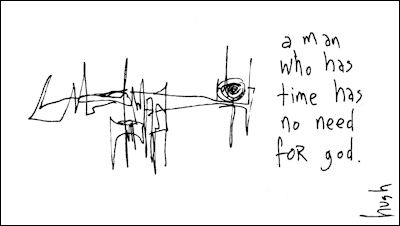
    As it regularly happens these days with me- by sheer coincidence, the day after I had this discussion with Meeta, I came across this work from Hugh MacLeod, which puts it so well

    time

    until next time, timed out for a fortnight ๐Ÿ™‚

  • Blocking Crowds

    Even if you’re not really a 140 type character, you’d have heard about the CBI – Chetan Bhagat Incident, that is. But if you haven’t, not to worry much, we have a link, starring our very own celebrity blogger Nikhil Narayanan, who created the hashtag that led to the deluge. Considering Nikhil’s proximity to another author (turned politician) we’re also probing into other possible links with the external affairs ministry. But that’s for later. :p

    In essence, what started as a debate on piracy – books, not Somalian warships and blockades- led to Chetan Bhagat blocking a couple of twitterers, and the phase that launched at least a few hundred tweets, each a warship using variations of the word ‘block’. Samples can be found here, and my contributions here. My friend Vimoh (as usual) wrote a very objective post on the entire episode, capturing life on Twitter and the presence of celebrities on Twitter very well. Chetan Bhagat can take solace in the fact that his desired aim of uniting India (as stated in 2 States) did happen on Twitter, with very few exceptions. My stated aim of Chasten Bhagat also happened. I think he now understands how the ‘2.0 state’ works, since a couple of days later, we found him very sportingly, making a dig at the incident – “wife screamed at me this morning for no reason. felt like blocking her.” Now that’s cool. ๐Ÿ™‚

    Some perspectives.I’ve blocked people on Twitter too (I still feel bad about those nice girls who sent me what they must’ve thought were useful links), but not after warnings in the public stream. Like I commented on twitter, The Comic Project said it best here, ” If you want to block, block; don’t talk” . In the same article, Surekha also pointed out that though it began as fun, it quickly spiraled into a mob. Something that Nithin, who proved to be a very good voice of reason, had pointed out just when the spiraling started. The ironic part is that I’d have missed out on all of this if Surekha hadn’t popped up on a chat window and told me something was brewing. (Fault attribution check :p)ย  And though I usually avoid hashtags, a window of wordplay opportunity I couldn’t miss. So i dived right in, ignoring the standard operating procedure of checking out origins. Big mistake, no pun intended. ๐Ÿ˜

    I hate mobs, and on the other blog, it is a subject that keeps appearing every now and then. So it sucks to have been part of one. In a post from long ago – 5 years back, titled “Communities and echo chambers“, Dave Winer commented “Your “friends” are an angry controlling abusive mob. …… If friendship is just that, people being friendly and supportive, great. But if it’s really defining who it’s okay to attack, then it’s not friendship.” I perhaps cannot define the relationships on twitter (always) as ‘friendship’, but as I become part of communities on various kinds of social networks on the web, it becomes all the more important to keep a check on the ‘belonging’ craving. Its a lesson learnt.

    until next time, mob bile…

    PS. But all that doesn’t stop me from an occasional dig – like yesterday, when I suggested a brand ambassador for Haagen Dazs, after their franchisee in Delhi did a unique preview – for those with international passports only. To an extent, the mob was in action yesterday too ๐Ÿ™‚

  • Brood Mode

    [The title, while in context, is also a Hi to an old blog pal]

    The last week of November gave me a chance to engage in one of my favourite pastimes – people watching. No, I wasn’t stalking anyone, it was just that I got a chance to watch more and diverse masses (different occasions) of humanity than my regular outings.

    So gawk I did, at famed dancers, musicians and celebrities, at their tantrum-throwing best, egos in full display. I watched people standing in long queues, eager for a glimpse of them, so eager that they were ready to trample the folks ahead of them, or cheat the line. Even after they sat down, they changed chair locations and occupied empty aisles that had been kept for easier crowd movement, angering those behind. I also had an argument with a guy who had a differently abled child, clearly in no state to enjoy the show. He had a regular pass, but said the child’s condition warranted his family being shifted to the VIP class. He said he was from the army, and when I refused entry into the VIP class, he questioned my humanity. I bit back a comment about what business he had bringing that child to aย  free entry event, which was bound to have unruly crowds, and how human he was while doing his duty at the border. I observed acquaintances at work taking advantage of the trust I had in them. In essence I watched a lot and learned a lot, again, on human behaviour, and myself.

    After I shared the last post with her, Mo had asked me why I was brooding these days. While I told her that I was reserving flippancy, wit and wordplay for the 140 character world ๐Ÿ˜€ , I thought she did have a point. A later conversation with Surekha gave me some insight, when we talked about social media and specifically Twitter. I had thought that the seeming transparency of that world would imply more fairness in our transactions, acknowledgment of other people’s efforts and a refinement in the way we deal with people. But no, the talkers still rule, popularity contests abound, and the meek still wait to inherit. These days I can hear some of them grumbling too. ๐Ÿ™‚ On hindsight, this is the same mistake I’d made with blogging too. Something I thankfully corrected.

    What’s the connection? Expectations. Of others and from others. From the celebrities, from the people who came to see them, from acquaintances, from relationships on the web and so on. On how they ought to behave and interact. Expectations I set based on my concept of fairness. “It’s not about what I want, it’s about what’s fair!”, Harvey had said, in The Dark Knight. But while I try to be as objective as I can, there is a limit to that too. When the expectations are not met, I get judgmental, which is not something I like to do. Let’s just say I then don’t meet my expectations of myself. ๐Ÿ™‚

    Earlier I used to be bitter about all this, and be rude to people, but now I just brood. I brood on how to get out of this cycle. How can I not expect, either from myself or from others, or ideally both. Does brooding help? No. Can I help it? No. Does that make me unhappy? No again, because like those processes that run in the background while I work on the computer, this is a question that’s being worked on too. ๐Ÿ™‚ย  No, that doesn’t make it a pseud brood :p

    And every now and then, I am reminded of the words of Harvey Dent Two-Face (again), as he flips the coin, and I wonder about the truth in them “The world is cruel, and the only morality in a cruel world is chance. Unbiased. Unprejudiced. Fair.”

    until next time, happy Dent? ๐Ÿ˜‰

  • Aftermath…..

    ‘Intrigued’ might seem an insensitive word, but as the nation observed the first anniversary of 26/11 last week, I was intrigued by the reactions of different segments towards it. Bloggers, microbloggers, all forms of media, brands, everyone had a take on it, and their own ideas. Yes, nobody forgot, but this is year 1. Doesn’t count.

    I got few mails asking me for my opinions on everything from government apathy to the twitterverse on 26/11 – the POV of a blogger. I hardly had any, and whatever I had, I usually share here, like this. (my views haven’t changed) But I had been thinking about my feelings on the day, and what, to others, and perhaps even a part of me, might seem to be apathy, until I read this well written post. (thanks to Balu) And that set me thinking on standards and ‘Who decides?’, and then on to a tangent.

    Who decides what is to be done and how?

    A nation is formed. Its popular leaders, elected by the people, decide the way the country should be run. From sectors that should be open to private investment to tax slabs and from infrastructure to relationships with neighbouring countries, a few individuals, representative, some would argue, steer the fate of the country. In a few years, the policies and processes set up to aid the smooth functioning of the conduit – between the representatives and the represented- starts to work against this desired objective, because the balance of power between the objective and the processes have shifted. In a few more years, even the objectives which should have perhaps been reviewed, have been taken a step further, and promptly forgotten.

    Humans get together and aggregate, communities are formed, communities agglomerate, society is formed (in the original usage, not the housing kind :|) The society builds in conformation. Even with the non conforming kind, there is an understanding. Belief systems evolve, religions are formed, and rules are made. Do’s and don’t s are established in societies and sub societies. Popular culture is created and social ethos are formed. In a few years, the reasons for why things are done, and in the way they are, get forgotten, a mindless following ensues. Non conformists emerge, but then, we’ve been there before. Trading one system for another.

    A few people get together and form an organisation, knowing that they can create a better product/service than the places they have been working in. The founders have a vision for their work place, they set up systems and processes to achieve this, they hire more people, who can implement these. In a few years, a conglomerate is formed, the founders are at the top of the heap, there is a new breed that manages daily affairs, the process diktats are in place…. you know where I am going with thisย  ๐Ÿ™‚

    In all these cases, there would probably be a disruption at the end, and the start of a new cycle. It is what seems to be expected. In general, nations will sit up and take collective notice only when they are themselves under attack. The travails of another city, much less country are viewed only through the prism of how it would affect us. Society will take up cudgels when they feel a threat to the status quo. Those in power will want to retain it. Organisations collapse when they are unable to see macro changes and lack the foresight to adapt. When they begin to get affected, and they react, in many cases, its too little too late.

    The common factor is the LCD, no, not the screen kind, the kind you learned in primary school – lowest common denominator – the human. Recently, when taking some personal decisions, I tried watching my own mind work, drilling down from the seemingly obvious reasons to the unstated ones, and from there, down to the foundations of why i thought the way I did, and therefore did the things I did. Belief systems, created and maintained by experiences, peer metrics etc, and thought structures, the changes to which were only superficial with time (contrary to expectations), they were all there, with the reasons buried under multiple layers built over time. My experiences, my perspectives, so I decide, on hindsight, objectivity was perhaps impossible.ย  Autopilot. This is perhaps what gets reflected in everything that I am part of – organisations, society, nation.

    The realisation was pretty simple. Standards and decisions are on auto pilot, though they seem otherwise. Humans. Us. Living in bubbles, deciding objectives and setting up structures to get there, and then forgetting why.ย  Even when I think I am deciding, what is deciding for me is the baggage of the past.

    I thought of the poor souls in Leopold, Taj, Nariman House on that fateful day….who till then had built a structure and process to their life. Is that what it takes to get one out of autopilot? A cataclysmic moment – the moment when beliefs and structures scarily slip away, and the illusion of control becomes exactly that – an illusion. In the aftermath, calculated scenarios mostly don’t count.

    until next time, deciding the questions

  • Progress report

    One of the most memorable parts of the Andaman trip was the conversation I had with D, on the day we went aimlessly walking on the promenade. The conversation also seemed to understand the mood and was in its own way, aimless. As i wrote in one ofย the posts, I am fascinated by night lights, especially by the sea shore. It reminds me of Cochin, and sends waves of nostalgia at me.

    The entire trip had also made me wonder about human ‘progress’ and the motivation behind it. In a few minutes, the conversation that began there navigated itself to individual motivations. The comparisons with the Leh trip that I’d madeย  a couple of hours before at Corbyn were still fresh in my mind. I had set expectations for this trip even before i started out – expectations not based on any previous trip to Andaman, but on previous vacations. I thought loudly on what these expectations were – the beauty of the place? the feelings the place and people evoked in us? a getaway from the daily grind? A new setting and a scope for ‘discovery’? Comfortable stay, good food? Probably any or all of these. Anyway the expectations were set.

    And then D brought up one unacknowledged aspect – our projection of how wonderful the trip was, best characterised by the photos we share on FB and other private albums. (earlier, family gatherings and conversations) Isn’t that an expectation in itself – a proof of good times? Sometimes for ourselves, sometimes for others. I thought that was a good place to start understanding our motivation.

    From childhood, when we had richer cousins/friends flaunting their better toys, or showing us snaps of places they’d been to, or talking about the wonderful food they’ve eaten, a kind of motivation existed – to match better that at some point in the future. A driving force that dictated the choices made in life, which justified the ‘sacrifices’ made. Study hard to get better grades, to get a better job, to make more money and to finally get all the things that the cousins/friends had, even if it was a couple of decades late,ย  all the stuff that can be a justification for what is (in a sense) euphemistically called the rat race. And then to look back at the proof of achievement and let out an audible sigh of accomplishment.

    The problem arises perhaps not from being a rat even at the end of the race, but probably the realisation that a personal motivation got subverted into a generic rat race, which then became a motivation in itself. The rest of the life story would depend on the stance towards the original motivation. In many cases, the race stops, the baggage is dropped and a path of ‘self discovery’ is started.

    In my personal map, this is the place where I see a ‘You are here’ sign. I would’ve been happy with this, if I hadn’t realised that it has the same ending as the rat race. The path is different, and because there are no obvious indicators like the rat race, I have to evolve my own set of indicators. But the desired end is the same, simplistically put, personal growth, with previously decided benchmarks. The consolation offered is that it was reached on one’s own terms. I wonder, is it really one’s own terms if the destination is no different?

    Ayn Rand said “Man’s ego is the fountainhead of human progress”. Human progress, not just from a humankind perspective – the places and things he builds, but a deeply personal one too, as the ‘ego’ would indicate. I was conscious of this when I shared the Andaman photos, conscious that somewhere, someone was setting a benchmark and the beginning of a race, just like I had, and continue to do, even outside the rat race. And I wonder whether I’ve really replaced one rat race with another in my case. And I still continue to wonder about ‘progress’.

    until next time, progress cards with my own signature :]