
Category: Society & Culture

  • All I have to do is dream…

    Yes. Quite liked the movie – Inception. Mostly because I found the concept  (dream incubation, lucid dreaming) interesting and because it forced me to pay attention. Sometimes, movies like that can be refreshing. Of course, it helped that the visuals were very watchable too, and the last shot added to the charm.

    For those who haven’t seen the movie, not to worry, the post only refers to it in terms of concept. At a very basic level, its about planting an idea (Inception) inside a person’s head. Only, he shouldn’t know it was planted by someone else, he should think it’s his idea.  In a world where a lot of people anyway falsely claim an idea as their own, you might wonder why this is interesting, but  ignore that for now. 🙂 Meanwhile, since the person needs to think its his idea, a basic version of the idea is planted in a dream state, in the subconscious.

    Like the movie maker has said about the end, its whatever you want it to be, so here goes. The other reason I liked the movie was because of the ‘life subtext” – the part that makes comparisons to The Matrix inevitable. I thought many acts of ‘Inception’ happen to us too, over a period of time – sometimes done by others, sometimes by ourselves – conditioning. And since we don’t really contemplate why we choose to do a certain thing/in a certain way, we end up thinking that what we’re doing is what we really want.

    Half my life
    Is in books’ written pages
    Lived and learned from fools and
    From sages
    You know it’s true
    All the things come back to you

    And just like how in the movie, the ‘projections’ (things and people used by a dream-architect to populate the dream world) turn hostile when the person detects an external presence in their sub conscious, in life, the problem starts when we suddenly realise the existence of the conditioning, and realise that perhaps, much time has been spent on chasing an ‘inception’.

    Every time that I look in the mirror
    All these lines on my face getting clearer
    The past is gone
    It went by, like dusk to dawn

    And yet, some would say that their lives have been made better by pursuing that one idea. So how do we really know? In the movie, the people who carry out ‘inception’ and the lower forms of the art (extraction) have a totem that helps them distinguish dreams from reality. I wonder if we have something comparable, but then, I wonder, if life would be as interesting as it is if I did have a spinning top or a rolling dice to give me a better grip on reality. 🙂

    until next time, deception 🙂

    Lyrics: Dream On, Aerosmith.
  • Mirror Images

    I came across this passage while reading Kiran Desai’s “The Inheritance of Loss”. The context is of a young girl, who, because of a new found romance suddenly becomes conscious of herself.

    “But how did she appear? She searched in the stainless-steel pots, in the polished gompa butter lamps, in the merchants’ vessels in the bazaar, in the images proffered by the spoons and knives on the dining table, in the green surface of the pond. Round and fat she was in the spoons, long and thin in the knives, pocked by insects and tiddlers in the pond; golden in one light, ashen in another; back then to the mirror; but the mirror, fickle as ever, showed one thing, then another and left her, as usual, without an answer.”

    I found that I could also identify with it in the context of our encounters with the social platforms around – Orkut, Twitter, Facebook, LinkedIn.. and how slowly the ‘Like’ and RTs seem to be defining the interactions and affecting even perceptions and understanding of the self. Its not as though people and comments never existed before, but the sheer mass of people we come into contact with, thanks to the social platforms is unprecedented. Through the conversations and responses, we see a bit of ourselves, a self colored by the other person’s perceptions. As the voices around us continue to increase, at some point, is there a danger of losing touch with what we really are? Yes, you could ignore or be selective, but then we’d just get back to an objectivity argument.

    “The biggest danger, that of losing oneself, can pass off as quietly as if it were nothing; every other loss, an arm, a leg, five dollars, a wife, etc. is bound to be noticed.”

    I read that, thanks to @aanteadda‘s share on Twitter – an excellent take on the Ramayana,(do read it) and in a completely different context – that of dharma, it happened to arrive around the same place. Rama, having lived his entire life by what he considered his dharma, is distressed by what he must do with Sita after the end of the war with Ravana, irrespective of what he personally wants. The author thinks that this is Rama’s tragedy, and that of every person who lives by ‘impartial and abstract principles’, which don’t take into account ‘individuals as persons,’ and can’t see the difference between a situation and a personal situation’, and it can only lead to the destruction of the self.

    And so I wondered, whether its people, or a moral code that one follows, whatever dictates what we do, is there really a difference – between the reflections from others and ourselves? Is there one right answer for what should define us and the way we live. I think not.

    We must prioritise, I guess, based on what we think will give us happiness, and just like this neat article on addiction (the internet in particular) ends, “we will increasingly be defined by what we say no to”, all thanks to an abundance of choices, from within and without.

    until next time, you always have a choice, but do you always want a choice?

  • Recycling Gods

    Sometime back, I’d written a post about super powered individuals who later came to be known as Gods, and how technology is perhaps taking us closer and closer to these versions of gods. And sometime back, Vimoh too wrote a very thought provoking post on the evolution of Hindu gods, and how, over a period of time, important Vedic gods like Indra, Varuna, Agni etc have lost their importance to a newer set who rose to prominence according to the stage of our civilisation – Ganesha, Saraswati, whose ‘hidden’ characteristics were brought to light. An evolution from gods “that govern the elements of nature to gods that govern abstract concepts of the mind”. He also hypothesises that  in the future, the list will be further transformed when man realises that the universe is more of a network than a hierarchy and when he finds himself at par with the highest of gods and the lowest of forms, he will realise his divinity.

    I’ve always wondered whether the original set of gods was a small number and as needs arose, historical characters were pushed into divinity, their stories exaggerated, and for later generations they served as gods. The original triumvirate – Brahma, Vishnu and Shiva have remained more or less a constant in their importance, though Brahma lost out in terms of places of worship.  But the evolution of gods is something I completely agree with.  As our needs changed and the things we could control changed, it was perhaps inevitable that the things we attributed to them would change. More importantly, they also changed with out interpretations of good and evil. Since our gods have always been close to us, their character and behaviour also reflected this change in ethos.  Huffington Post says they’re now pop culture, through Bollywood movies, for example. But yes, they were always more human, and ‘approachable’ anyway.

    It does bring up a point though. I wonder how our current depiction of Hindu Gods would affect how later generations perceive them. The modern retelling, which sometimes adds layers hitherto absent. Imagine a future generation treating Ramanand Sagar’s Ramayana the way we treat the vedas now simply because earlier sources may not stand the test of time. If they saw Sippy’s Mahabharat and also saw Jha’s Rajneeti, would they be able to grasp the parallel? Or would they miss it because they haven’t ‘lived’ with the gods like we have? ‘Sita’ in the television series was ‘Deepika’, the actress, who has also played other roles in serials and movies. So, without a context, it might be just another role she did. There is a reason I’m thinking this way. Any of the gods could be just a role play – incarnations/manifestations – different roles in different contexts at different times. We rely on certain images and certain texts which are possibly incomplete in their current form. And thus rises the question that invariably gets asked in such discussions – who created who?

    Each age fills up the void of its unknown with its own versions of God or his opposite number. Like Vimoh states at the end of his post, the future explorer will be an amalgamation – with knowledge from many disciplines. For now, we pursue the mystery from among the tools we choose based on our interest, bias, and faith – science, religion, philosophy, and so on. The question is, will we ever reach a point when everything is known, and the God shaped hole would be finally filled with our knowledge. Maybe that’s the point when the current Brahma gets irritated and presses the ‘Delete All’ button, and the Brahman starts with the next Brahma. 🙂

    until next time, divine grapevines 🙂

  • Collective bargain

    “The way they speak about dinosaurs now, a few years later, that’s how they will talk about the mill workers”, says a character in City of Gold, a Hindi film by Mahesh Manjrekar, adapted from a play by Jayant Pawar. Its based on the Great Bombay Textile Strike. A decent movie, with some great performances and with its share of stark realty, though parts of the second half had a Bollywood melodrama hangover. I guess the response at the multiplexes (many of which are ironically what the mills gave way to) wasn’t really great either. But it was a story that had to be told.

    The subject has interested me earlier too. To be precise, in 2005, my last official trip to Mumbai. The office was at Peninsula Center, and when I looked out through the windows, I could see a few chimneys. I wondered enough to come back and read up a bit. I was curious because amidst the RGV underworld flicks and the contemporary images I had of Mumbai, this seemed to be a part of history that had never figured in conversations. A legacy that seemed to be buried in the collective consciousness.

    A single movie might not really be enough to cover the individual lives that were affected, though it does try to portray a microcosm. But as the line in Frost/Nixon goes “You know the first and greatest sin of the deception of television is that it simplifies; it diminishes great, complex ideas, stretches of time; whole careers become reduced to a single snapshot.”

    Though it is said in a different setting, and context, the connect I sensed was legacy. How a person is perceived by a later generation. Artists have their paintings, actors/directors/crew have their movies, politicians, sportsmen/women have their auto/biography/memoirs, authors have their books, musicians have their music, they have a better chance at being remembered by a larger number of people, long after they’re gone, a better chance than us, the commons. A  collective’s legacy would be the place and time they lived in  – the larger picture, their collective actions, the people who became popular, the events that shaped the future. What happens if a collective chooses not to remember, or chooses to remember only parts? Who does it matter to then?

    until next time, decadent chronicles

  • Back to eternity

    Despite being a Star Trek fan, I happen to think that Time is the final frontier, at least in the horizon that I can see. I find it quite intriguing that, though it might be looked on as a tool for tracking, I can perhaps not account for most of my lifetime. I don’t mean the large picture, I haven’t lost it totally yet, but specific minutes. Take for example, the last hour and account for all the thoughts that rushed in. I would find it difficult.

    If you close your eyes, and allow your breath to be the only meter, the perspective of time undergoes a shift. Meditate a bit, and its easy to see. Easy to see that even the measurement of time – years to seconds and beyond is our  construct. But it is so ubiquitous and enmeshed in our lives that it seems as though it is a constant and only we change. It requires dramatic events for us to pause and note the passage of time. Kahlil Gibran has said, ‘Perhaps time’s definition of coal is the diamond”

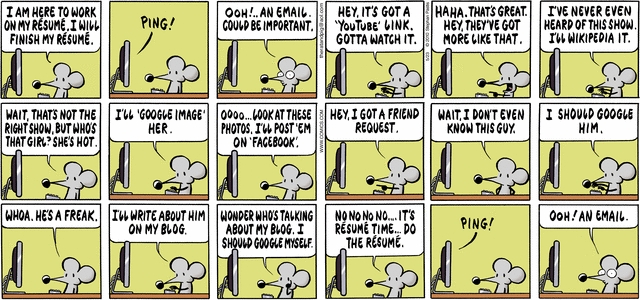
    Meanwhile, I wonder if all the information about those unaccounted for minutes is stored somewhere in my brain, and is just not deemed enough to be of any priority for me, and hence seems inaccessible. The tools that consume me these days – most specifically Twitter, and more recently, Foursquare, also help me keep track of what I’ve been up to, and when it works the same way for everyone is when there is an information deluge, and that seems to be something we find difficult to handle. Something that we have discussed before. There is a toon I found (here) that correctly describes the way a lot of us seem to be functioning now

    Clipboard01

    And in another example of how man is shaping his own evolution, I read about companies like Lifenaut, which  ultimately aim to create humanoid robots powered by a backup of the original human’s brain. (via @pkaroshi) The first step is to create a digitised version – an avatar, and give it enough data for it to mimic the original human. It makes me wonder whether we will be able to create ‘consciousness’.

    And that makes me think a bit more – by the time, we are technologically advanced to create it, will we have forgotten what consciousness is? Which also begs the question whether we have ever understood it at all, when we are not even mindful of the minutes of our lives? How does one define it? So many reactions which seem pre-programmed when one thinks of it, actions and reactions more out of habit than any conscious choice being exercised.

    So yes, with all of the work happening at a rapid pace, (do read) I think its more ‘when’ than ‘if’ – that we will become immortal, and time, from a future point of view, will become immaterial, because the future will be infinite. But we still may not be able to undo what we did a minute back. Where does that leave us? To quote Pico Iyer (from Abandon) “God has to be understood in the context of everything that is not Him”. But that is a different discussion, I guess. Its only that with every advancement that humanity makes, and in that process also usurps things once attributed to divinity, I begin to wonder where that leaves our versions of God?

    until next time, time.ly links 🙂

    PS. I tweeted sometime back, even if you never read an Asimov work, or never plan to, this is one that you should read. The Last Question.