It is freedom weekend in this part of the world. We make an impromptu lunch plan, and use the metro. Then go to a mall for bubble tea, our new comfort drink. There is something metaphorical about that – our bubble inside a messy reality. I noticed that at the restaurant, on the roads, in the mall, there weren’t a lot of smiling people. I reflect that maybe it’s a sign of the times. After all, if you go by social media, everyone else is doing better.
And it isn’t just online, it’s a reality too.I think specifically about the service staff in the restaurant, security guards at the metro station. They are working on a day when everyone else has the day off. Waking up early, going back late. They are living lives of precarity, something I read in Eula Biss’ Having and Being Had.
“…depending on the will or pleasure of another was the original meaning of precarious, and that it comes from the Latin for prayer. Precarity is everywhere, it seems. Maybe it is, as Anna Lowenhaupt Tsing writes, the condition of our time. It is also the defining feature of an entire class of people, the precariat.
Illness or disability can force somebody into the precariat as can divorce, war, or natural disaster. The precariat is composed of migrant workers and temp workers and contract workers, and part-time workers. People who work unstable jobs that offer “no sense of career.” There are few opportunities to advance in these jobs, and no way to bargain for better terms.
I chose pre-tirement a year and a half ago, in my mid-40s. Yep, it’s a thing – the space between full-time work and retirement – a reduced workload in return for $ that meet my needs and some wants. Monika Halan’s recent column reminded me of the real question I grappled with: “Will I outlive my money or will my money outlive me?”
I agree with her take on the learn-earn-burn model and sketchy finfluencers, but I don’t think the classic career peak-in-your-50s idea will last. Here’s why.
1. Short-termism is now baked into most companies. Layoffs, shrinking business cycles, and the fast pace of disruption mean you’re constantly solving new problems with new tools. That’s largely fluid intelligence, which peaks around 40. Until now, we’ve extended careers beyond 40 largely with crystallised intelligence (experience, wisdom), but AI is catching up with both. Soon, someone younger, faster, and AI-enabled might do the same work cheaper.
2. That also means even a decade-long career may be a stretch. Once humans turn knowledge into rules, rules become algorithms, automation happens and jobs disappear. Damn AI learns!
3. This shift is especially brutal for Gen X and Millennials who weren’t prepared for it. Add subpar savings, unhealthy lifestyles, and rising stress, and mental and physical health issues are inevitable. And no, companies won’t support you.
Since I’m aged enough to offer unsolicited advice: if you’re in your 30s/40s, aim for pre-tirement by 50. Think of it as a Pascal’s wager. Better to have financial freedom so you can grow on your terms, and are not forced to make money-driven choices.
The path? Good old compounding – of intelligence, wealth, health, and relationships. 1. Stay curious. Keep learning. Solve new problems to keep your mind sharp. 2. Spend and invest consciously. Don’t finance today’s wants at the cost of tomorrow’s needs. 3. Stay healthy, not just fit – body and mind. Saves you meds money and lets you enjoy your freedom. 4. Find people in whose company you can be yourself. It aids the above three too.
In the near and mid-term, AI’s quick evolution will question not just work’s efficacy as an income provider, but also its ability to deliver a sense of purpose. On an existential scale, I think the second will cause more damage.
Delivery guys riding on the wrong side of the road, kids behind you kicking your seat on a flight, speaking on the phone loudly in a public space – these are a few of my favourite peeves. I am sure you have yours too. That’s why this post on LinkedIn caught my attention – “things pissing me off” in situations where people aren’t following rules is something I could relate to.
Barring a few exceptions where I am absolutely not able to tolerate what I believe is ‘inconsiderate behaviour’, I don’t engage. But engage or not, these instances also reveal my snap judgements. e.g. what an inconsiderate idiot, speaking loudly during a movie. I judge myself the most, but also try to intellectually understand my motivations.
That’s why I found this particular episode of The Knowledge Project – in which Shane Parrish speaks to Todd Herman – fascinating. Around the 49th min mark, Shane asks Todd if he has a hard time relating to average people, people who just didn’t want to be the best at what they do. I could relate to it in my professional context – another pet peeve. Todd admits how despite having matured, he still has to watch out as his ego still tries to stack them as ‘average’. Todd explains that he does this because he over-indexes what he personally finds important. e.g. a career-driven person might judge someone who prioritises being a parent.
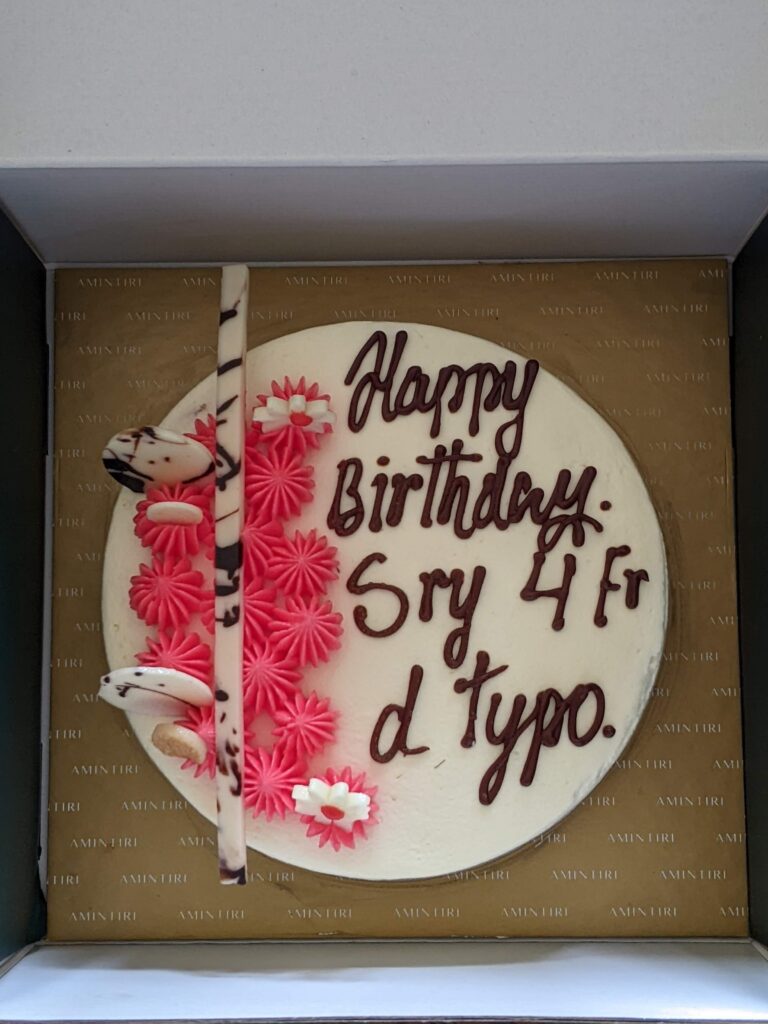
I battle my own bugbears – punctuality, work ethic, grammar and spelling errors etc. That image below is my team taking revenge on my birthday cake. Cheapos! 😂
The point is that others are not average/ inconsiderate people, they are at best average/inconsiderate in the thing I am over-indexing for! There are many contexts and reasons why they don’t behave in a way I think they should . As I commented on LinkedIn, I have realised that being able to afford consideration (or applying oneself) is a privilege.
But that was level 1. When I dug deeper, I saw my real problem. When that ‘idiot’ is not following my worldview (‘ideology’) – whether it is ‘considerate behaviour’ or being conscious of spelling mistakes – it raises (in my own mind) doubts on the objective correctness of my ‘ideology’. Will Storr has a brilliant insight – “for humans, ideology is territory”. We fight for ideas like animals fight for land.
At this point, we have evolved to an extent where we hold hundreds of “shoulds” and “shouldn’ts” in our heads. And we expect the world to comply – from nationalism to having pets/kids to the usage of the Oxford comma and so on. Any deviation from our ‘ideology’ is treated as a judgement against us. No wonder every interaction has the potential for conflict. We are defenders of our own little faiths that make up our identity. What we could practice, when we have the privilege, is to step back and think about the little judgements we make, in work and life scenarios, and then react with empathy, because it is not a personal attack.
There have been many posts on this blog about morality, and recently, I found two quotes that connect it to judgement and empathy.
“The drug of morality poisons empathy” ~ Will Storr (again) “Compassion is the basis of morality.” ~ Arthur Schopenhauer
I found these to be an educative lesson on how I look at my subjective morality, and how I behave with others in real life.
It has been almost exactly 4 years since I wrote Default in our Stars. I ended that post with
A question I asked myself while writing this was, when there is no agency, what happens to morality? My own first answer was worrying – maybe you just become numb to life’s deeper questions because there’s always an algorithm to give you something you didn’t know you wanted. And that’s the panacea that this age warrants. And hence default in our stars, and an artificial existence.
Sometime back, a comment on an advertisement I had shared on LinkedIn on World Suicide Prevention Day led me to think again on the subject. I had a bunch of thoughts, and after I had framed it myself, I took the help of everyone’s favourite assistant to break it into byte sized points.. Given my (lack of) expertise, it’s a reach, but I love my curiosity. 🙂 So here we go, picking up specifically from the point of societal impact – reduced interactions, as algos increasingly recommend everything.
1. Human Interaction Decline: Before the Industrial Revolution, getting things done required relatively more human interaction. Since then, it has been declining. From real marketplaces to supermarkets to telephone operators to a faceless internet and so on.
2. App-Driven World: Now, apps have taken over many tasks that previously required a human touch — answering a question, booking a cab, planning vacations, ordering a meal, buying from the local shop — are all done with increasingly reduced human involvement.
3. Command & Gratification: Apps obey without asking for explanations, giving us control and instant gratification. “Click to order”. In parallel, social media provides gratification through validation – likes, comments etc, again something that formerly happened only IRL
4. Centre of the Universe Mindset: This on-demand gratification makes us feel like the centre of our own universe, where every gratification is possible and tailored for us, fast and friction-free. A perception that everything is my way on the information highway.
5. Human Interaction = Tedious?: As human interactions inherently involve alternate perspectives and unpredictability, they can seem more ‘tedious’ in comparison to seamless app transactions.
6. Natural Selection’s Role: Here’s where natural selection comes in. Entropy is relentless, and the one force that is equally relentless in trying to stop it, is natural selection. Evolution thus tries to increase order in successive iterations. That’s also how humans got here.
7. Tech’s Push for Efficiency: In general, app interactions are more predictable than human ones, aligning with this drive for less entropy. For instance, Urban Company/Uber have automated much of this already, helping us choose predictability and efficiency over complexity in daily transactions.
8. Tech & Relationships: Something I missed in the original post is another connection between biology (nature) and tech. In their book The Molecule of More, Daniel Z. Lieberman and Michael E. Long describe two kinds of relationships. “Agentic” relationships orchestrated by dopamine – formed to accomplish goals, very purpose-driven, and in contrast, “affiliative” relationships – formed for connection and enjoyment, driven by oxytocin. We all know the connection between tech and dopamine, and that’s probably why we are increasingly pushed to transactional agentic relationships.
9. Blockchain’s Faceless Trust: So, where is this going? As D pointed out when I chatted with her on this, blockchain takes this further with its “faceless, trustless” system of certainty. It’s arguably the next step in reducing unpredictability.
10. AI and the Future: AI, despite its hallucinations, will likely bring even more predictability in both outputs and outcomes. But what does that mean for our place in this increasingly transactional world? Honestly, I’m still figuring that part out. 🤷♂️
The WEIRD mindset has moved beyond its original strongholds and is becoming increasingly dominant across the globe. Money, society’s favourite currency, demands it. Munger has famously said “Show me the incentives and I will show you the outcome“. It is ironic that at a species level, there might be a desire to survive, but that, at an individual level, the WEIRD penchant for autonomy and predictability is overriding it. Natural selection will have no qualms about its means of reducing entropy coming at the cost of an entire species.
In Lessons in Chemistry, Lewis Pullman’s character is an orphan (in real life, his father is Bill Pullman, who in other lives was a fantastic American President in the mid 90s and in the 2020’s was a tortured, but great detective). But I digress.
His character is quite an achiever, but I don’t think that’s how the average orphan’s life goes. There are a lot of famous people who were orphaned, but subsequently adopted. I’d think that the number not adopted would be higher though, and in any case, we rarely know about unexceptional lives. Many of us who lose even one parent early in life feel the loss consciously or subconsciously. And I am reasonably sure it shapes our character and worldview. At least I can speak for myself. Even for those whose loss comes later in life – after their own lives are reasonably well established, there is the sudden jolting realisation that an unquestioning, non-judging backup, even if it was never used, is now gone forever.
And so I wonder, what does it mean to live a life when it starts with rejection? How does it feel when they become conscious of it the first time? Does it happen when one among them get adopted? Is there loneliness, or does their bond with the others help them avoid that? What about a sense of privacy? Do they even get that, do they even think of that when they rarely have space of their own? What about ownership? How does the concept work when everything is practically shared?
When they grow up, how does all this affect the way they engage with the world? What about expectations – from others, their own of themselves, or fulfilling someone else’s? Do their relationships suffer from the baggage of rejection? Does their behaviour with others get affected because of their (non) notions about privacy and ownership? How complex must it be for them to accept and receive love?
Sometimes I think being raised by parents or even one parent is one of those privileges – like having a well-functioning body with all appendages intact, all sense organs working fine – that we easily take for granted. After all, we only have to reflect on the routes we want to travel in the journey of life, and that in itself is not easy. Imagine being rootless, unable to resolve where one came from.