Category: Society & Culture

  • Rootless

    In Lessons in Chemistry, Lewis Pullman’s character is an orphan (in real life, his father is Bill Pullman, who in other lives was a fantastic American President in the mid 90s and in the 2020’s was a tortured, but great detective). But I digress.

    His character is quite an achiever, but I don’t think that’s how the average orphan’s life goes. There are a lot of famous people who were orphaned, but subsequently adopted. I’d think that the number not adopted would be higher though, and in any case, we rarely know about unexceptional lives. Many of us who lose even one parent early in life feel the loss consciously or subconsciously. And I am reasonably sure it shapes our character and worldview. At least I can speak for myself. Even for those whose loss comes later in life – after their own lives are reasonably well established, there is the sudden jolting realisation that an unquestioning, non-judging backup, even if it was never used, is now gone forever.

    And so I wonder, what does it mean to live a life when it starts with rejection? How does it feel when they become conscious of it the first time? Does it happen when one among them get adopted? Is there loneliness, or does their bond with the others help them avoid that? What about a sense of privacy? Do they even get that, do they even think of that when they rarely have space of their own? What about ownership? How does the concept work when everything is practically shared?

    When they grow up, how does all this affect the way they engage with the world? What about expectations – from others, their own of themselves, or fulfilling someone else’s? Do their relationships suffer from the baggage of rejection? Does their behaviour with others get affected because of their (non) notions about privacy and ownership? How complex must it be for them to accept and receive love?

    Sometimes I think being raised by parents or even one parent is one of those privileges – like having a well-functioning body with all appendages intact, all sense organs working fine – that we easily take for granted. After all, we only have to reflect on the routes we want to travel in the journey of life, and that in itself is not easy. Imagine being rootless, unable to resolve where one came from.

  • An entropic guide to history

    In the last year, I have read four ( + one) books that I thought summed up the why-what-how of humanity’s evolution very well. Respectively, The Case Against Reality: How Evolution Hid the Truth from Our Eyes (Donald D. Hoffman), and Being You: A New Science of Consciousness (Anil Seth) (my favourite this year), The Master and His Emissary: The Divided Brain and the Making of the Western World (Ian McGilchrist) (first among my favourites last year), The WEIRDest People in the World: How the West Became Psychologically Peculiar and Particularly Prosperous (Joseph Henrich) (don’t worry, it is inclusive enough in this context), and finally the + one The Cosmic Game: Explorations of the Frontiers of Human Consciousness (Stanislav Grof) because while it is fringe science and despite the qualitative proof, I wasn’t convinced on the existence of divinity, I think our experiences in our non-ordinary states of consciousness has a connection with the ‘why’.

    The theme that unites them is entropy and ‘order’. Haha, school stuff, I know. So here’s a quick refresher. Simplistically, entropy is the measure of the degree of disorder in a system. The second law of thermodynamics states that in any isolated system, the total entropy tends to increase or remain constant over time. Our universe is an isolated system because, as far as we know, there is nothing else other than our universe; there is no external environment that our universe can exchange matter or energy with.

    Let’s begin with Hoffman. He points out how natural selection is the only process we know that ‘fights’ entropy. It pushes organisms to higher degrees of functional order to try and delay entropy if not offset it completely. Across a vast amount of time, it has tweaked living systems to not just be fit for survival, but also reduce disorder. But there is a trade-off. We don’t see reality as it is. He posits that “some form of reality may exist, but may be completely different from the reality our brains model and perceive.Maya, anyone? He compares this to icons on our screens that are a way of interacting with the system but don’t look/feel/behave like the system underneath. They are a user interface that spares you tiresome details on software, transistors, magnetic fields, logic gates etc. And everything we perceive around us through our sensory organs and mind is just like that – icons that help us navigate. Our perceptions don’t even have the right language to understand/describe reality. Think of it like the UI or formats we have evolved for navigating the world, and there are different ‘languages’ for different species.

    The non-ordinary experiences – courtesy psychedelics etc – that Grof writes about , I suspect, opens up our brain to a different language and thus a different interpretation of the world. A perception of reality in a different language.

    Anil Seth also touches upon how our brain is wired for survival and the functional order that natural selection is driving towards. Reality is an interpretation, and the entire process is not optimised for accuracy, it is designed for utility. ‘We perceive the world not as it is, but as it is useful to us.’ A mechanism of making it seem real so we respond to it. Additionally, perception is a ‘controlled hallucination’ (phrase by Chris Frith), an active construction as opposed to a passive registering of an external reality. The brain constantly makes predictions about the causes of its sensory signals through a Bayesian process in which the sensory signals (also) continuously rein in the brain’s various hypotheses. Perception is thus a continual process of prediction error minimisation (reducing the difference between what the brain expects and what the signal provides) because lesser error, more order, lesser entropy.

    McGilchrist ‘s work goes deeper into the functioning. The right is present and pays attention to the world outside, the left re-presents. The differences between them are less about what they do and more about how they approach something. A fascinating perspective on how the two halves of our brain have quite different worldviews – the “left hemisphere is detail-oriented, prefers mechanisms to living things, and is inclined to self-interest, where the right hemisphere has greater breadth, flexibility, and generosity.” Relatively, mechanisms offer more control (order) and predictability than living things. Thanks to its ability to break things down into simple answers and better articulation, the left hemisphere has been able to grab control at an accelerated pace since the Industrial Revolution, and create a world where it prizes precisely these capabilities in individuals, institutions, and culture at large.

    And finally, Henrich, overlapping with McGilchrist, shows how cultural learning adaptively rewires our brains and biology to calibrate them for navigating our culturally constructed worlds. “Unlike other animals, we have evolved genetically to rely on learning from others to acquire an immense amount of behavioural information, including motivations, heuristics, and beliefs that are central to our survival and reproduction.” From kinship altruism and pair bonding to our own motor patterns to projectile technology and food processing to grammar and social norms. When you look around, the dominant narrative is the WEIRD (Western, Educated, Industrialised, Rich, Democratic) one. Broadly, individualism and personal motivation (self focus, guilt over shame, dispositional thinking – based on intent not context, low conformity, self regulation and control and patience, time thrift, value of labour, desire for control and choice), impersonal pro-sociality (impartial principles, trust, honesty and cooperation with strangers and impersonal institutions, emphasising mental states in moral judgment, not revengeful but willing to punish third parties for not sticking to principles, reduced in-group favouritism, free will, belief in moral truths like physics principles, linear time), and perceptual and cognitive abilities and biases (analytical over holistic thinking, attention to foreground and not surroundings, endowment effect, overconfidence on own abilities) are all features of this, and the correlation with higher functional order is evident.

    If I look around the metro crowd in India and across the world, the optimisation for WEIRD is rising. As I wrote in Kaumpromise, we can still see an alternate way in patches. It’s interesting how with the rise of AI, we are at once creating even more order in many ways but at the same time ceding control to blackboxes. That requires some thought, and another post!

    P.S. There is a nice time dimension to this as well, brought out in monochronic and polychronic cultures. Read more here.

  • Kaumpromise

    There is nothing quite like death to shake a worldview. There is a reset that happens in one’s head, and the relationship or even lack of it, changes this only in degree, not kind. There is no immunity either, by now, I’d know.

    This one took me out of my comfort zone, in terms of physical location. In the last year or so, especially since the previous time I encountered death, I’ve felt myself become a tad more dispassionate about Cochin as relationships seem a lot more fragile. I am myself much to blame, decades of muscle memory of holding others at arm’s length is hard to shake off. And this is beyond Cochin, and in a place where I have avoided staying for more than a night. Each time I have tried to tell myself that my creature comforts can be skipped for a few days, there has been a rebellion within and I’ve been forced to say “I can’t.”

    I brace myself this time too, and stood in a corner, observing others. I think we all are capable of projecting an aura of “do not approach” when we so want. Mine is at full blast. And yet, one child (whom I first knew as literally a child, and is now about to become a CA) breaks through it, and asks me if I I am ok, if I need anything. Maybe it is that, maybe it is the death gut punch, or maybe it is my newfound willingness to look at (at least some of) the world without a ‘transaction alert’ warning, but the next evening, I am at the table for evening tea, doing stuff I do when I am comfortable with people – pulling their legs, except these are people I had never even said a decent hello to. The day after, I am pushing someone to accept something the family feels he should take, and he is reluctant. They’re all crying, I think I might have forgotten how to. Says a lot.

    But the larger facade broke before that evening at the table, as I watch folks of all forms walk through the door to catch a last glimpse of the one who had passed. It strikes me that I didn’t know more than a few people who would care to drop in to see me before I went up in smoke. The image of an old man, barely able to move a few steps, break down in grief, is still alive in my mind. Sometimes, I realise, it takes death to understand the meaning of life.

    A few days later, I am back in Bangalore. I see the unhindered adulteration in packaged food, in the things that restaurants do, and in general, the greed in every seller, I wonder if that is what has been lost when faceless people sell things to faceless others. It is easier to not care when you don’t see the people you harm. That is not an option in a smaller community or at least it gets punished faster.

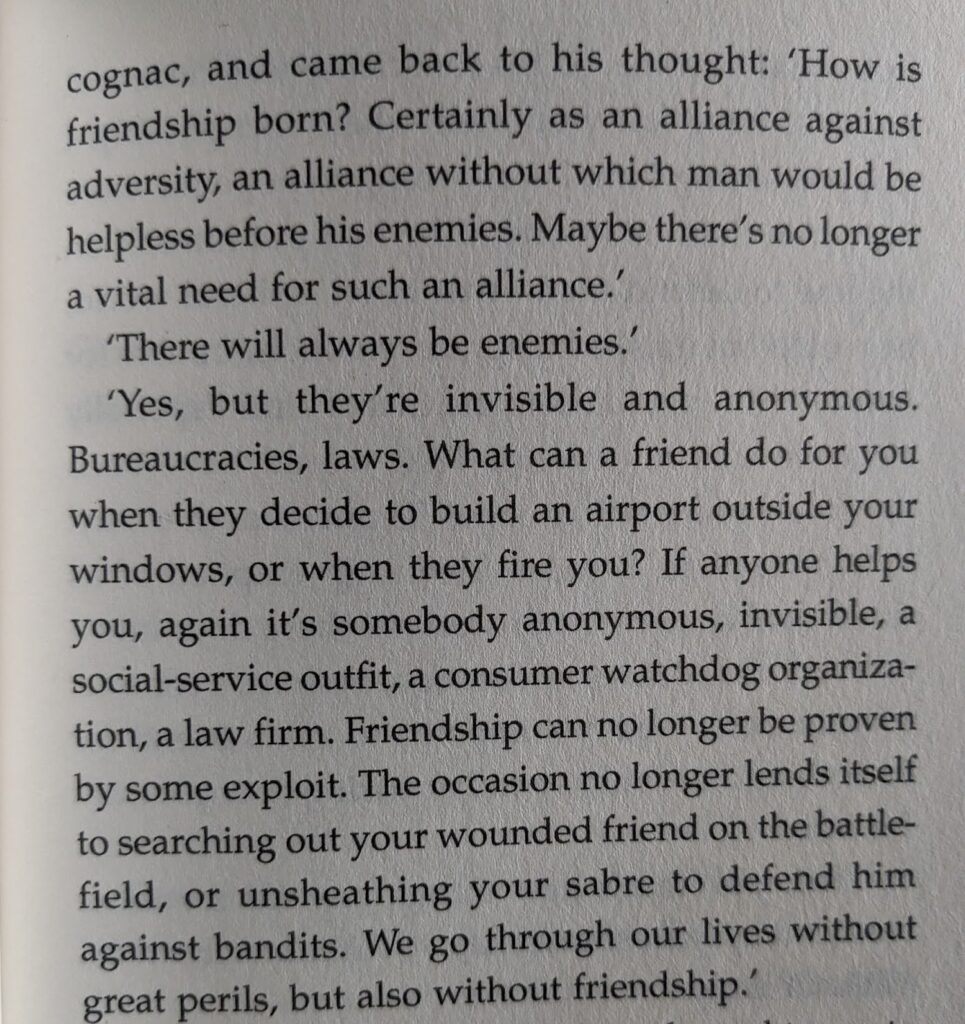
    I am also reminded of what else family and community can do when I read Milan Kundera’s brutal take (in Identity) on why friendship isn’t in vogue these days.

    Milan Kundera Friendship

    When I zoom out of my individualistic approach, I realise I had seen community the way it was meant to be. Life savings in cooperatives, because it’s a world in which everyone still knows everyone else or is just a degree of connection away. Local cable over OTT because births and deaths and important local news is covered in the former. It isn’t perfect, and I won’t romanticise it because I know I wouldn’t be able to tolerate the scrutiny beyond short bursts, but its manifestations are revelatory. As the insightful narrator in Gullak says, yeh trauma bhi hai aur therapy bhi. And I wonder what the proverbial middle path is.

  • The philosophy of Jubal Harshaw

    Robert A. Heinlein wrote Stranger in a Strange Land in 1961, and that’s where I met Jubal Harshaw, though he has apparently featured in other books by the author. He is described thus – “Jubal E. Harshaw, LL.B., M.D., Sc.D., bon vivant, gourmet, sybarite, popular author extraordinary, neo-pessimist philosopher, devout agnostic, professional clown, amateur subversive, and parasite by choice.

    Also, “Dr.Jubal Harshaw, professional clown, amateur subversive and parasite by choice, had an almost Martian attitude towards “hurry”. Being aware that he had but a short time to live and having neither Martian nor Kansan faith in immortality, he purposed to live each golden moment as eternity – without fear, without hope, with sybaritic gusto. To this end he required something larger than Diogenes’ tub but smaller than Kubla’s pleasure dome; his was a simple place, a few acres kept private with electrified fence, a house of fourteen rooms or so, with running secretaries and other modern conveniences. To support his austere nest and rabble staff he put forth minimum effort for maximum return because it was easier to be rich than poor – Harshaw wished to live in lazy luxury, doing what amused Harshaw.”

    Some reviewers consider him to be the author’s mouthpiece. Whatever that might be, and from the little I know of him, I have been impressed by Harshaw’s philosophy. My favourites below.

    1. “…most neuroses can be traced to the unhealthy habit of wallowing in the troubles of five billion strangers.”
    2. “I believe in everyone’s working out his own damnation but that is no excuse to give a dynamite cap to a baby”
    3. “Do-gooding is like treating haemophilia – the real cure is to let haemophiliacs bleed to death… before they breed more haemophiliacs.”
    4. “You go into a man’s house, you accept his household rules. That’s a universal rule of civilised behaviour.”
    5. “Love is that condition in which the happiness of another person is essential to your own.”

    It’s really heartening to see how a worldview can resonate after decades. From there flows the idea of focusing on things that do not change.

  • Slowly and then suddenly…

    …because we’d like to have the best physical abilities that any species has in terms of moving, seeing, hearing, strength etc. From the mind’s perspective, an organ that could upgrade itself to store more, to experience more, to work faster, to be more accurate. And it doesn’t stop there – reading others’ minds, telepathy…

    We will see the beginning of all this in our lifetime. The progress might be slow, so slow that perhaps later generations wouldn’t realise how we’d lived without most of the artificial things that they would be taking for granted. How would this affect the experiences of life that we go through now – joy, sorrow, pain, ecstasy, spirituality?  How long before what we call human would give way to a being that would probably exist forever, possibly without living? Will they even realise it when it happens?

    The man… the machine

    This is from my first post on what I called the augmented human, back in 2009. And I continue to ask myself what the man-made man will be like.

    (more…)