
Category: Society & Culture

  • Binary Code

    Facebook is in the process of updating its Newsfeed algo again so that we see more posts from friends and family, and less from ‘Pages’. Great news, except that when every person is media, and there is a limit to the pruning one can do, the feed will still consist of biases, prejudices, hoaxes, paid endorsements without disclosure, and yes, cat videos, Lincoln’s quotes on self driving cars, click bait and baby pics. My point above is less about filter failure and more about the continuing explosion of content and its distribution to set the context.

    But now let’s talk about filters. The sheer volume of content means that (in general) the reader will want quickly digestible information before he/she moves on to the highly entertaining video waiting in line. Absolutely connected to ‘the demise of the middle ground in the attention economy‘. The article talks about nuance in political debate getting lost, but I think its reach extends beyond that. As this fantastic Guardian article “How technology disrupted the truth” states, “..everyone has their own facts“. But why do this happen? (more…)
  • Prosperity’s moral code

    A few months ago, TechCrunch had a post debating the role of capitalism in a world that includes AI, where jobs are disappearing at a rate faster than new jobs coming in.  Capitalism has always been played as a finite game, focused on profit for a set of people, largely irrespective of the costs to others or society at large. As I wrote in “A shift in the world order“, its only real foe in the recent past has been the nation state, and its executive arm – the government. A foe increasingly struggling to even defend its own relevance, I’d say. As the dominant system of the world, we will then automatically (whether rightfully, is debatable) begin questioning capitalism’s morality codes. More than what we are doing currently, because the impact will not just be higher, it will also start affecting more people.

    Earlier this year, I had written on how if it intends to survive, capitalism needs to expand its scope, and play an infinite game – whose purpose is to continue the flow of the game, and bring in new players. Something similar to what Douglas Rushkoff calls digital distributism (read) a model that aims for the circulation of money rather than the extraction of money. An evolution that capitalism needs to go through, or it runs the risk of imploding. This, of course, is not really in line with the way an earlier generation of corporations, or Silicon Valley operates.  As Maciej Cegłowski writes in “The Moral Economy of Tech“, treating the world as a software project gives us a rationale for being selfish. We pretend that by maximizing our convenience and productivity, we’re hastening the day when we finally make life better for all those other people. (more…)

  • Informed Renunciation

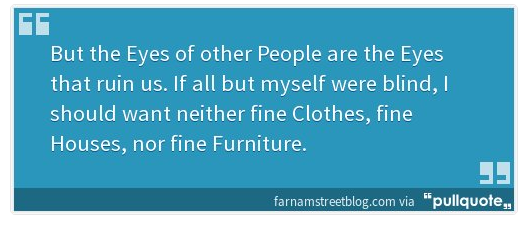
    Around me, I see a few people who seem to have stayed put at a certain point in time in terms of their lifestyle – the clothes they wear, the homes they live in, the gadgets and vehicles they use, the content they consume, and so on. In many cases, I have attributed it to age. Maybe they just couldn’t perceive the incremental enjoyment that the new thing offered, or maybe priorities changed – either in terms of economics or interest. But there are also relatively younger folks who eschew a lot of things I might consider a need. In both cases, I wonder whether it is a conscious choice/ trade off, or something that just slipped in unobtrusively until it became a way of life, or something that circumstances forced.

    Untitled

    (Ben Frankin, via) (more…)

  • The divide and the rules

    It has been just over a year since I wrote “A responsible meritocracy“. My view was that meritocracy had indeed played a huge role in dislodging systemic inequalities (e.g. ethnicity, religion, even economic background) but not only is it not an ideal system, it is now widening the gulf between the haves and have-nots, and even creating entry barriers to prosperity. To use an adage from pop culture, it’s a hero which has lived long enough to see itself become a villain. Arguable, yes.

    Every system is bound to create two sets of people – those who benefit from it, and those who do not. I’d rate the success of a system on two counts – the ability of its beneficiaries to see the other side, and what they do about it.  The merit in a meritocracy is accrued courtesy intelligence/smartness. Intelligence is a means to creating the universally acknowledged currency – money. In that respect, I’d say that Silicon Valley has been a big beneficiary, and probably the most visible. (more…)

  • Life menus

    In last week’s post, I had referred to this excellent post – “How Technology Hijacks People’s Minds…” in the context of Google/Facebook/Amazon. As I had mentioned, I liked it because it had a direct connection with the can-want-need framework I (try to) use in my personal consumption. Specifically, his first point on the ‘menu’ and the illusion of choice. To quote from the post,

    When people are given a menu of choices, they rarely ask:

    • “what’s not on the menu?”
    • “why am I being given these options and not others?”
    • “do I know the menu provider’s goals?”
    • “is this menu empowering for my original need, or are the choices actually a distraction?” (e.g. an overwhelmingly array of toothpastes)

    (more…)