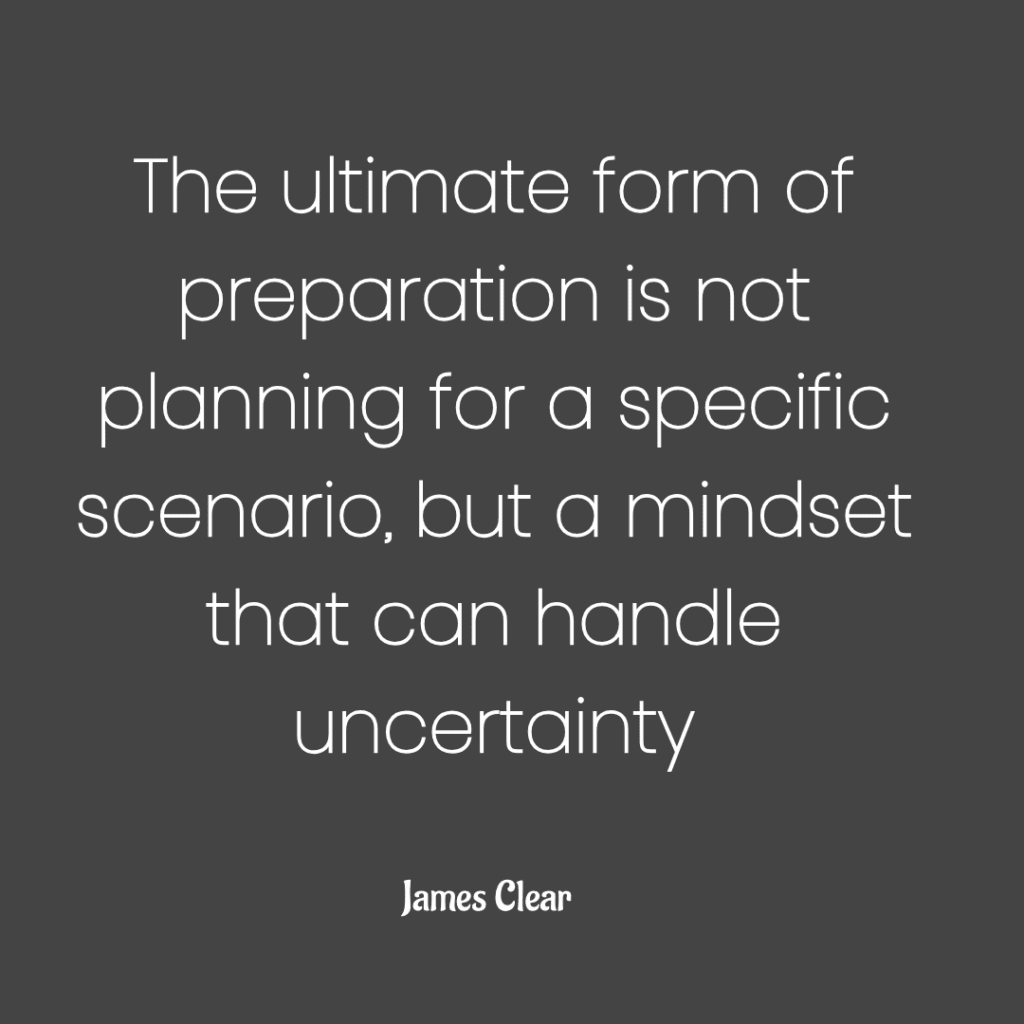
I chose pre-tirement a year and a half ago, in my mid-40s. Yep, it’s a thing – the space between full-time work and retirement – a reduced workload in return for $ that meet my needs and some wants. Monika Halan’s recent column reminded me of the real question I grappled with: “Will I outlive my money or will my money outlive me?”
I agree with her take on the learn-earn-burn model and sketchy finfluencers, but I don’t think the classic career peak-in-your-50s idea will last. Here’s why.
1. Short-termism is now baked into most companies. Layoffs, shrinking business cycles, and the fast pace of disruption mean you’re constantly solving new problems with new tools. That’s largely fluid intelligence, which peaks around 40. Until now, we’ve extended careers beyond 40 largely with crystallised intelligence (experience, wisdom), but AI is catching up with both. Soon, someone younger, faster, and AI-enabled might do the same work cheaper.
2. That also means even a decade-long career may be a stretch. Once humans turn knowledge into rules, rules become algorithms, automation happens and jobs disappear. Damn AI learns!
3. This shift is especially brutal for Gen X and Millennials who weren’t prepared for it. Add subpar savings, unhealthy lifestyles, and rising stress, and mental and physical health issues are inevitable. And no, companies won’t support you.
Since I’m aged enough to offer unsolicited advice: if you’re in your 30s/40s, aim for pre-tirement by 50. Think of it as a Pascal’s wager. Better to have financial freedom so you can grow on your terms, and are not forced to make money-driven choices.
The path? Good old compounding – of intelligence, wealth, health, and relationships.
1. Stay curious. Keep learning. Solve new problems to keep your mind sharp.
2. Spend and invest consciously. Don’t finance today’s wants at the cost of tomorrow’s needs.
3. Stay healthy, not just fit – body and mind. Saves you meds money and lets you enjoy your freedom.
4. Find people in whose company you can be yourself. It aids the above three too.
In the near and mid-term, AI’s quick evolution will question not just work’s efficacy as an income provider, but also its ability to deliver a sense of purpose. On an existential scale, I think the second will cause more damage.
Category: Self
-
In considerate mode
Delivery guys riding on the wrong side of the road, kids behind you kicking your seat on a flight, speaking on the phone loudly in a public space – these are a few of my favourite peeves. I am sure you have yours too. That’s why this post on LinkedIn caught my attention – “things pissing me off” in situations where people aren’t following rules is something I could relate to.
Barring a few exceptions where I am absolutely not able to tolerate what I believe is ‘inconsiderate behaviour’, I don’t engage. But engage or not, these instances also reveal my snap judgements. e.g. what an inconsiderate idiot, speaking loudly during a movie. I judge myself the most, but also try to intellectually understand my motivations.
That’s why I found this particular episode of The Knowledge Project – in which Shane Parrish speaks to Todd Herman – fascinating. Around the 49th min mark, Shane asks Todd if he has a hard time relating to average people, people who just didn’t want to be the best at what they do. I could relate to it in my professional context – another pet peeve. Todd admits how despite having matured, he still has to watch out as his ego still tries to stack them as ‘average’. Todd explains that he does this because he over-indexes what he personally finds important. e.g. a career-driven person might judge someone who prioritises being a parent.
I battle my own bugbears – punctuality, work ethic, grammar and spelling errors etc. That image below is my team taking revenge on my birthday cake. Cheapos! 😂
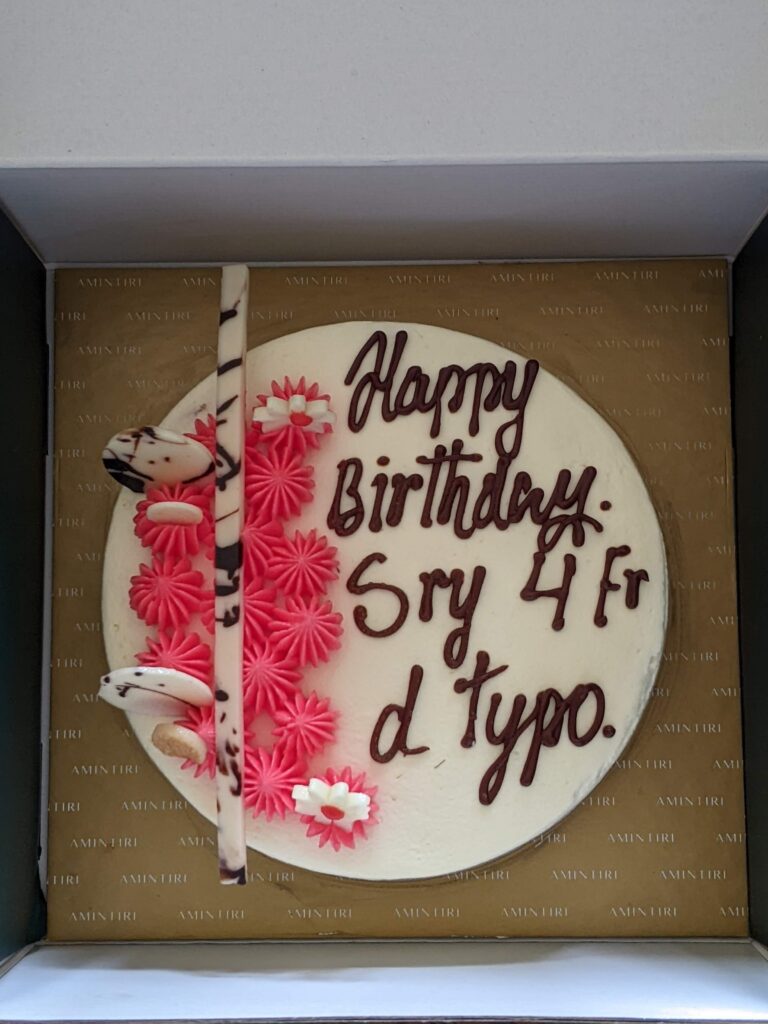
The point is that others are not average/ inconsiderate people, they are at best average/inconsiderate in the thing I am over-indexing for! There are many contexts and reasons why they don’t behave in a way I think they should . As I commented on LinkedIn, I have realised that being able to afford consideration (or applying oneself) is a privilege.
But that was level 1. When I dug deeper, I saw my real problem. When that ‘idiot’ is not following my worldview (‘ideology’) – whether it is ‘considerate behaviour’ or being conscious of spelling mistakes – it raises (in my own mind) doubts on the objective correctness of my ‘ideology’. Will Storr has a brilliant insight – “for humans, ideology is territory”. We fight for ideas like animals fight for land.
At this point, we have evolved to an extent where we hold hundreds of “shoulds” and “shouldn’ts” in our heads. And we expect the world to comply – from nationalism to having pets/kids to the usage of the Oxford comma and so on. Any deviation from our ‘ideology’ is treated as a judgement against us. No wonder every interaction has the potential for conflict. We are defenders of our own little faiths that make up our identity. What we could practice, when we have the privilege, is to step back and think about the little judgements we make, in work and life scenarios, and then react with empathy, because it is not a personal attack.
There have been many posts on this blog about morality, and recently, I found two quotes that connect it to judgement and empathy.
“The drug of morality poisons empathy” ~ Will Storr (again)
“Compassion is the basis of morality.” ~ Arthur SchopenhauerI found these to be an educative lesson on how I look at my subjective morality, and how I behave with others in real life.
-
Unidentity-fying
A theme has been emerging, even more stronger since I wrote “Living a life of Intentionality“. Pithily summarised as “At this age, I prefer an identity that provides the least friction and regrets in the life I want to lead.” How do I get there? A key factor I identified for myself is acknowledging the difference between my wants and likes, and deeply questioning my wants. Where does that get me? From that post, Intentionality helps you have your needs and considered likes as anchors. When that happens, a whole lot of clarity emerges – what you spend time and money on, people whom you will go overboard for, how you plan your days, weeks and months, and what can get you out of those lil twinges of envy and seemingly deep pools of a mid-life crisis.
But while I was trying to get there, I encountered a strong opponent – myself, or rather, my identity. I first brought it up in Marshmellowing. The key point in the first was how in my approach to getting what I needed/wanted, my larger desire for ‘freedom’ led me to optimising for optionality – a huge bias for scenario planning. I think the identity I created thanks to this is aptly called the Marshmallow mind (by Frederik Gieschen), and its best expression is a poem I read in Poor Charlie’s Almanack: The Wit and Wisdom of Charles T. Munger, attributed to A.E. Housman
The thoughts of others
Were light and fleeting,
Of lovers’ meeting
Or luck or fame.
Mine were of trouble,
And mine were steady;
So I was ready
When trouble came.
In Marshmellowing – The Prequel, I wrote about my path to this identity/self image from childhood. A great description of it appears in Robert M. Sapolsky’s Why Zebras Don’t Get Ulcers. In the personality section, Sapolsky practically described my (former) Type A personality down to a behavioural “time-pressuredness” (research by Meyer Friedman and colleagues), default hostility, and a persistent sense of insecurity, the last being a predictor of cardiovascular problems. Add to it disciplined, discomfort with ambiguity, and (formerly) repressive in terms of emotional expression, and you have my profile! Damn!
My self image, and increasingly my identity was the kind of person who thought in a certain way and behaved in a certain way. While its origins was my ‘responsible child’ identity that possibly repressed my freedom of emotional expression in favour of (parental) attachment, in adulthood, it transformed into a “responsible adult” self image that ironically optimised for freedom and optionality, and underplayed the need for attachment. It became an identity, and many of my decisions were biased in that direction.
It is only in the very recent past – through reading and reflection, that I have begun to be at least a little fine with unplanned-ness. As I wrote on LinkedIn, the universe’s tendency is randomness! An excellent read in a different context was The Tao of Physics. I realised that In both quantum field theory and eastern philosophies, physical phenomena (including us) are mere transient occurrences in an underlying entity. How humbling that is!
I think I have made progress by moving from fixed goals through fixed strategies to fixed goals through flexible strategies. I hope, after we are confident of financial freedom, that I can move to flexible goals and flexible strategies. Meanwhile, the biggest task in all this is the mindset. Mindset made the identity, and now it has to dismantle it. Erich Fromm wrote this a long time ago – “Life, in its mental and spiritual aspects, is by necessity insecure and uncertain…The psychic task which a person can and must set for himself, is not to feel secure, but to be able to tolerate insecurity without panic and undue fear“. Decades later, we have a pithier version.

-
Marshmellowing – The Prequel
In Marshmellowing, I wrote about how a life spent optimising for predictability (or at least optionality) is probably what is keeping me from the life I want to live. And the person I want to be.
At a proximal level, I understand why I am the way I am. The marshmallow mind (delayed gratification) is not only a muscle that automatically plans for the future, but is also the custodian of a self image it created. But I am still figuring out why it came to be that way. What is that self image in this context? And how did it get created?
A bunch of my reading, listening, and reflecting in the last couple of years has been to understand why I am the way I am – at macro and individual levels. At the macro level, I have been able to synthesise a bit, this post is an attempt to track the evolution of my self image.
In one of my favourite podcasts – Dr. Gabor Maté on the Tim Ferriss Show, the former mentions how outside of physical needs, the two other critical needs humans have is attachment and authenticity. We need attachment because without the care of parents or vice versa we would die. Back in the savannah, we had to go by gut feel because there was no social learning mechanism. We therefore needed authenticity – connection to the self. He then shares a fantastic insight on how our authenticity gets suppressed right from childhood, with a great example.
When I look back, I can see at least four elements that make up my current self. As a marketer, I have to alliterate. So here goes.
Responsibility
I don’t remember that far back, but my 10 year old self has a version of what Dr. Maté was referring to. Some of my earliest memories are about studying hard. If I did that, mom wouldn’t be angry and I would be spared a beating. She was driven by the fact that she didn’t have much time (she was diagnosed with leukaemia around the time I turned 10). At school too, being a good student meant the admiration of peers and the affection of teachers. I gradually built a self image of a responsible person. From an authenticity perspective, I was probably more creatively inclined, and terribly shy. But between my academics, music and things like quizzing, I was thrust into some level of limelight at my first school.
Rebellion
Somewhere in my teens, and it is no coincidence that it was around the time of mom’s passing, I developed quite a sense of humour. Maybe it began as a coping mechanism, but soon after, its underlying theme was a rebellion against any perceived injustice and authority. I think that is my authentic self, and it drew people to me. It does now too. Everyone likes someone who takes a stance and in the process, make them laugh. But back then, it wasn’t enough to dislodge the lesson that being responsible was what helped attachment. I need to be grateful that my authentic creative self found outlets and kept itself alive.
Relationships
While I was in engineering college, my grandmother, who was probably the most influential person in my life and someone I deeply loved, left our home to live with my uncle. A few years later, after engineering, I ended up having to figure out my own higher education because there was no one who gave me perspective. Maybe I could have asked. But these experiences led me to a mindset that relationships as a means to attachment was a dead-end. This got accentuated when D and I arranged our own marriage. When I look back, my dad and D’s parents were gracious in their acceptance. But a mindset had been created. Attachment would come with success, and that would come from taking responsibility of my own life. It is ironic that the responsibleness that was originally meant for attachment then moved me away from people.
Relevance
Relevance as a means to advance the career, and make some money. I am thankful that another facet of my authentic self – curiosity (reading, figuring out)- played its part, though not by active design. Between this, my sense of responsibility (at work), and the sense of humour that is sometimes weaponised as sarcasm, I got myself a sufficiently differentiated personality to reasonably succeed in my career. Relevance continues to be a way of making sure I am employed in some form and my FU Money target is met sooner than later.
And that sums me up, or at least the self image. Now, we are a year or two from our FU Money, and I can still crack a joke. What is the problem?
There are three, actually. My marshmallow mind is the result of ‘responsibility’ winning. It comes with costs. The marshmallow mind continues to plan the future and make predictions. In this other phenomenally good podcast on Hidden Brain, Lisa Feldman Barrett talks about how the brain can get trapped in its own predictions. When the predictions don’t work out, the result is stress.
As she elaborates, it operates at a different level too. The brain is an energy budgeting machine optimised for survival and reproduction. Apparently, the suppression of authentic emotions can potentially result in chronic stress, contributing to a bankrupt body budget. Over time, this could predispose individuals to depression, as the brain repeatedly predicts and conserves energy to cope with unresolved internal conflicts. Feldman Barrett describes depression as a state where the brain, faced with chronic energy deficits, prioritises conserving resources. This manifests as fatigue, lack of motivation, and inability to update predictions or engage with the environment. Exactly what I want to avoid.
And finally, it doesn’t help when predictability becomes the objective in all situations across life. It perpetuates a stress response even in non-threatening situations. Relationships are frowned upon by my predictive mind because humans increase complexity and reduce the accuracy of predictions. The loss of relationships is also a suppression of authenticity, because relationships are the biggest component of who I want to be.
And that’s why all my efforts now are to regulate my marshmallow mind!
-
Marshmellowing
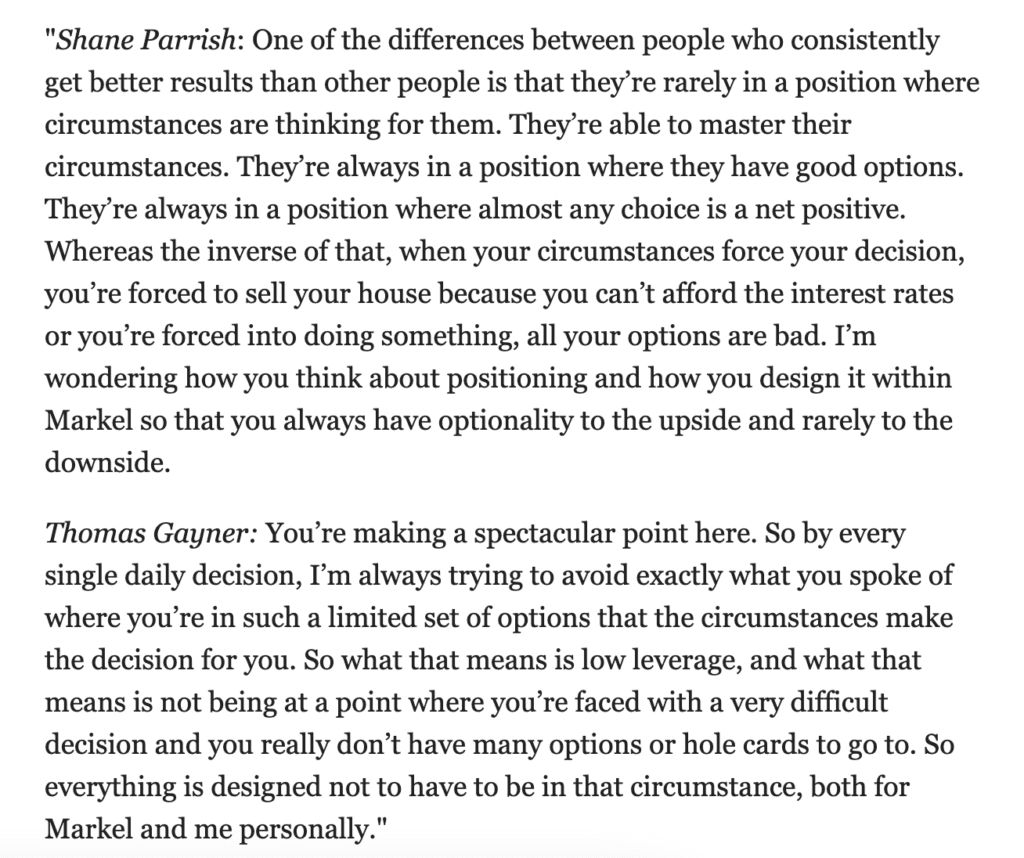
“When the student is ready, the teacher will appear.” That played out well in this context. I remember seeing this (image below) in a Farnam Street newsletter a while back and it validated something I had been doing for a while. In any situation, can I place myself such that circumstance/environment doesn’t cause a decision I’ll regret? Because, to quote from Ozark, “People make choices. Choices have consequences.”
Optimising for this is the reason behind almost everything I had built as a muscle – planning, granular detailing, specific scenario planning, constantly aiming for predictability (or at least optionality), the people I let in and how much, and deliberation on what I do. And that mindset, I told D recently, is probably coming in the way of the life I want to lead.
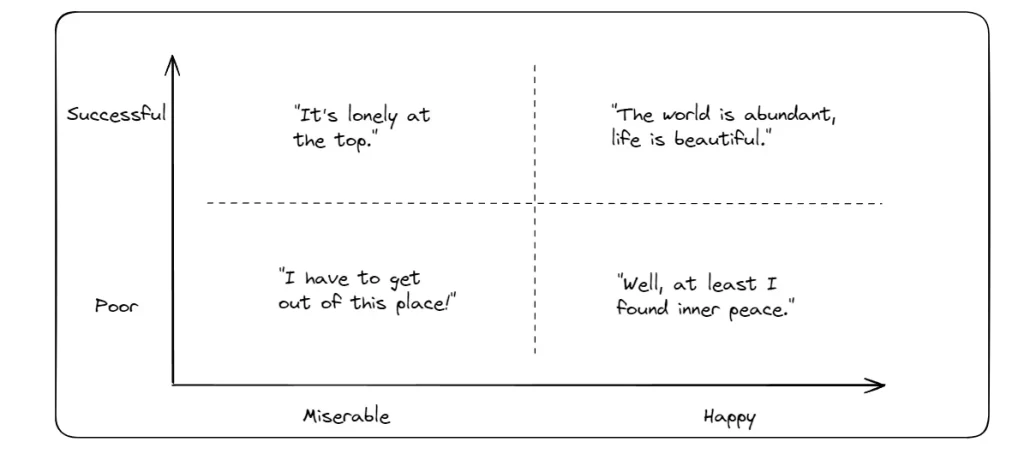
A little more of context setting before we address that. This is where the master appears – in the form of this post. If we go by the image below (from the post), I am successful and on that line dividing miserable and happy. Just to clarify, there is no ‘reaching the top’ in my case. I define (my) success as being able to say ‘I have enough’ on wealth, health and relationships, and can still retain my curiosity.
At this point, I have the Marshmallow mind (context), and the post accurately describes my conundrum.
So you do the work. You sacrifice. And because you’re sacrificing while others are out having fun, success becomes more and more important to your identity. You slowly forge the chains that can keep you up there, in that top left quadrant, in which you thought only other people could get stuck. But that pivot to living a fulfilled life doesn’t happen. Marshmallow Mind has become too powerful. And Marshmallow Mind lives in the future...Marshmallow Mind tricks us into believing that the rewards for delayed gratification compound forever. They don’t. Eventually, they turn into a trap whose escape requires a radical break with our old identity. As Buffett put it, “the chains of habit are too light to be felt until they are too heavy to be broken.”
The Marshmallow mindset affects the way I react to things, because the muscles are a habit now. And layered on that is a self image. It’s time for some mellowing. As Tim Ferriss says in this phenomenally good conversation with Gabor Mate, sometimes, you need life to save you from what you want to give you what you need. I think life has done its bit in terms of multiple kinds of losses, gains, and lessons.
But the challenge is that my system will resist the learning! More about that in another post, citing another fantastic podcast. For now, the plan is something that I heard in that podcast, where the guest’s daughter’s karate teacher says, “Get your butterflies in flying formation”, because what I seek is “the rapture of being alive“.
P.S. Seems I caught this a couple of years ago, I now need to take some concrete actions 🙂