Category: Self

  • Marshmellowing

    “When the student is ready, the teacher will appear.” That played out well in this context. I remember seeing this (image below) in a Farnam Street newsletter a while back and it validated something I had been doing for a while. In any situation, can I place myself such that circumstance/environment doesn’t cause a decision I’ll regret? Because, to quote from Ozark, “People make choices. Choices have consequences.

    Optionality

    Optimising for this is the reason behind almost everything I had built as a muscle – planning, granular detailing, specific scenario planning, constantly aiming for predictability (or at least optionality), the people I let in and how much, and deliberation on what I do. And that mindset, I told D recently, is probably coming in the way of the life I want to lead.

    A little more of context setting before we address that. This is where the master appears – in the form of this post. If we go by the image below (from the post), I am successful and on that line dividing miserable and happy. Just to clarify, there is no ‘reaching the top’ in my case. I define (my) success as being able to say ‘I have enough’ on wealth, health and relationships, and can still retain my curiosity.
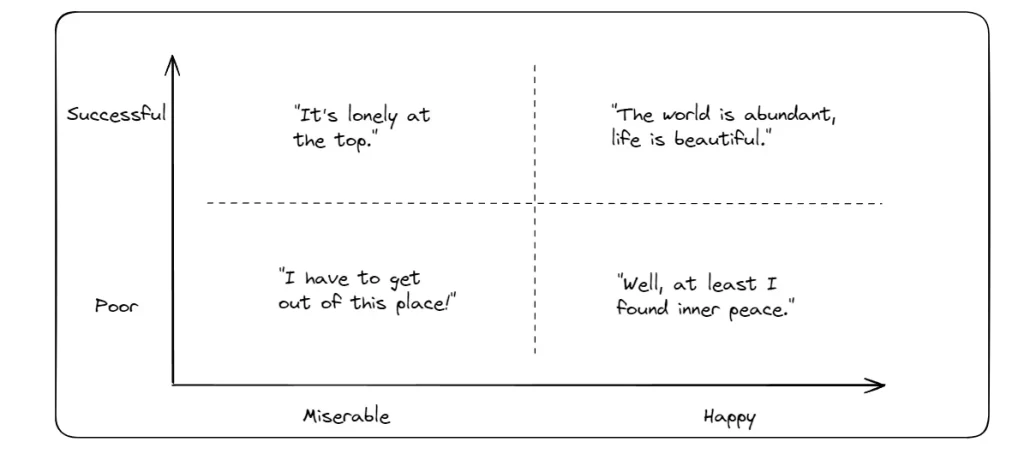
    Successful-Happy

    At this point, I have the Marshmallow mind (context), and the post accurately describes my conundrum.

    So you do the work. You sacrifice. And because you’re sacrificing while others are out having fun, success becomes more and more important to your identity. You slowly forge the chains that can keep you up there, in that top left quadrant, in which you thought only other people could get stuck. But that pivot to living a fulfilled life doesn’t happen. Marshmallow Mind has become too powerful. And Marshmallow Mind lives in the future...Marshmallow Mind tricks us into believing that the rewards for delayed gratification compound forever. They don’t. Eventually, they turn into a trap whose escape requires a radical break with our old identity. As Buffett put it, “the chains of habit are too light to be felt until they are too heavy to be broken.”

    The Marshmallow mindset affects the way I react to things, because the muscles are a habit now. And layered on that is a self image. It’s time for some mellowing. As Tim Ferriss says in this phenomenally good conversation with Gabor Mate, sometimes, you need life to save you from what you want to give you what you need. I think life has done its bit in terms of multiple kinds of losses, gains, and lessons.

    But the challenge is that my system will resist the learning! More about that in another post, citing another fantastic podcast. For now, the plan is something that I heard in that podcast, where the guest’s daughter’s karate teacher says, “Get your butterflies in flying formation”, because what I seek is “the rapture of being alive“.

    P.S. Seems I caught this a couple of years ago, I now need to take some concrete actions 🙂

  • Schooled for life

    One of the things I spend a lot of time reflecting on is my own OS or wiring, and its updates. In a recent conversation with D, courtesy a college reunion (25 years!) I realised that I have very, very few friends from school and college whom I stay in touch with. Why was that, I wondered.

    I don’t have many memories of my first school – Std 1 and 2. I remember the uniform vividly, and the prizes I won. I have forgotten what they were for though. I have a flood of memories about my second school – Std 3 to 7. Probably because I think they were my best days. I was almost always ranked first in class, I sang, recited poetry, was part of the quiz team, and even played hockey! What I remember most was how accommodating the teachers were when I had to miss classes for practice and competitions. Many of them actively encouraged me to pursue the things I showed some interest and talent in.

    And it went beyond that. There was something in the people I knew then. I remember how once, there was some competition in a different school, and G, my classmate and biggest competitor for the first rank in class, hadn’t advanced to the final round and yet stayed back so she could drop me at home. I shifted schools after 7th because we were moving to a different part of town. Immediately after my exams, I also had a minor surgery. R, my Hindi teacher, visited me in the hospital with her husband. What I remember most, thus, is the kindness.

    I have to admit that I don’t think I repaid it much. After I had shifted schools, I participated in some competition, now representing my new school. My old teachers were there too, and being the uber shy idiot I am, I didn’t even acknowledge them. How bad they must have felt!

    I didn’t like my new school at all. Somehow I just didn’t fit in. They prioritised academics at the cost of everything else, and there was very little space for the other things I enjoyed. While I made a few friends, the camaraderie I had in my other school just wasn’t there. On hindsight, maybe mom’s illness was also playing on my mind.

    I think it also had to do with the kind of neighbourhoods I lived in. Before we shifted, we lived in a university campus. Largely egalitarian – people working in the same place, living in similar quarters, earning within the same range, enjoying the same facilities and so on. When we moved to the city, the house itself was one of the smallest in the street, though I don’t think I paid it that much attention. The inequalities in general were bigger, something that reflected in the kids at school too. The in-groups were stronger, and I feel it to this day in WhatsApp groups.

    It wasn’t that there weren’t kind people there – I remember how M consoled me for hours after mom passed away. I went to ridiculous movies with R,A and S. I had a good friend V, who had a terrible accident and was in pain for months. I used to visit him in the hospital and his relatives used to make me sing. Yes, facepalm. I used to guiltily look at V even as I sang. At reunions (which I mostly avoid) and in the WhatsApp group, I see a totally different person. Someone I cannot relate to at all. Maybe his wiring changed after that accident, and the mental and physical anguish it caused. The change in me after 10th was quite drastic. Mom’s death pretty much unleashed a wicked sense of humour, which was my armour until recently.

    I think, after her death, and later, when my grandmother moved to my uncle’s place during my engineering days, my subconscious probably decided that relationships had a shelf life. That friends were that, only in a certain context. When it came down to it, I was the only person I could depend on. It took D and most of my life to get over that.

    Then again, as the joke goes

    Jesus miracle friends
  • Living a life of intentionality

    Context Setting

    Man can do what he wills but he cannot will what he wills.

    Arthur Schopenhauer

    Intelligent people know how to get what they want. Wise people know what’s worth wanting.

    Shane Parrish

    My typical simplistic approach to problem solving is why, what, and how. So here we go:

    (more…)
  • The philosophy of Jubal Harshaw

    Robert A. Heinlein wrote Stranger in a Strange Land in 1961, and that’s where I met Jubal Harshaw, though he has apparently featured in other books by the author. He is described thus – “Jubal E. Harshaw, LL.B., M.D., Sc.D., bon vivant, gourmet, sybarite, popular author extraordinary, neo-pessimist philosopher, devout agnostic, professional clown, amateur subversive, and parasite by choice.

    Also, “Dr.Jubal Harshaw, professional clown, amateur subversive and parasite by choice, had an almost Martian attitude towards “hurry”. Being aware that he had but a short time to live and having neither Martian nor Kansan faith in immortality, he purposed to live each golden moment as eternity – without fear, without hope, with sybaritic gusto. To this end he required something larger than Diogenes’ tub but smaller than Kubla’s pleasure dome; his was a simple place, a few acres kept private with electrified fence, a house of fourteen rooms or so, with running secretaries and other modern conveniences. To support his austere nest and rabble staff he put forth minimum effort for maximum return because it was easier to be rich than poor – Harshaw wished to live in lazy luxury, doing what amused Harshaw.”

    Some reviewers consider him to be the author’s mouthpiece. Whatever that might be, and from the little I know of him, I have been impressed by Harshaw’s philosophy. My favourites below.

    1. “…most neuroses can be traced to the unhealthy habit of wallowing in the troubles of five billion strangers.”
    2. “I believe in everyone’s working out his own damnation but that is no excuse to give a dynamite cap to a baby”
    3. “Do-gooding is like treating haemophilia – the real cure is to let haemophiliacs bleed to death… before they breed more haemophiliacs.”
    4. “You go into a man’s house, you accept his household rules. That’s a universal rule of civilised behaviour.”
    5. “Love is that condition in which the happiness of another person is essential to your own.”

    It’s really heartening to see how a worldview can resonate after decades. From there flows the idea of focusing on things that do not change.

  • I am the absolute

    The translation of Ahaṁ Brahmāsmi. Don’t worry, it isn’t my ego talking.

    I was reminded of this thanks to this fantastic episode on Lex Fridman’s podcast – with Joscha Bach.

    I remember it was a while back when I first heard the postulation that Adam & Eve hurriedly covering themselves after eating the apple was an allegory for humans first developing consciousness about themselves. Joscha extends this and talks about how the Bible, specifically Genesis 1, has sections on the mind systematically creating a a game design that helps interact with the world. In his own words,

    where it’s being described that this creative spirit is hovering over the substrate and then is creating a boundary between the world model and sphere of ideas, earth and heaven, as they’re being described there, and then it’s creating contrast and then dimensions and then space, and then it creates organic shapes and solids and liquids and builds a world from them and creates plants and animals, give them all their names. And once that’s done, it creates another spirit in its own image, but it creates it as men and women, as something that thinks of itself as a human being and puts it into this world. And the Christians mistranslate this, I suspect, when they say this is the description of the creation of the physical universe by a supernatural being. I think this is literally a description of how in every mind a universe is being created as some kind of game engine by a creative spirit, our first consciousness that emerges in our mind even before we are born and that creates the interaction between organism and world. And once that is built and trained, the personal self is being created and we only remember being the personal self, we no longer remember how we created the game engine.

    This is basically the development of consciousness. And we cannot remember the time we made it. The game engine is the universe we keep building until we are no longer around.

    And the Bible is not alone in this. Remember Samudra Manthan from Hindu mythology, it is full of symbolism. An individual in this world seeking immortality. Transcendence. The mountain Mandara represents the human mind and the manthan is its churning in the vast collective consciousness. The devas and asuras obviously are the positive and negative influences. Vishnu’s koorma avatar (turtle) which stabilises the mountain during the churn point to how we should try to focus our mind. (on God, but I will abstain from that part :D)

    Halahala, the emergent poison that Shiva swallows (earning him the name Nilkanth) shows how we must confront our inner demons . From Kamadhenu to Airavata to Kalpavriksha, there are all sorts of distractions that are possible. Dhanvantari appearing with the amrit symbolises the importance of health. The amrit is what allows you to merge with the collective consciousness and thereby in a sense become immortal.

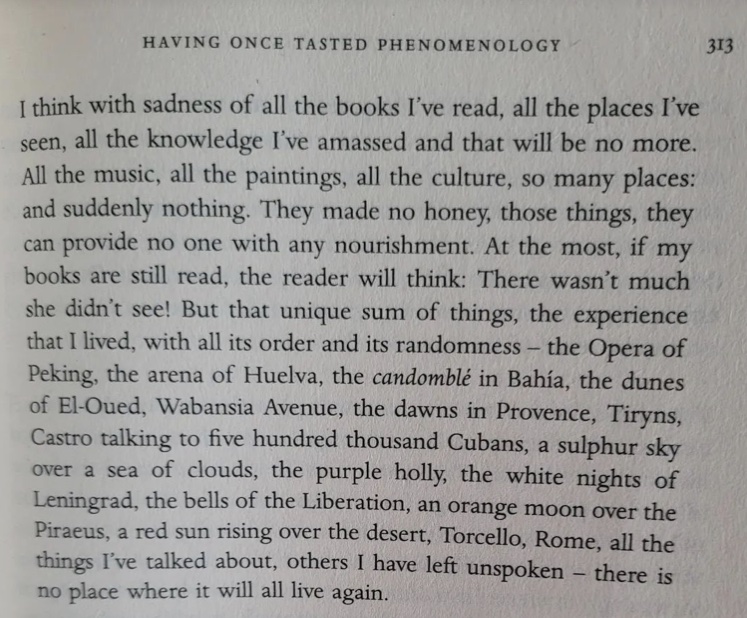
    Ok, snap. I don’t think I will get there. In The Flavours of Death, I had posted an excerpt from Simone de Beauvoir’s The Coming of Age

    Simone de Beauvoir Death The Coming of Age

    …’there is no place where it will all live again’. And that’s just it. Outside of photos, notes like these or maybe conversations with friends, the universe that was created in my mind will no longer exist when I die. It dies with me. And thus Ahaṁ Brahmāsmi. The universe that I made with all its affections and peeves and desires and animosities and fears and longings and expectations, disappears when I take my final breath. I will not be around in the aftermath to feel that sadness, but I am here now, and I do feel the twinge.

    Aham bummed asmi ? #okbye