Category: Self

  • A picture to go with me

    Something in Mishi Saran’s ‘The Other Side of Light’ made me think of a visual that would accompany me on the final journey. I’m not really a painting kind of person, so it’d probably be a photograph.

    A photograph that captured my life in one still moment, or my soul itself. Something that was much more than a thousand words. Something that only I understood and could connect with, so its existence beyond my own would be meaningless.

    For now, I don’t think I have a photograph like that. Or perhaps each photo, when I look back at it, is as much the deserving one as another. Each one, a different me, real and alive at that point in time, reduced to memory soon as it is captured.

    until next time, transience

  • Posture child

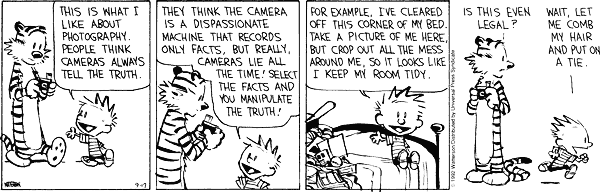
    I guess that’s the reason why Calvin & Hobbes is so utterly loved by so many folks. Profound, timeless, universal truths expressed in such a unique way!

    I had never seen this one until recently. Why blame Instagram for filters? They existed long before anyway 🙂 I thought this strip found great application in all kinds of posturing from time immemorial, and especially so now – in the social media context, when everyone is a publisher. Over a period of time, I wonder how fast we would forget who we really are (if ever we come to know it or knew it) It would probably be irrelevant in the real-time era. We would be the statuses and photos and everything else we like and share every minute. After all, I’m no longer the person who wrote it anyway, and who’s to say the non posturing self is the real deal?

    until next time, impostor 🙂

  • A larger plan

    Most of everyone who knows me would agree that I am a compulsive planner. This habit has been reinforced on several occasions when I have been better prepared than others in situations. However, I also believe that it is quite a trade-off – between the safety of knowing in advance what to expect and the thrill and joy of leaving oneself open to an experience. The middle path is quite difficult to achieve in this case.

    That was why I was very intrigued by the phrase – Negative Capabilitythe willingness to embrace uncertainty, live with mystery, and make peace with ambiguity. From experience, it is forced upon us too. The best laid plans can go awry often because even the best of minds cannot sometimes envision every possible scenario. That’s not the only time I have been humbled by the limitations of the human mind. From something as simple as understanding what’s really going on in another person’s mind (not to mention my own understanding of my mind) even as they tell you things to larger questions on purpose and destiny, we’d be fools to think that we can know the mechanism of everything around us.

    But as humanity progresses, is there a tendency to convert everything to science, or a skill/process that anyone so inclined can master? As we discover more, I wonder if there is a collective ego that develops and one that says we can understand and control everything around us. As a race, are we becoming increasingly intolerant towards uncertainty?

    But as this post says, the idea that the current version of our mind is only one step in evolution is very compelling. I wonder if, by increasingly closing our mind to uncertainty, we are moving in a direction opposite the one that will help us solve the greatest puzzle of it all – why are we here?

    until next time, what’s your plan?

  • Plan C

    This post has been pending for a while, the date of publishing of the article that inspired the post is evidence enough. It is about people who leave their jobs to follow their passion, but instead of the success stories we are used to, it focuses on the difficulties on that path. Even if you’ve not taken that path already, it’s quite possible that you have contemplated it. It’s romantic – the freedom, being your own boss and doing the thing you like – Plan B. But it’s not easy, and it begins as early as even identifying one’s passion. (must read)

    Interestingly, NYT themselves had an article almost a year later that asked “What Work is Really For” and answered that with an Aristotle quote “we work to have leisure, on which happiness depends.” Though I didn’t know about this quote until recently, this is a perspective that I have often used to debate with people who say those who do not like their jobs should quit. There are many reasons why people don’t, and one of them is consciously making a choice to work (possibly on things they don’t enjoy) for the 2 days (and vacations) when they are able to spend their resources – money, effort and time – on things they enjoy.

    The reasons people don’t scale up those 2 days could be many, including the difficulties involved in the early stages of setting up, and then maintaining a positive balance – of money and life. Money is after all an essential resource. It buys things, it opens doors. But when your passion becomes your work and your principal source of money, does it feel the same? Or does it become a job?

    I liked the second NYT article also for its last 3 paragraphs. It addresses the money conundrum. It talks about how right from when we are born, we are taught to be consumers, thanks to capitalism, which though calls itself an open market where we have the freedom to buy is actually a system unto itself.  The choices are not really independent. It points out that education should be meant to make us self determining agents. True freedom requires that we take part in the market as fully formed agents, with life goals determined not by advertising campaigns but by our own experience of and reflection on the various possibilities of human fulfillment. But that’s not an easy path either. It calls for independent thinking and a subjective view of fulfillment and happiness. And that brings us to the familiar “to each his own”

    until next time, work it out 🙂

    Bonus Read: Six Rules to guide your career

  • The masks we wear

    In TDKR, there is an interesting conversation between John Blake and Bruce Wayne, during which the former says that he knows Bruce is the Batman. He then talks of how he does not remember his mother’s death, but remembers his father’s murder well, and that the anger stayed with him. People understand, he says, but they don’t really know. They understand for a while, and they expected him to move on, to let go of the anger.  But he couldn’t do it, and when people realised that, he was sent to therapy and foster homes.

    He realised in time that for people to accept him, he would need to wear a mask that would hide his anger. He reveals that when Bruce visited the boys’ home he lived at years back, he immediately recognised that Bruce was Batman, because he himself wore a mask.

    Thanks to various experiences, I think all of us wear masks. Some of them are not because of experience, but for acceptance among others. Either ways, it works as a coping mechanism, and depending on our skills, at various levels of invisibility to those around us. Sometimes we are conscious of the mask and try to reach a place where we can live without them, by becoming strong enough to either face the past or deal with ‘acceptance’ on our own terms. Yet, despite those efforts, many a time, circumstances are such that the mask becomes the man, consciously or unconsciously. Whether or not that is a good thing is completely context dependent.

    But sometimes we are able to move on, just as Bruce was, embracing aspects of the Batman mask into his own personality. Or maybe it’s the other way – Bruce being a mask that the ‘true’ Batman personality wore. 🙂

    until next time, masker aid