Category: Religion

  • The case against cosmic justice

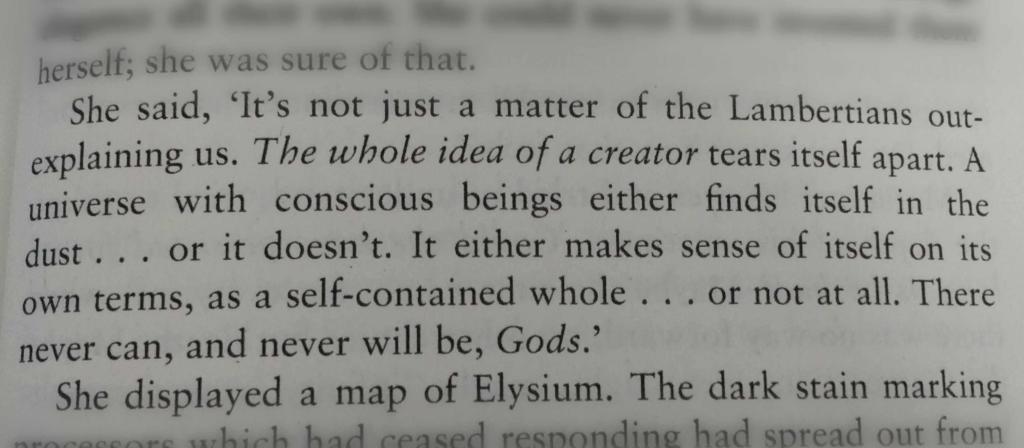
    Evolution, as I have already stated sometime back on this blog, is a fascination these days. Fundamentally, I see it as a gigantic A/B testing mechanism operating over large swathes of time, with only one seeming agenda – moving on. A lot of things make immense sense when I accept that as the only framework. Including the idea of God, which has several key roles. e.g. to provide the impetus to move on even when things are not going well (faith), explain the things that science cannot (yet) and so on. If it helps someone, it is a great idea, though as a species we have been consistently been stupid enough to let the practitioners of organised faith take advantage of us for their own needs.

    Clipboard01

    But that’s not what this post is about. One of the offshoots of faith (God/Cosmos/insert whatever works for you) is the related idea of cosmic/divine justice. I used to believe in that until very recently, and it was one of the attributes of being what I called myself – a spiritual person. But at this point, I don’t think it exists. There are at least two perspectives that brought me to it. (more…)

  • Currencies of hope

    In The Narratives of our lives, I had written about how, thanks to the advances of civilisation, many institutional narratives like religion, nation, culture etc have assumed increasing levels of importance in our lives, and how these (and our personal) narratives are probably our way of ensuring a sense of belonging. ‘The Age of Spiritual Machines‘, criticism on the concept of singularity notwithstanding, has convinced me on the cold, sanitised nature of evolution, so these days, I try to see what evolution’s play is, in these narratives.

    Thanks to a wine-induced pop philosophy conversation, I got thinking about theism and atheism. The epiphany (for me) was that they are just two sides of the same coin, and the currency was hope. Simply put, the foundation of the theist’s hope is God, and that of the atheist’s is the ability to determine his own future. ‘Our beliefs create the world we live in’, but across belief systems, hope is a critical ingredient for man’s survival. I realised that as long as we are the dominant species, hope has to hang around, or vice versa. By virtue of providing a common imaginary friend to a sufficiently high mass, religion not only addresses our need to belong, it also gives us hope. What each of us hope for is a very subjective thing, but collectively, it makes religion a really dominant narrative in many lives. When I thought about it, I recognised an even bigger force – money. (more…)

  • For Charlie to tango

    The interesting question is, just because something thinks differently from you, does that mean it’s not thinking? We allow that humans have such divergences from one another. You like strawberries. I hate ice-skating. You cry at sad films. I’m allergic to pollen. What does it mean to have different tastes – different preferences – other than to say that our brains work differently? That we think differently from one another?
    ~ The Imitation Game (via)

    I watched the movie last weekend, and this was one of the scenes that stayed with me. By sheer coincidence, the book I was reading then was The Age of Spiritual Machines, which dwells on the progress of artificial intelligence, and therefore, its impact on humanity. Humanity will be forced to reckon with AI sooner than later, (an earlier post) but long before that, we will need to learn to deal with ourselves. Have we really learned to live with our divergences? Take this as an example :

    (more…)

  • The legacy need

    The last two books I read had only a faint connection. One was historical fiction and the other was a memoir. The first – “A Spoke in the wheel” by Amita Kanekar – is a take on Buddha and his teachings by a monk three hundred years after the Buddha’s death when his teachings have begun their journey into religion, the emperor Asoka being the key catalyst. The second – “City of Djinns” By William Dalrymple is his discovery of Delhi – past and present – in a year that he spent in the city in the early 90s. The connection, as you might have guessed, is historical narrative.

    It is natural to think that there is a huge difference in a work of fiction and a more research and experience led memoir, but the point of the post is that with time, it is difficult to establish that. In the book on the Buddha, the monk chronicling his life and teachings is irritated by the supernatural abilities being attributed to him. But we do know that many people believe in it now and even consider him as one among the avatars of Vishnu. On a related note, William Dalrymple delivered a body blow to my notions of the Mahabharata era when his conversation with an archaeologist constituted a distinct possibility that the war was fought with sticks and stones and probably a bit of metal! (the proof being excavations around what is considered one of the earliest versions of Delhi – Indraprastha) I am a huge fan of Hindu mythology and it has fascinated me from as long as I can remember. I truly believed that they had happened in some form, but the archaeologist is clear that most descriptions in the epic would fall under ‘poetic license’!

    It made me wonder if there would be any difference between the two books say, a hundred years from now. It is possible they might exchange roles. It is also possible that they both are treated as fiction, or as factual pieces of work. I think all scenarios are possible because at the time of chronicling something, we believe that its factuality would be transmitted across time. And yet, we could debate the Mahabharata’s historical authenticity and Buddha’s superpowers both ways! So think about it, the same thing could happen to the information we store now as well. Thanks to digitisation, more data is being created in this world than ever before and (arguably) every point made has a counterpoint. There are no objective annotations because even the original construction is a product of biases, interpretations, perspectives and so on.

    That brings me to legacy, something a lot of us care about. From children to business empires to art to helping others, there are many avenues. However, I think that unless there is documentation, the chances of a legacy lasting beyond a few generations is questionable. For example, Dalrymple finds the last line of direct Mughal descendants and their knowledge of their ancestors is limited to a few generations before them. The futurist in me does fantasise about a global neural network and consciousness that connects all of humanity and has sufficient storage to instantly collect, catalog and annotate all ‘memories’  in as objective a state as possible for later generations to study them.

    But meanwhile, even as I dissect my baggage of the past, I am now forced to consider my need for leaving a legacy – something behind that will represent me when I’m gone.  After all of the above, how relevant is that need? Isn’t it just a demand made by the ego, a story we create for ourselves? Something to continue the narrative of our lives? We do talk a lot about letting go of the baggage of the past, but isn’t legacy also a baggage? A baggage of our future? If we let go of that, how different would our thoughts and deeds be? Understanding that is probably the key to living in the moment. I could easily twist my favourite cricketer-gentleman’s words for this context- He’s not concerned about his legacy, he’s concerned about what actually makes him come alive in the first place, which is that love of life, the desire to live completely.

    recite-15416-48543400-hiy6v5

    until next time, present participant
  • The world we create

    A while ago, I had written about the narratives of our lives, a look at various narratives across time – from religions and nations to popular culture and brands to the internet – that have (arguably) tried to fulfill our sense of belonging. All the narratives I had considered were external in nature, though they might be dictated by our choices and preferences.

    An excellent comment on the post by The Lit Room made me consider ‘the narrative of individual imagination’. As I answered, it is probably the most important one, as it takes all sorts of external stimuli, and converts it into a unique stream of consciousness. Just when I began thinking of writing a follow up post by including that aspect, I was reintroduced, thanks to Devdutt Pattanaik’s Sita, to the concept of ‘aham brahmasmi‘ – “every human creates his own imagined version of the world, and of himself. Every human is therefore Brahma, creator of his own aham“. I think it is impossible to crack everything that goes into the making of one’s own consciousness, which is probably what led to

    Clipboard01

    (image via)

    But there are at least a couple of perspectives that the book provides in terms of how one can create an ideal ‘world’ for oneself. It says, “stay true to the idea of dharma. Be the best you can be, in the worst of circumstances, even when no one is watching.” I thought a bit about what actually drives our actions, and realised that at the bottom of it is fear. (debatable) Not just one fear, but many, many fears driven by our contexts – some we acknowledge, some we don’t. George Lucas probably figured it out earlier, (see) though we might travel paths different from what Yoda has suggested. The book also states that – Fear is a constant, and faith is a choice. Fear comes from karma, from faith arises dharma. Faith in what, was the next thing I pondered over. In oneself, and a moral code that one adheres to? Or a higher power/cosmic law that governs all that happens? Or is it just a mechanical process with the fittest surviving? There are more options as well, probably, but I like to go with the first, because in the world that I create, my actions can ensure I do not have to fear.

    Meanwhile, also from the book – Shiva chooses the path of asceticism and self control to control the aham, and the world it creates. Vishnu chose to live amidst materialism and yet find a way to break free – a middle path. (now I can see why Buddha is assumed to be a form of Vishnu) I think there are several degrees to choose from, and there lies the challenge. I also realise that it if each of us are creating our own worlds, we cannot really answer the questions of the world at large – a universal answer – because it is an aggregate of each of our worlds, which are different from each other and have unique rules. We can only find the answers to our own world, and through our individual paths, find our own version of the answer to the purpose of life.

    until next time, muddled path