
Category: Purpose

  • A proxy life

    I have forgotten where I first came across Goodhart’s Law. It was probably Farnam Street. It states that “when a measure becomes a target, it ceases to be a good measure.” An illustration should help.
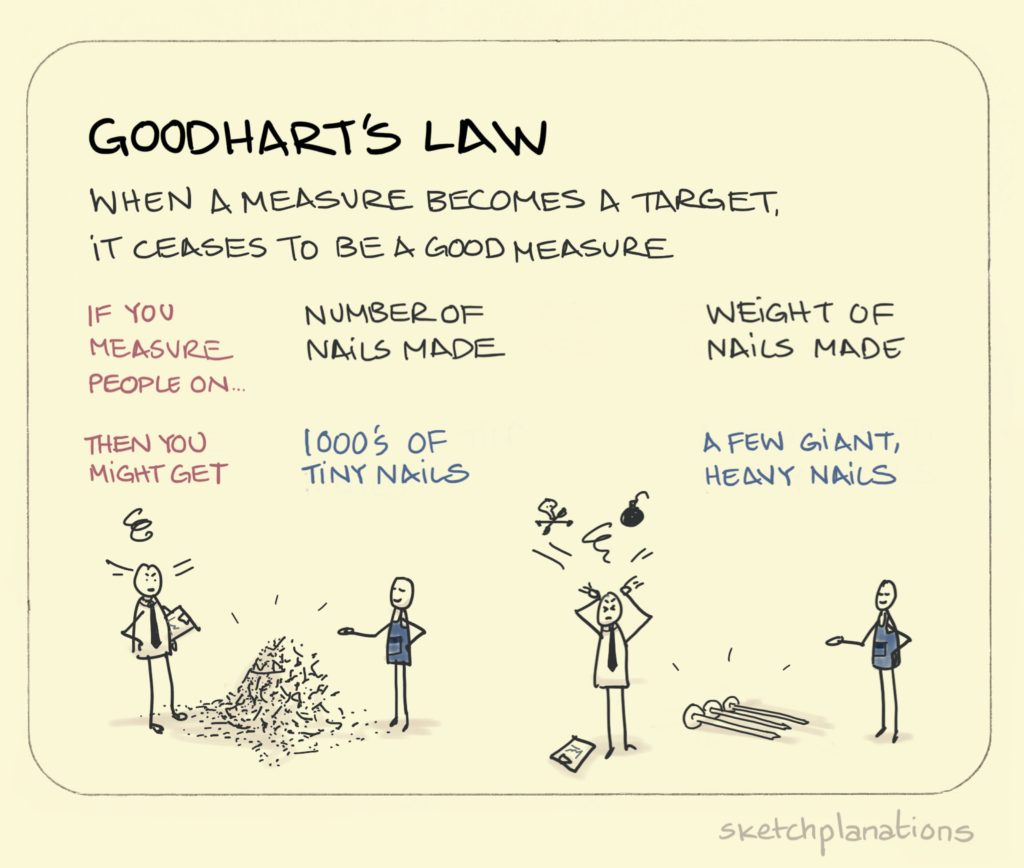
    https://sketchplanations.com/goodharts-law

    In the organisational context, it serves as a great lens to evaluate strategy and progress. As the illustration above shows, the entire direction of a desired goal can be changed when measures become targets. But, and maybe it’s a Baader -Meinhof phenomenon, I am now seeing different versions of it everywhere.

    To set some context, as more and more things have been digitised, the volume of information has just exploded. For instance, before the advent of social media, there were limits to one’s “people like me” canvas, because even an awareness of them was constrained by physical distances and the limits of one’s social circle. It had to be in real life, and public spaces like a cinema or even a vacation spot were probably an extreme. Social media changed that scale massively. Many factors including this volume of information, the lack of a granular understanding of the lives of this new set of people whom you’d never meet, and the innate human desire to do better than neighbours meant that appearances became the norm. Since we are not wired to process such large volumes of information, we dug deeper into ‘measurement by proxy.’ Not that this mode of measurement is new. For instance, we have used material manifestations (apparel, cars etc) as a measure of wealth. The stock price is a single-number measure of everything about the company. But with abundance of choice and the limits of processing power, we started developing heuristics and measuring what was easy. Meta photos (FB/Insta/WhatsApp) became a measure of everything from the quality of life to the strength of relationships. Popularity as a measure of excellence, price as a measure of quality, fitness as a measure of health, #booksread as a measure of erudition and so on.

    How does this connect to Goodhart’s Law? We end up optimising our resources for the measure, not the end goal. Which means that though the goal is say, happiness and a good quality of life, we end up aiming for the measure. From the kind of photo that will get more likes to buying that thing/experience that will surely make us happy. And as we feed this more, the mind keeps on wanting. The happiness fades in a short span of time. And as the Buddha has wisely pointed out, that loss of happiness is what becomes suffering.

    In the AI risk narrative, there is the story of the paperclip maximiser, a seemingly trivial task of maximising paperclips that might lead to “first all of earth and then increasing portions of space into paperclip manufacturing facilities”. The corresponding human version that I wrote in Peak Abstraction was that maybe we will get to a state where, if we get enough likes on the couple photo on Insta, there would be relationship bliss! What a wonderful world.

  • Designing my desires

    A world of transactional efficiency

    It was a little over 4 years ago that I first brought up the increasingly transactional nature of our interactions and even existence in general. I was reminded of it while listening to Amit Varma’s podcast with Nirupama Rao. Interestingly, they brought up contexts similar to what I had used – mails and rails. I had used birthday greetings going from long mails/cards to a ‘Like’ on someone else wishing the person a birthday. Travel was the other context, and I liked Amit’s example of train journeys being a unique experience. In contrast to say, the flight from point A to B.

    Last year, around the same time, I had framed it as An Efficient Existence, and used the example of Taylor Pearson’s 4 minute songs – the timeframe he had mentioned for songs in the context of  certain rules that creators need to follow if they want their work to be consumed and appreciated. I had brought up an earlier era of Floyd, Springsteen, Fleetwood Mac etc whose songs didn’t follow that template. Demand or supply, what happened first, I asked. Does it have to do with the abundance of choice now, and the demands of instant gratification? While templated packages for all sorts of consumption are increasingly the norm, people also want to finish and move on to the next thing on their list. Transactions. (Generalising), there seems to be very less desire to have an immersive experience. Outside the screen, that is. As the Spotify ads show (unintentionally and literally) we’re usually in a bubble, oblivious to our surroundings.

    (more…)
  • If it makes me happy…

    In a workshop I attended recently, the trainer made an interesting point that being a little selfish and taking care of our own needs first will actually enable us to help others better. Around the same time, I also read this very interesting post on the conversational gambit. Extremely helpful for those of us who aren’t good at going from zero to conversations quickly. Put simply, ask a question. The one that stuck with me was “When were you happiest?” I directed the question inwards and got some answers. Then I upped it to “What will make me happy?” That was complex, but something I heard recently gave me some direction.

    People say that what we’re all seeking is a meaning for life. … I think that what we’re seeking is an experience of being alive, so that our life experiences on the purely physical plane will have resonances with our own innermost being and reality, so that we actually feel the rapture of being alive.

    Joseph Campbell
    (more…)
  • Image and identity

    “You can either be judged because you created something or ignored because you left your greatness inside of you. Your call.”

    James Clear

    In an earlier post – An impulsive path to freedom – I had identified my own self image as a barrier to the freedom I desire. I wonder if it’s because it’s something I constantly think about, but I saw interpretations of it across a couple of pop culture phenomena I consumed recently.

    (more…)
  • An efficient existence

    The Cyberiad by Stanislaw Lem is a book I recently read, and loved. It was written in Polish in 1965, and translated to English in 1974. Lem wasn’t an author I had heard of, despite having read many science fiction anthologies. An online post that extolled him at the cost of my favourites like Asimov was what led me to this book. (I would have linked it, but I’ve forgotten how I found it!) Lem has been translated into 41 languages and has sold 30 million copies. But he was rebuffed by quite a few American writers including Philip K. Dick, multiple times, because he was perceived as being annoying, and had commented that American writing was “ill thought out, poorly written…” Also, his belief was that the only true motive for writing was to contribute to literature.1

    It made me think of a post in one of the newsletters I often recommend to folks – Taylor Pearson‘s The Interesting Times. As I tweeted sometime back, his writing is centrifugal – pointing to books, posts and ideas, and centripetal – goes deep into an idea and provides food for thought (the latter is different from what Austin Kleon meant in the original framing 2). The specific post I am referring to – 4 minute songs, which was about certain rules that a creators need to follow if they want their work to be consumed and appreciated, was the latter, and made me reflect. I wondered whether, even at an individual level, we are increasingly optimising for others’ consumption over our own expression.

    (more…)