Category: Flawsophy

  • A clocked up life

    Time has always been one of the most important constructs for me. In most of my actions, it is probably the first parameter kept in mind. The debate on whether it’s a human construct or a dimension that exists anyway is still not resolved in my head. But I still swing more towards a construct because in the words of one Julian Barbour, “Change merely creates an illusion of time, with each individual moment existing in its own right, complete and whole.” He calls these moments ‘nows’ and further postulates that “Time is simply the measure of the space between two separate and unrelated ‘nows.’” Unfortunately, this seems to take us further away from any possibility of navigating that distance beyond the linear flow we experience.

    I was reminded of this because of an article I read in TOI and from my own recent experiences. The article was about an Amazonian tribe called Amondawa that had no concept of time. They live in a world of events and had no words for ‘next week’, ‘last year’ etc. Also, no one had an age. Instead, when their position in life changed, they took on a new name!!

    For a fortnight in May-June, I was in Kerala, spending most of my time in a hospital waiting room. My entire routine had been changed. Nothing can be more disruptive for a creature of habit, but it did gave me a chance to observe time and my relationship with it. I noticed that time played an intrinsic part in my life because of associations – from mundane things like when I had to take a bath/ go online to things like when I would see D next. The associations make memories and our visions for the future, and those make up our navigation mechanism. If the associations did not exist, time’s importance could be reduced to a minimum, if not completely.

    On those starlit nights, it was easy to remember Dr.Manhattan’s  line from Watchmen, though in another context ” I am looking at the stars. They are so far away. And their light takes so long to reach us. All we see of stars are their old photographs.” But for us, it’s a now. So which really is the now -the stars’ now or my now or both? But then again, if not time, what would be my main narrative?

    until next time, anti-clock-wise 🙂

  • The Uncertainty Principles

    Not the quantum theory kind. Sometime back I read this interesting post on HBR on uncertainty, which made me think about my relationship with the concept. I must admit that I have more than a little affection for certainty. That is exhibited in most of everything I do – from my routine to travel itineraries to life planning. It also manifests in relationships – not just with people, but even services like Twitter. 🙂 It is probably a bit about control, and a bit about not having to waste what I consider premium currency – time.

    In the post, Tony Schwartz states that

    It feels good to know things for sure. It makes us feel safer, at least in the short term. But certainty has its limitations. Very rarely, I’ve discovered, is certainty the outgrowth of careful consideration and deep understanding. Far more often, it’s a primitive instinct — a way we defend against uncertainty, which understandably feels unsettling and even dangerous.

    I really can’t disagree with that, though I think that sometimes it’s an individual’s conscious choice. The sad part is that the automaton inside us usually makes this choice for us. Further in the article, he also adds a neurological perspective on why we are pulled to certainty, and then “Above all, certainty kills curiosity, learning, and growth.” And that’s the part that I am ironically, unsure of. My take is that if I am certain about a set of things, I am able to focus on, and do better in another set of things.

    Devdutt Pattanaik’s ‘The Pregnant King’ was an excellent read, and though it was the story of Yuvanshva, the king gives birth to a son after drinking a magic potion meant for his wives, it is also about the nature of the world and the fluidity of dharma among other things. There are a few interesting statements in it, if I consider it from the uncertainty context.

    In an argument with Pisachas, Yuvanshva states that “every civilisation needs its delusion” and we don’t take kindly to things that “threaten the facade of order”. I think that would hold for individuals who prefer certainty too. In another conversation between Yuvanshva and the Angirasa, there is a meaning given to the existence of this world,

    When all is understood and accepted, the world will lose its purpose and cease to be. The world exists only to make us wise. Ignorance fuels pain and from pain comes our search for wisdom.

    But my favourite is in the form of two diametrically opposite approaches to the purpose of life that comes earlier in the book – Yaja and Upayaja, two Siddhas who never agreed on anything, yet ended up taking the same decisions.

    Yaja sat under a banyan tree and sought truth in stillness. Upayaja always sat before a waterfall and sought truth in movement. Yaja said, “By observing the flow of rasa, one can train the mind to accept destiny. This is the purpose of life. Upayaja argued, “By manipulating the flow of rasa, one can change the world and fructify all desires. That’s the true purpose of life.”

    Though Upayajya’s argument might seem in favour of certainty, I’d say that both are versions of the same story – embracing uncertainty. And thus, another lesson from the book springs to mind “The truth is not poison. It is our inability to handle it that makes it poisonous” The same goes for uncertainty too… I guess 🙂

    until next time,

  • Insignificance

    I remember writing this post about 4 years back, with an insight on why I didn’t particularly like to travel. Things have changed since then, and I do travel as much as possible these days. The odd discomfort of viewing masses of humanity still persists, but the reasons are more nuanced.

    What reminded of that post was this article that beautifully expressed the discomfort with the title “The Sad, Beautiful Fact that We’re All Going to Miss Almost Everything“. The article uses this in the context of books, films, music, television and art. But I relate it more to places and people. I still remember that the saddest part of leaving Leh was that it was perhaps my only visit to the place and I had not seen everything that had to be seen. In the case of people, the rise of the statusphere (Facebook and Twitter) has only added to the feeling that one is constantly missing something significant.

    It is probably going to get worse, unless of course, we manage to do the Matrix-USB type thing of instant information absorption. Even then, it would probably go the way things are headed to these days anyway- consuming without experiencing. The real time challenge of being updated about people would still exist. And perhaps it will end up the way the line goes, “we will increasingly be defined by what we say no to”. But, as the author of the article I linked to, above, notes,

    It’s sad, but it’s also … great, really. Imagine if you’d seen everything good, or if you knew about everything good………That would imply that all the cultural value the world has managed to produce since a glob of primordial ooze first picked up a violin is so tiny and insignificant that a single human being can gobble all of it in one lifetime. That would make us failures, I think.

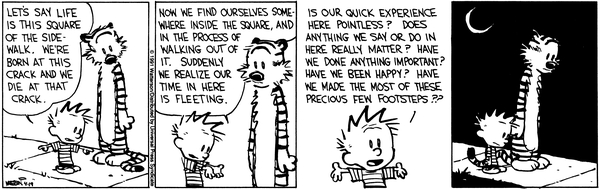
    If I had to adapt that to places and people, I could say that the creator might feel insignificant if we could discover all of it in a lifetime. However, the collective advance of humanity is not a complete solace when it comes to the individual’s existential angst. As one of my fave Calvin strips go

    until next time, insignificant choices too?

  • Integral Calculations

    The reasonable man adapts himself to the world; the unreasonable one persists in trying to adapt the world to himself. Therefore all progress depends on the unreasonable man. ~ George Bernard Shaw, Man and Superman (1903) “Maxims for Revolutionists”

    Now, I guess if i stretched that to Charlie Sheen, especially the last sentence you’ll think I have been swiggingTiger Blood” too. 😀 But I did have this notion after I read Scott Adams’ post on him.

    Imagine if you stopped filtering everything you said and did. ….just try to imagine yourself living without self-censorship. Wouldn’t you sound crazy?…. Imagine you are so unafraid of consequences and the opinions of other people that you start sentences before you have a plan for how they will end……I think Charlie is fascinating because he’s living without fear. That translates into a disturbing degree of honesty……But I also think that a total lack of fear would look like insanity to the casual observer. And perhaps it is. But it’s a strangely great kind of crazy.

    When I read up about moral absolutism, I wondered what/who would decide the absolutes one would stand by, and were they really absolutes? After reading all of that, I guess moral integrity towards the self better explains what I had in mind.

    So, if Mr. Sheen has decided that no-self-censorship and no-fear are the integral parts of his self from now on, and lives the rest of his life by it, we might consider it bizarre by civil society standards, but he just might be in a better space than we are in terms of moral integrity. (not hinting at a goddesses irony 🙂 ) The alternate consensus that this is just the drugs talking is not as comforting as it should be, when I think of it from this perspective.

    Does our general dissatisfaction stem from our willingness to conform to society’s norms of moral integrity, and the lack of courage to show society the middle finger whenever warranted? The individual consciousness against the urge to belong? I’m still thinking.

    until next time, integration and differentiation 🙂

    P.S This is not sheenfluence

  • Stop. Watch.

    Playing music on the mobile as you drift to sleep is probably nothing new. I’m sure many people do it. The snag of course is managing to switch it off before you sleep. You could create a list and make sure it stops after x number of songs, but there’s some joy to be found in random shuffling. There’s probably an app somewhere that will somehow manage it, but I haven’t found it yet. What I would like is something that will sense my breathing pattern and switch off, but that might be wishing for too much 🙂

    ‘The Tibetan Book of Living and Dying’ brings up an interesting point, when it discusses sleep in the context of death and the state of consciousness. It asks

    How many of us are aware of the change in consciousness when we fall asleep? Or of the moment of sleep before dreams begin? How many of us are aware even when we dream that we are dreaming?

    From the music example, it is easy to guess that I certainly am not. In fact, my experiment on this failed too, as I completely lost track during a conscious attempt to ‘know’ the moment I fell asleep. I then realised that I should perhaps try being ‘conscious’ while I am awake without flowing from thought to thought unconsciously, especially since D is not very encouraging about me trying to sleep more. 😐

    Try recollecting the last 15 minutes minute by minute, and you’ll sense the unconsciousness 🙂

    until next time, asleep yet?