
Category: Flawsophy

  • I am the absolute

    The translation of Ahaṁ Brahmāsmi. Don’t worry, it isn’t my ego talking.

    I was reminded of this thanks to this fantastic episode on Lex Fridman’s podcast – with Joscha Bach.

    I remember it was a while back when I first heard the postulation that Adam & Eve hurriedly covering themselves after eating the apple was an allegory for humans first developing consciousness about themselves. Joscha extends this and talks about how the Bible, specifically Genesis 1, has sections on the mind systematically creating a a game design that helps interact with the world. In his own words,

    where it’s being described that this creative spirit is hovering over the substrate and then is creating a boundary between the world model and sphere of ideas, earth and heaven, as they’re being described there, and then it’s creating contrast and then dimensions and then space, and then it creates organic shapes and solids and liquids and builds a world from them and creates plants and animals, give them all their names. And once that’s done, it creates another spirit in its own image, but it creates it as men and women, as something that thinks of itself as a human being and puts it into this world. And the Christians mistranslate this, I suspect, when they say this is the description of the creation of the physical universe by a supernatural being. I think this is literally a description of how in every mind a universe is being created as some kind of game engine by a creative spirit, our first consciousness that emerges in our mind even before we are born and that creates the interaction between organism and world. And once that is built and trained, the personal self is being created and we only remember being the personal self, we no longer remember how we created the game engine.

    This is basically the development of consciousness. And we cannot remember the time we made it. The game engine is the universe we keep building until we are no longer around.

    And the Bible is not alone in this. Remember Samudra Manthan from Hindu mythology, it is full of symbolism. An individual in this world seeking immortality. Transcendence. The mountain Mandara represents the human mind and the manthan is its churning in the vast collective consciousness. The devas and asuras obviously are the positive and negative influences. Vishnu’s koorma avatar (turtle) which stabilises the mountain during the churn point to how we should try to focus our mind. (on God, but I will abstain from that part :D)

    Halahala, the emergent poison that Shiva swallows (earning him the name Nilkanth) shows how we must confront our inner demons . From Kamadhenu to Airavata to Kalpavriksha, there are all sorts of distractions that are possible. Dhanvantari appearing with the amrit symbolises the importance of health. The amrit is what allows you to merge with the collective consciousness and thereby in a sense become immortal.

    Ok, snap. I don’t think I will get there. In The Flavours of Death, I had posted an excerpt from Simone de Beauvoir’s The Coming of Age
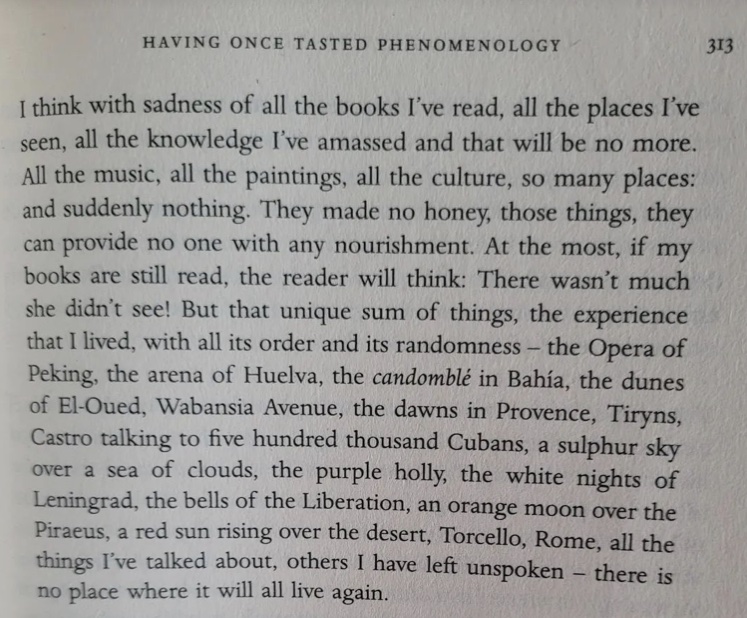
    Simone de Beauvoir Death The Coming of Age

    …’there is no place where it will all live again’. And that’s just it. Outside of photos, notes like these or maybe conversations with friends, the universe that was created in my mind will no longer exist when I die. It dies with me. And thus Ahaṁ Brahmāsmi. The universe that I made with all its affections and peeves and desires and animosities and fears and longings and expectations, disappears when I take my final breath. I will not be around in the aftermath to feel that sadness, but I am here now, and I do feel the twinge.

    Aham bummed asmi ? #okbye

  • Slowly and then suddenly…

    …because we’d like to have the best physical abilities that any species has in terms of moving, seeing, hearing, strength etc. From the mind’s perspective, an organ that could upgrade itself to store more, to experience more, to work faster, to be more accurate. And it doesn’t stop there – reading others’ minds, telepathy…

    We will see the beginning of all this in our lifetime. The progress might be slow, so slow that perhaps later generations wouldn’t realise how we’d lived without most of the artificial things that they would be taking for granted. How would this affect the experiences of life that we go through now – joy, sorrow, pain, ecstasy, spirituality?  How long before what we call human would give way to a being that would probably exist forever, possibly without living? Will they even realise it when it happens?

    The man… the machine

    This is from my first post on what I called the augmented human, back in 2009. And I continue to ask myself what the man-made man will be like.

    (more…)
  • On the first anniversary of ‘ordinary kindness’

    It’s Saturday. The intercom rings at 5AM. D and I both curse, and a 20 second conversation follows on how this had to be a delivery, and why the security is buzzing us when we have agreed on “9 to 9, no calls”! D manages to reclaim some sleep, I can’t.

    At 7 ish AM, I am pissed, and have to use extra willpower to enforce my morning exercise routine. I want to give that security guy a piece of my mind, and hurry to catch him before his shift gets over. Turns out I am a minute late, and the other security guy doesn’t have his number stored. WTF dude! I am even more pissed, and tell him that I need the number when I return from my morning jog.

    (more…)
  • Opinion poles

    A few months ago, D and I were talking about something at work making me angry. Since Yoda has said that it is fear that leads to anger, and is the path to the dark side, I needed to figure out the root of that anger, and then understand the fear. I knew it wasn’t job loss (I had already quit), but was stuck.

    I would learn later we tend to focus on negatives, because in the savannah, avoiding the things that might kill you was more important than seeking the things that will give you pleasure. Pleasure and pain are just feedback mechanisms, not an end. Whether it’s the pain caused by your body failing you, or mental agony. Psychological pain is an indication that our subjective map of the world needs a revision. (Cognitive Fitness, Anil Rajput) And that indeed turned out to be the case.

    D insightfully pointed out that my faith in my value system, which I mistakenly assumed others at the workplace also subscribed to, might have been broken by the incident. And that would make me afraid because that is the only one I am comfortable with, and any changes in it would be a compromise I couldn’t abide by.

    I would also learn later that there is a term for something like this, borrowed from physics. Hysteresis – the lingering values of a previous age continuing to guide our judgments.

    The last couple of months have been a great learning experience. About myself, the world at large, and the relationship. One of the important lessons has been that I am free to hold on to my values, and continue to negotiate with others, but as Marcus Aurelius rightly said, “the universe is transformation, life is opinion.

  • Three score and ten

    He was a shadow of his former self, and his memory was not what it used to be. But I could see his eyes light up when he was reminded of who I was. We spoke a bit, and I like to think that a bit of his joviality returned in those brief moments. My interactions with him are more than three decades old, and our memories of each other are probably a bigger bond than any relationship we have. He complimented my demeanour, much to the annoyance of the other M. He passed away a few weeks later. These days, I am ambivalent about meeting old people. On one hand, I think I’d like to remember them in their prime. But then again, there is a good chance that I’d be meeting them for the last time. So these days, when I do meet, my behaviour factors that in.

    The worst thing about death is the fact that when a man is dead it is impossible any longer to undo the harm you have done him, or to do the good you haven’t done him…They say: live in such a way as to be always ready to die. I would say: live in such a way that anyone can die without you having anything to regret.

    Leo Tolstoy, (via Arthur C. Brooks’ From Strength to Strength)

    ——————————

    (more…)