Category: Flawsophy

  • Natural Law

    After a couple of years of Samsung, I bought a Moto X (2nd gen) phone, the Droid Turbo and Nexus 6 also being considerations. In the first few days of use, the automation that Moto’s Assist, Actions and Voice allows has impressed upon me the potential of such technologies and the dependency we could have on them.  As Karen Landis states in the Pew Internet Project’s Killer Apps in the Gigabit Age, “Implants and wearables will replace tools we carry or purchase…It will also redefine what a ‘thought’ is, as we won’t ‘think’ unassisted.

    It reminded me of an article I’d read in Vanity Fair titled ‘The Human Factor“, and a particular observation in it – To put it briefly, automation has made it more and more unlikely that ordinary airline pilots will ever have to face a raw crisis in flight—but also more and more unlikely that they will be able to cope with such a crisis if one arises. This thought is elaborated in ‘Automation Makes Us Dumb‘, drawing the difference between two design philosophies – “technology – centred automation” and “human- centred automation”. The former is dominant now and if one were to extrapolate this , a scary thought emerges.

    I think the best articulation of that scary thought is by George Dyson in Darwin Among the Machines – “In the game of life and evolution there are three players at the table: human beings, nature, and machines. I am firmly on the side of nature. But nature, I suspect, is on the side of the machines.” I had seen this in Bill Joy’s amazing 2000 Wired article “Why the Future doesn’t need us“, which itself discusses the idea that Our most powerful 21st-century technologies – robotics, genetic engineering, and nanotech – are threatening to make humans an endangered species. (more…)

  • The circle of nothingness

    During a recent trip to Cochin, Dad pointed to a newly constructed building and asked me if I remembered what had been there before it, since he couldn’t. Neither could I, though I might have walked/cycled/ridden/driven past it many, many times. I get quite disappointed on such occasions, because when a memory is removed, it’s almost as though a slice of my life, thin though it may be, has been taken away forever. Strange though it may seem, I feel a sense of guilt, towards myself for not retaining a complete picture of my own life, and towards the object itself. A few days later, we passed a plot on 12th Main, Indiranagar, where a commercial building is being constructed. This place will ‘always’ remain in my memory as my uncle’s house, though they moved away quite a few years ago.

    All of this reminded me of Schopenhauer’s “The world is my idea“, and a post I had written more than four years ago, the last paragraph in particular. From nothingness comes an idea, it then takes a tangible shape in a mind, and then probably manifests itself in words, deeds, objects and so on. Beyond its physical life, it exists in the minds of the people with whom it has been shared, maybe in forms massively different from its original, until the minds themselves are no more, and no connection exists between the current form and the original. “Soon you will have forgotten the world, and soon the world will have forgotten you.” ~ Marcus Aurelius  (more…)

  • A republic of convenience

    Masala Republic is a Malayalam movie I watched recently. First, my sympathies with those who attempted the heroic task of watching it in a theatre, but to be fair, it did give me some food for thought. No, not about my choice of movies, but things slightly more important in the scheme of things. It talked, for instance, of issues that needed a voice – the changing socio-political and economic dynamics of Kerala caused by a huge influx of people, mostly low wage workers from Bengal and the North East.

    The movie begins with the disruption brought about in the life of these folks by a ban imposed on Gutka, which apparently is part of their staple diet! This reminded me of the (real) scenario I witnessed when the liquor ban was announced in Kerala. Almost overnight, I saw an ecosystem disbanded – small shops around bars, auto-rickshaws that ferried drunk guys home, to name a few components.

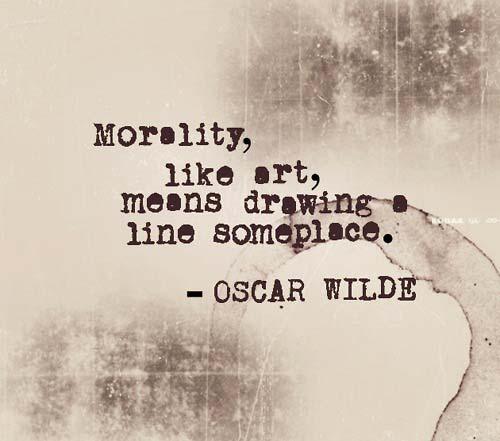
    Notwithstanding the political play that brought about this ban, I was forced to ask – isn’t alcohol consumption an individual’s choice? One might cite domestic violence, decrease in productivity, drunken driving etc, but unlike say, smoking, it does not automatically cause damage to the larger society. Isn’t a blanket ban a bit like banning automobiles because of road accidents? If the justification is that individual choice must bow before collective progress, then can we really condemn Sanjay Gandhi for the infamous sterilisation programme? After all, population control would, at least arguably, have meant progress. What we are debating therefore, (I think) is the means. And means is exactly what an alcohol ban is. Does society really have the moral right to take such a decision? Who decides society’s collective moral compass and what can resist such selective applications of morality?

    Clipboard01

    (via)

    Who decides where the line is?

    P.S. Would be glad if you could point out whether I am missing some relevant piece of information or logic here.

  • Happiness and compassion

    Though I’d explored the idea of inculcating a sense of compassion in others in this post a fortnight back, I still think our own compassion needs to serve as a solid base. Not being judgmental is one way, but it’s not easy to practice. So I took a step back and wondered if compassion was a result and not a behaviour. The first behavioural direction I could think of was happiness. In myself, I have seen a correlation if not a causation. I am more compassionate when I’m happier. So I decided to explore this a bit. (more…)

  • The people we are….with

    After I shared the “We, the storytellers” post on Twitter, Surekha sparked off this interesting discussion on how we could persuade others to be less judgmental and more compassionate. I really didn’t have a fix-it-all answer and felt that it was more important that we simply practice this ourselves. That, however, did not stop me from thinking about it.

    The next day, my reading list had this post, which touched upon things that get people to change their behaviour. I remembered this William James quote used in the post from something I had seen a while back at Brain Pickings.

    Clipboard01

    (more…)