
Category: Internet

  • The narratives that we drive

    It probably started with the ‘narrative’ post, but a few things I read later made me wonder about our choices of narratives and where this could be leading to. Some narratives happen to us depending on our circumstances – time, geography etc, and some we choose of our own volition, or so it seems. Continuing from the earlier post, I think it’d be safe to say that with a more connected world, our ability to choose narratives has been heightened. Abundance of creation, and consumption. I think this was the related fantastic little piece of content that triggered this entire line of thought. It has some thoughts on material consumption, and though delivered differently, it has some profound insights as well.

    Partly thanks to that abundance, the noise around us has also increased, and has found better ways of being amplified. To quote Clay Shirky,

    It is our misfortune, as a historical generation, to live through the largest expansion in expressive capability in human history, a misfortune because abundance breaks more things than scarcity.

    In fact, one could argue that compulsive consumption (material, and otherwise) is one of the reasons for our ‘emptying out‘. (do read) As I was writing this, I had a sense of deja vu, and some searching pointed me to this, written 3 years back, in which I tried to figure out whether there was a middle path between a self that was driven by others’ perceptions and one that was driven by a moral compass dictated by few external stimuli. In that post, I had quoted from Paul Graham’s ‘addiction’ post,“we will increasingly be defined by what we say no to” I think that still holds true.

    In this era of abundance, what narratives should we choose to be part of? How can one be objective, is one even right by being objective? An excellent post whose advice I hope to implement more is this. I really couldn’t disagree with any of the 30 things mentioned, it just seemed intuitively right. But I think this would serve as an excellent first lesson..

    (via)

    until next time, an open and shut existence
  • The narratives of our lives

    This wonderful post at Ribbonfarm got me thinking about places as narratives. Specifically, it reminded of something I wrote a few years ago on the subject – Watermark. The conclusion of the post that got me thinking was this – The space we inhabit is more topological than ever as we locate our positions within networks instead of maps and this may be the most true narrative about the present age: No matter where in the networked world we’re coming from or traveling to, we’re already there.

    Indeed, places were probably the earliest narrative that existed – in our early days as a species, we probably didn’t move away much from the place we were born. As civilisation evolved, I think many more institutional narratives were added – religion, nation, culture, and so on. In the era of consumption, even brands (media and otherwise) have attempted to invade the space. For example, in our own lives, there are many narratives that we consciously or otherwise become part of – the kind of books we read, the music we listen to, the movies we watch – in short, popular culture. Each generation has its own set – from Ramayan on TV to Facebook.

    Sometime back, I had written about the internet being the zeroth place – the one that supersedes all the other places, including the physical ones, in our life. Especially with a social layer, it has the capability to accommodate all our narratives – individual and societal. The Ribbonfarm post talks about how the default nature of the digitised era is to store, and no matter how much data our society manages to produce, we’re even better at finding places to keep it. In that sense, it isn’t just geography that the internet seems to have removed as a driver, but time itself. The other day, when I was reading The Confusion, I happened to read a post from 2005 which summed up how I felt about The Baroque Cycle in general. Yes, I tweeted about it. 🙂 But I still can’t be sure about the evolution, and wonder if the abundance of storage might drive us to consciously seek out ways where the information will not be stored. eg. the rise of Snapchat.

    I have always felt that narratives are a way to fulfill our sense of belonging. Across time, this role has been played by several entities. The internet has made it possible for even the smallest of niches to have its own narrative. Where does it go from here?

    until next time, comment on the narration? 🙂

  • Of fame and purpose

    I completely missed Bigg Boss 6. Except for knowing that the arrested-for-sedition cartoonist and Sapna Bhavnani were participants, my exposure to it was limited to lunch conversations at office, where two of my friends seemed to be avid followers. 🙂 I thought my ignorance was only fair, since they are usually clueless when I mention the names of micro-celebrities on Twitter.

    Increasingly, I am realising that popular culture is going through massive fragmentation. The above was an example. I think this generation is connected with more people than any before it. It has always been so, with better means of communication, but this time, it has been an explosion. We’re still coping with the overload, or filter-failure, as Clay Shirky calls it. Despite social networks, or probably because of them and their algorithms, we miss out on many things.

    I was thinking of all this in the context of fame. Fame, to me, has some connection with my favourite subject these days – purpose. Fame can serve as a means, or end, or a by product of purpose. The thing is, with the fragmentation I mentioned earlier, fame probably has to be redefined, also because its shelf life has been drastically reduced. Once upon a time, a name/photo appearing in a newspaper was an achievement. (let’s ignore the notoriety piece 🙂 ) Later, before channels mushroomed, it was television. But now….

    One of the things that might happen because of all this is the gradual de-linking of fame and purpose, if it does exist. I’m still trying to figure out how that will shift our perspectives on purpose.

    until next time, being famous ain’t what it used to be…

  • Posture child

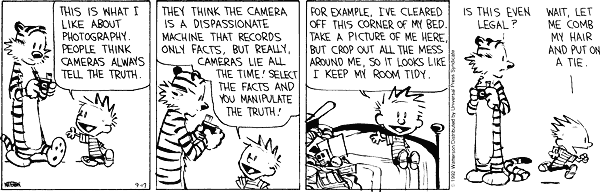
    I guess that’s the reason why Calvin & Hobbes is so utterly loved by so many folks. Profound, timeless, universal truths expressed in such a unique way!

    I had never seen this one until recently. Why blame Instagram for filters? They existed long before anyway 🙂 I thought this strip found great application in all kinds of posturing from time immemorial, and especially so now – in the social media context, when everyone is a publisher. Over a period of time, I wonder how fast we would forget who we really are (if ever we come to know it or knew it) It would probably be irrelevant in the real-time era. We would be the statuses and photos and everything else we like and share every minute. After all, I’m no longer the person who wrote it anyway, and who’s to say the non posturing self is the real deal?

    until next time, impostor 🙂

  • Gene-rational

    Sometime back, there was a debate on Samadooram, a talk show on Mazhavil Manorama. The topic was the changing nature of colleges in Kerala, specifically the waning influence of arts and creativity in general. Panelists included a student politician, a regular student, a college professor, a socio-cultural commentator, a literary figure, among others. Among the various sub-topics discussed were the rapid increase in number of colleges, the pressure on students, the internet revolution, the effects of changing societal and familial conditions, with several aggressive comments on how the earlier generation should give way to the new, rebutted well by the older panelists. All the panelists, and many in the audience gave varying perspectives on the subject and it became a very interesting albeit noisy debate, which brought out several moments of generational difference.

    When the Roadies spoof became a rage and a discussion topic, I remembered tuning out after Season 1 because I just couldn’t understand the entire exercise. I also understood that for some reason, it meant a lot for a section of the 18-25 audience, and that it was a big deal.

    It made me think of what has changed, beyond the passage of time  and why. I realised that the entire ‘intent’ of various phases in our lives had changed. The innocence of childhood, the new found freedom and the process of evolving a world view during college have all given way to a single point agenda for the child from the time it is born. The intent is to mould a creature that can survive the peer competition and whatever else the world can throw at it. The changes in education and the college atmosphere are IMO, by-products of this.

    The paradox is that thanks to the internet, this is probably the best time for an individual to explore and make the most of his interests in life. It gives you the freedom and the tools to be the person you want to be. Unfortunately, it is quite possible that at a young age, they don’t have the confidence (or even the clarity of thought) to choose a path. They are guided by society’s norms, norms which have a benchmark of ‘success’ that rarely accommodates the individuality perspective. The ones who break these shackles get to live a life.

    until next time, grown down