
Category: Choices

  • Habit much!

    Nearly five years ago, when I wrote about the closure of my second (and probably final, given the zero usage now) book of accounts, I had ended it with how the days of our lives have found a rhythm, a familiarity. They actually point to the habits that have become a part of my life. Earlier this year, when I wrote The building blocks of freedom, the ending was again a commentary on habits. As I quoted in it (from a splendid post Routine Maintenance), while habits are indeed a way to off-load cognitive overheadat their most extreme, habits can slide into addictions and compulsions, patterns that resist our conscious efforts to break themRitual dissolved into routine.

    Habits, as I wrote, are possibly a micro-version of intentionality. They are are physical, mental and even emotional. But when we don’t review them, it is almost as though they hijack our intentions and make them subservient! It’s almost like the new Batman’s point about scars – Our scars can destroy us, even after the physical wounds have healed. But if we survive them, they can transform us. They can give us the power to endure, and the strength to fight. As I have realised many times recently, it is extremely difficult to be objective about my habits. It is only when I am deeply mindful that I observe some of my habits, and sometimes laugh at their absurdity. But when I go back and understand where it came from, I also give a mental hug to my earlier self. 🙂

    Very recently, it also made me review my deep-set approach to retirement. I had mentioned that in my previous post – the third point in Uma Shashikant’s excellent article (below).
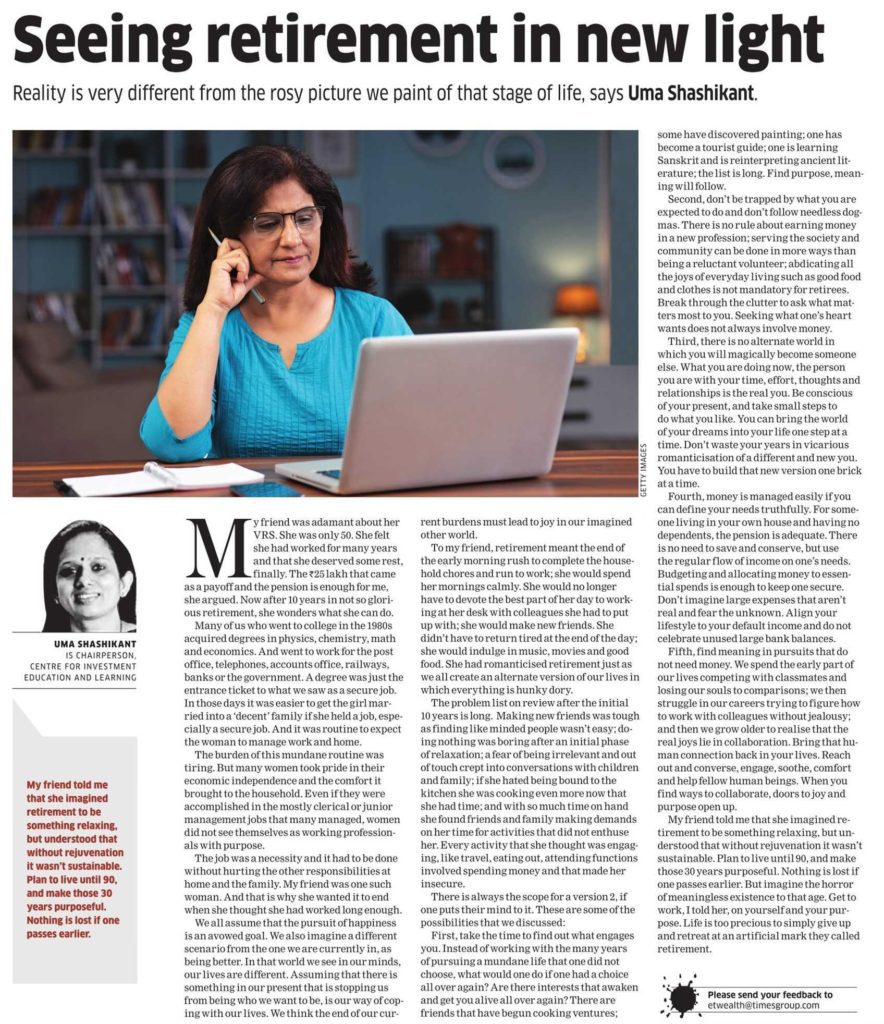
    I always assumed that the day I stopped working for a living, I could switch into a ‘different me’. I now see how it’s quite impossible. I will have to start looking at the ‘difference’ right now, and build new habits and junk old ones that can help me move in the direction of the ‘new’ me. The idea is that it won’t seem new. Turns out this isn’t a problem that only I encountered. In a couple of books and articles that I read recently, I came across some very insightful perspectives.

    Familiarity and habit impoverishes the way they look at things. They are mostly unable to break away from the past and see things in a fresh way. It doesn’t help that breaking away might mean losing everything that made them great/admired. Lack of interest and curiosity are aggravated by biological conditions, and this intellectual and emotional indifference may cause inertia. 

    Simone de Beauvoir, The Coming of Age

    Marcel wrote of the human tendency to become stuck in habits, received ideas, and a narrow-minded attachment to possessions and familiar scenes. Instead he urged his readers to develop a capacity for remaining “available” to situations as they arise. Similar ideas of disponibilité or availability had been explored by other writers, notably André Gide, but Marcel made it his essential existential imperative. He was aware of how rare and difficult it was. Most people fall into what he calls “crispation”: a tensed, encrusted shape in life — “as though each one of us secreted a kind of shell which gradually hardened and imprisoned him.”

    “On the Ontological Mystery,” Gabriel Marcel, via At the Existentialist Café

    And while being too lazy to type out the one above, I found someone had already written about ‘crispation’. And found this (below) there. It reminded me of the converging life Amor Towles wrote about.

    “We all end up as packaged goods,” Westbrook Pegler remarked a little while before he died. The dreary road to the wrapping and bundling counter is probably inescapable: there is the hunt for the discovery of what works, then the erosion of curiosity about what else might work, then the disappearance of all curiosity about anything unfamiliar, and at last the prison of the safety of one’s own accepted manner. Yeats was a little way off the mark; the peril for the artisan no less than for the artist is not that his circus animals may desert him but that he will let slip past the time when he ought to turn them back to the forest.

    via James Mustich

    And finally, my favourite story on what habits can do, and where I don’t want to end up. Poignant, hard-hitting, and true.
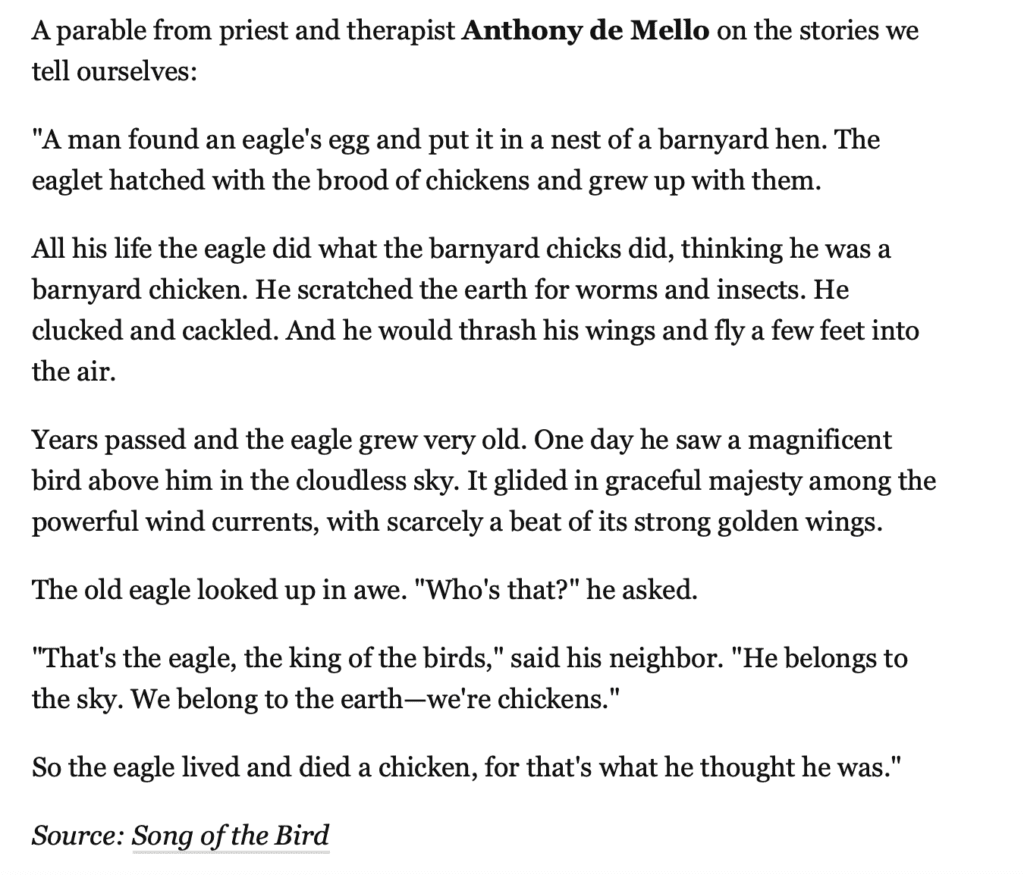
    via James Clear

  • Moral Signs 2

    “It’s these times. Morality is a moving target”

    Robert Folger, Snowpiercer

    A ‘grandchild’ at work wants to move to an edtech. She is convinced it’s an ‘opportunity that she won’t get later’. I contest on both counts. She is immensely talented, and given her work ethic, it is easy to see that she will be an absolute star. I would like her to do well, but it is an organisation I have actively talked against – IRL and on Twitter – and there is enough proof of its misdeeds. She wasn’t aware of this, and is nonplussed, but doesn’t want to turn back now. I bring up our debates on how she felt Seagram’s “Men will be men” was legitimising misogyny, and furthering a regressive world view. That got us on to morality. I remembered the ‘professional’ version I had written a while ago and sent it to her. I also remembered that I had meant to write this personal version earlier.

    Morality and self image

    (from the previous version)

    “We’re living in an era of ‘woke’ capitalism, right? I’m Nike, I pretend to care about black people. You pretend to hate capitalism and buy my trainers.”

    “Industry” (BBC/HBO)

    This pretension helps us retain our self image while consuming the things and experiences. There is narrative cohesion while avoiding uncomfortable truths. And sometimes, even some virtue signalling. 

    In general, the world is hyper competitive, and the choices we make might not sit well with self image, especially when morality is also at play. In the post, I had brought up the point that having a moral compass means saying goodbye to what would be considered lucrative opportunities. Even more so in the last few years. Crypto, real money gaming, fintech, edtech – the big pillars of the recent startup boom – all have moral loopholes (generalising). Same goes for Big Tech. But now regulation and external factors are catching up.

    The self image is gloating with “the arc of the moral universe is long, but it bends toward justice.” (Dr. Martin Luther King Jr.) But everything is a cycle.

    Let’s go beyond work and take say, entertainment. Recently, I tweeted

    You can catch many discussions on Saudi blood money around the web. If one were absolutely moral, one should immediately stop watching these sports. I don’t watch any of these, but that’s largely because I am uninterested.

    And anyway, I can make similar cases against movies and every other general consumption – apparel, on-demand deliveries, house help, and practically every daily touchpoint. It isn’t easy for me to slither out of everything.

    As you can see, being very objective about one’s own morality is dangerous for self image, and thus sanity. Maybe that compromise is the origin story of cancel culture (canceling on Twitter only, not in life). While I can see how that helps self image, I also do believe there is a limit to not being objective about oneself.

    Morality is plastic

    The Activa is being sold to the husband of one of the housekeeping staff at the apartment. He comes by on a Saturday evening, after his daily labours, and shows me his Aadhar card on a taped-up plastic-covered mobile phone. He doesn’t know how to forward it, so he’d give me a photocopy, he says. He also insists that I count the cash. He seems very particular that I treat the entire transaction with the dignity it deserves, including our price negotiation. It furthers my own narrative about why I shouldn’t give it to him for free, but hey, I am watching me. I know that an equal reason is that this amount is part payment for something I have been eyeing. Something I don’t need but would like to have. I tell myself that he and his family will be rid of a few commute problems at a lower cost. That it’s a net positive.

    There is an intense discussion happening in the apartment WhatsApp group – a couple of street hawkers (no, not fancy bikers) have set up shop on the pavement and the residents are worried about the area becoming a hub, and thus creating bigger problems. I see the case for shooing them away though I won’t voice it. I also won’t voice the contrarian view – D and I didn’t want to trigger a WhatsApp war. I see one of the hawkers when D and I go for a stroll after dinner. He is selling plastic items, and is using one of his buckets as the seat. It is around 9PM on a Saturday night. He is older than I am, and I begin to think about my conversation in office about how our chairs aren’t ergonomic enough.

    A moral operating system

    I used to judge myself by the only morality is action, but I couldn’t handle all the trade-off. I also realise that this entire conversation is from a position of privilege. And that my estimation of how easy that makes it, is woefully lowballing it. I remind myself that there is no morality in nature, only causality (Jonathan Haidt). Maybe we need to evolve a lot more if we need morality and practicality to co-exist. And maybe that won’t happen.

    So what can I do? I can stretch myself and do the right thing even if it takes me away from my comforts. I can recognise the limits, and stop being judgmental of self and others.

    Yesterday I was clever, so I wanted to change the world. Today I am wise, so I am changing myself.

    Rumi
  • A proxy life

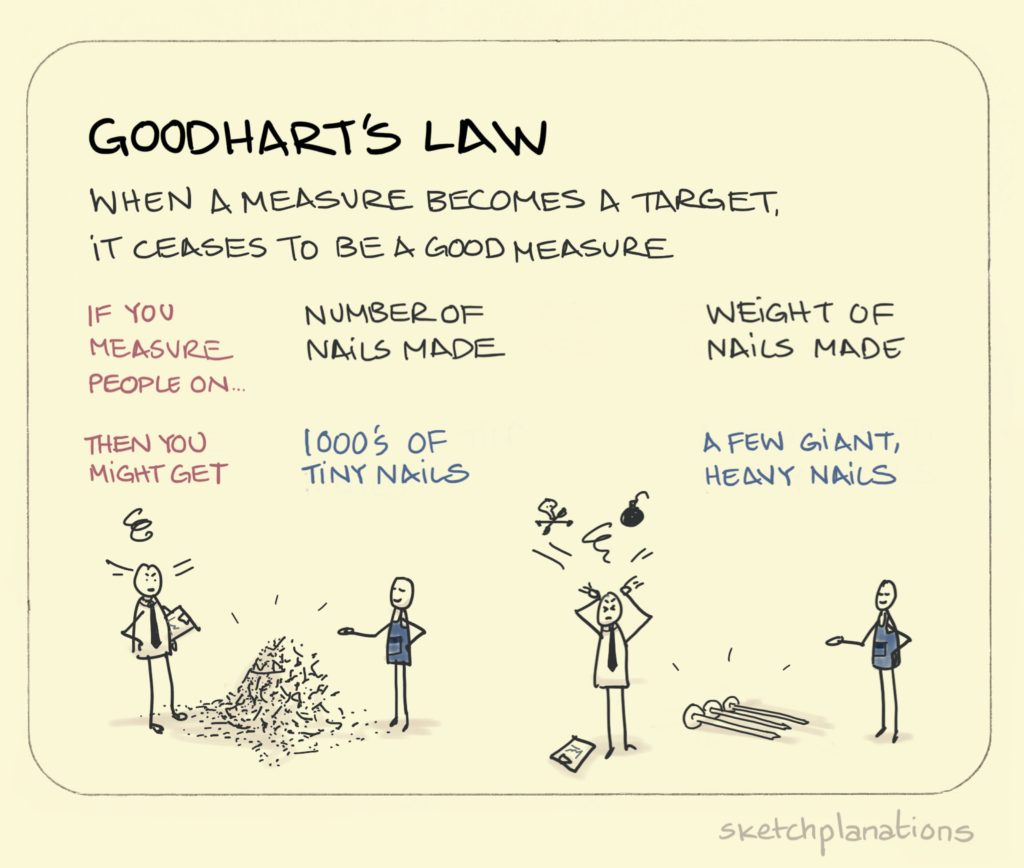
    I have forgotten where I first came across Goodhart’s Law. It was probably Farnam Street. It states that “when a measure becomes a target, it ceases to be a good measure.” An illustration should help.

    https://sketchplanations.com/goodharts-law

    In the organisational context, it serves as a great lens to evaluate strategy and progress. As the illustration above shows, the entire direction of a desired goal can be changed when measures become targets. But, and maybe it’s a Baader -Meinhof phenomenon, I am now seeing different versions of it everywhere.

    To set some context, as more and more things have been digitised, the volume of information has just exploded. For instance, before the advent of social media, there were limits to one’s “people like me” canvas, because even an awareness of them was constrained by physical distances and the limits of one’s social circle. It had to be in real life, and public spaces like a cinema or even a vacation spot were probably an extreme. Social media changed that scale massively. Many factors including this volume of information, the lack of a granular understanding of the lives of this new set of people whom you’d never meet, and the innate human desire to do better than neighbours meant that appearances became the norm. Since we are not wired to process such large volumes of information, we dug deeper into ‘measurement by proxy.’ Not that this mode of measurement is new. For instance, we have used material manifestations (apparel, cars etc) as a measure of wealth. The stock price is a single-number measure of everything about the company. But with abundance of choice and the limits of processing power, we started developing heuristics and measuring what was easy. Meta photos (FB/Insta/WhatsApp) became a measure of everything from the quality of life to the strength of relationships. Popularity as a measure of excellence, price as a measure of quality, fitness as a measure of health, #booksread as a measure of erudition and so on.

    How does this connect to Goodhart’s Law? We end up optimising our resources for the measure, not the end goal. Which means that though the goal is say, happiness and a good quality of life, we end up aiming for the measure. From the kind of photo that will get more likes to buying that thing/experience that will surely make us happy. And as we feed this more, the mind keeps on wanting. The happiness fades in a short span of time. And as the Buddha has wisely pointed out, that loss of happiness is what becomes suffering.

    In the AI risk narrative, there is the story of the paperclip maximiser, a seemingly trivial task of maximising paperclips that might lead to “first all of earth and then increasing portions of space into paperclip manufacturing facilities”. The corresponding human version that I wrote in Peak Abstraction was that maybe we will get to a state where, if we get enough likes on the couple photo on Insta, there would be relationship bliss! What a wonderful world.

  • Artificial Culture

    It’s almost a year and a half since I wrote In Code we Trust. More recently, Tim Ferriss had Eric Schmidt on his podcast (transcript). In what I thought was a fascinating discussion based on the latter’s recent book  The Age of AI: And Our Human Future, (coauthored with Henry A. Kissinger and Daniel Huttenlocher), they also brought up AlphaGo. Go was a game that humans had been playing for 2,500 years, and it was thought to be incomputable until DeepMind’s AlphaGo beat world champions. As Schmidt explained, some of its moves and strategies were the kind no one had thought of before. In Kissinger’s words, we’re entering a new epoch, similar to the Renaissance, this age of artificial intelligence, because humanity has never had a competitive intelligence, similar to itself, but not human. To note, a more recent version – AlphaGo Zero self-taught itself without learning from human games, and surpassed its predecessor in 40 days!

    (more…)
  • Designing my desires

    A world of transactional efficiency

    It was a little over 4 years ago that I first brought up the increasingly transactional nature of our interactions and even existence in general. I was reminded of it while listening to Amit Varma’s podcast with Nirupama Rao. Interestingly, they brought up contexts similar to what I had used – mails and rails. I had used birthday greetings going from long mails/cards to a ‘Like’ on someone else wishing the person a birthday. Travel was the other context, and I liked Amit’s example of train journeys being a unique experience. In contrast to say, the flight from point A to B.

    Last year, around the same time, I had framed it as An Efficient Existence, and used the example of Taylor Pearson’s 4 minute songs – the timeframe he had mentioned for songs in the context of  certain rules that creators need to follow if they want their work to be consumed and appreciated. I had brought up an earlier era of Floyd, Springsteen, Fleetwood Mac etc whose songs didn’t follow that template. Demand or supply, what happened first, I asked. Does it have to do with the abundance of choice now, and the demands of instant gratification? While templated packages for all sorts of consumption are increasingly the norm, people also want to finish and move on to the next thing on their list. Transactions. (Generalising), there seems to be very less desire to have an immersive experience. Outside the screen, that is. As the Spotify ads show (unintentionally and literally) we’re usually in a bubble, oblivious to our surroundings.

    (more…)