Category: Choices

  • Understanding the revolution

    No, I don’t think I am exaggerating when I call it a revolution. Relatively, it’s not a bloody one yet, but we’ve only begun. As individuals who are part of it, it is difficult for us to acknowledge, let alone grasp its consequences now. (read for perspective)

    To deal with something, I first need to make an attempt to understand it, and this post is just that. To begin with, I have noticed at least two parallel forces that have worked to get us to this point. The first is privilege and increasing inequalities in society, on which I have written quite a few posts. The second is a subject on which I’ve only written a couple of posts – intersubjective reality, but its influence is equally important. Let me elaborate.

    “But that’s the truth!”, I often hear, and for a while now, my response has been “Whose truth?”  For an absolutely mind bending perspective on it, read The Case Against Reality. (thanks Gautam) To massively paraphrase, we build “realities” based on the stories we tell ourselves, and this is completely shaped by our perceptions and biases. Everything we perceive is a mental representation and there is nothing objective about it. The closest we get to reality is by experiencing something ourselves, and that is inherently subjective. As Scott Adams brutally but succinctly put it, “Humans did not evolve with the capability to understand their reality because it was not important to survival. Any illusion that keeps us alive long enough to procreate is good enough.(more…)

  • Prisons of happiness

    I read a few articles recently debating whether the purpose of life is happiness or usefulness/leading a worthwhile life. The Aztecs as well as contemporary thinkers favour the latter. I am not convinced though. For starters, I think ‘purpose’s is something our consciousness insists on. The world will go on without us, it is for us to derive a sense of meaning for ourselves. And since it is subjective, I’d optimise for happiness/avoiding discomfort (I’m bunching it together for now) simply because my usefulness/being worthwhile to others around increases when I am happy.

    This is a topic I have been circling for a while now – There is no middle path? was a take on happiness vs avoiding discomfort, for instance. A favorite line of thought from “And the Mountains Echoed” has been coming back to me in various forms from various people in the last fortnight. “..but most people have it backward. They think they live by what they want. But really what guides them is what they’re afraid of. What they don’t want.” That is essentially avoiding discomfort. (more…)

  • Growth, Prosperity & Infinite Games

    One of the things that struck me in Douglas Rushkoff’s “Throwing Rocks at the Google Bus” was how much the line of thought on growth resembled the “infinite game” philosophy of James P Carse. In the former, the author explains how, as money becomes an end to itself as opposed to a means, a system built on a central currency gets into a growth trap. i.e. growth for the sake of growth. To frame it in the second book’s context, this tends to be a zero-sum game for all involved. There is a clear winner, and that winner takes all. i.e. a finite game.

    Rushkoff explains how at this point in time, platform monopolies, (e.g. Amazon, Uber, AirBnB) and businesses in general, are playing finite games. And that is how growth has become the enemy of prosperity. In the second half of the book, he calls for more sustainable (and inclusive) ways of growth. This has much in common with Carse’ definition of an Infinite game, whose only purpose is the continuation of play, and sometimes, bringing more players into the game.  (more…)

  • There is no middle path?

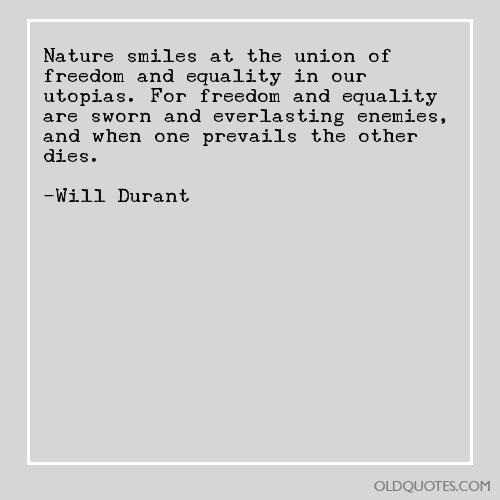
    Will Durant is a pleasure to read, and it has largely to do with the succinct way in which he expresses complex thoughts, be it in history or philosophy. In The Lessons of History (by him and Ariel Durant) I found this idea particularly thought provoking –

    346474

    Very intuitively, I have always thought the ideas of freedom and equality as ends which are allied. But a bit more thought, and helped by the Durants’ arguments, and it is quite evident that they aren’t. This reminded me of something I’d written about five years ago on happiness vs peace of mind. (read the very interesting comments by Surekha on it) (more…)

  • Informed Renunciation

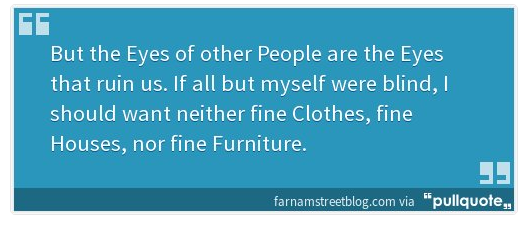
    Around me, I see a few people who seem to have stayed put at a certain point in time in terms of their lifestyle – the clothes they wear, the homes they live in, the gadgets and vehicles they use, the content they consume, and so on. In many cases, I have attributed it to age. Maybe they just couldn’t perceive the incremental enjoyment that the new thing offered, or maybe priorities changed – either in terms of economics or interest. But there are also relatively younger folks who eschew a lot of things I might consider a need. In both cases, I wonder whether it is a conscious choice/ trade off, or something that just slipped in unobtrusively until it became a way of life, or something that circumstances forced.

    Untitled

    (Ben Frankin, via) (more…)