Taylor Pearson wrote an excellent primer on blockchain a while ago. While explaining why blockchain matters, he quoted something by Alfred North Whitehead
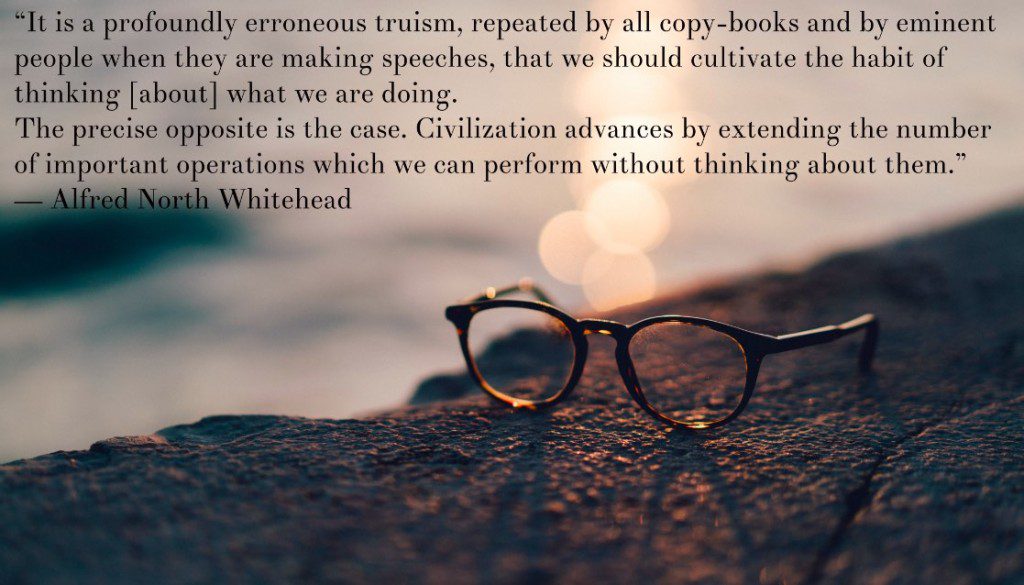
Photo by Joshua Newton on Unsplash

Taylor Pearson wrote an excellent primer on blockchain a while ago. While explaining why blockchain matters, he quoted something by Alfred North Whitehead
Photo by Joshua Newton on Unsplash
I don’t watch cricket anymore, but did catch the video of Dhoni’s very colourful exchange with Manish Pandey in the 2nd T20 vs South Africa earlier this year. Interesting as it was, what really caught my attention was how Dhoni calmly hit a six in the very next ball! Think about it – you’re annoyed about something but able to quickly not just get over it, but do a spectacular job in the next few seconds! This not a one off incident, because this is essentially how the man earned the “Captain Cool” moniker.
I related it to this fantastic long read at Farnam Street about how fighter pilots technique quick and accurate decisions. It’s called the OODA loop and the letters stand for Observe, Orient, Decide, Act. Daniel Kahneman’s Thinking, Fast & Slow is one of the most insightful books I have read, but I wished there would be an application guide on how to practice it in daily life. I think the OODA loop is the best practitioner’s guide I have seen. (more…)
Towards the end of The Way of Zen, Alan Watts has a line that creates a binary between natural and good. I must admit that I felt some validation there!
Over many years and experiences, the resident (and dominant) cynic in me has come to believe that “naturally good” in terms of a person’s character and behaviour can only be an act. This is also coming from the unoriginal observation that we have a “delusion of free will”. The choices we make are less based on a conscious free will, and controlled more by a combination of genes which have fought and survived over millennia and one’s own experiences and environment. While cooperation and goodness are indeed a part of the survival toolkit, they are not the dominant aspects. We’re selfish, the only difference is in the degree of the act, and how much we have trained ourselves. (more…)