Category: Life Ordinary

  • More on the Uncertainty Principles

    Ok, so it’s not long back that I wrote about uncertainty, but in this real time world, I can’t blame myself for thinking of it on a regular basis. I wonder if it also has to do with the macro environment I grew up in – the typical 80s kid in India, whose ‘options’ across the board – from movie heroes to restaurants to soaps and television channels usually boiled down to one. (remember?)

    From my own experiences, I know it is possible even now, but it’s a choice and a very difficult one at that, and one that might be difficult to reverse later. An extended trip to Kerala sometime back- home, made me realise that there are those who have made that choice, or rather, have for some reason remained in a lifestyle with minimum choices. Belonging to an earlier generation, but who have refused to let the ever changing world rock their boat. It isn’t that the boat isn’t rocked regularly in their ‘small’ world, but the rocking seems to happen within a framework – as though there is some tacit understanding with the cosmos, a reward for not adding to the cosmos’ complications.

    Uncertainty has a permanent live-in arrangement with most of us, and now dictates the relationship so much that we take it as a given. I am not a comfortable partner, but for various reasons, can’t do much about it. I wondered what the future would hold. As is becoming a practice with me, I found interesting perspectives in the book I was reading – ‘The Mammoth Book of Short Science Fiction Novels’.

    Asimov’s “Profession” had a world where a person’s station in life, and life itself is dictated by certain tests he undergoes at 2-3 points in life – Reading Day, Education Day and every individual is slotted basis the result of these tests. (not exams, mental examinations which figure out the natural aptitude of the individual’s brain) John Jakes’ “The Sellers of the Dream” has a world where companies sell a ‘fashion’ for a season, which includes physical and mental changes done to an individual and changes his/her personality. But in Larry Niven’s “Flash Crowd”, one of my favourites, I sensed the best summation of our current status “For each human being, there is an optimum ratio between change and stasis. Too little change, he grows bored. Too little stability, he panics and loses his ability to adapt.”

    I wonder if this is timeless, and am not too certain that the last sentence on losing the ability to adapt is very encouraging.

    until next time, certain tees I can’t live without

  • A People Person?

    Scott Adams’ post titled “People who don’t need people” (via Surekha) reminded me of Asimov’s Spacers, the first humans to emigrate to space, and their life on Aurora, the first of the worlds they settled. Scott Adams predicts that “we will transfer our emotional connections from humans to technology, with or without actual robots. It might take a generation or two, but it’s coming. And it probably isn’t as bad as it sounds.

    In the huge canvas that Asimov had created, the Spacers chose low population sizes and longer lifespans (upto 400 years) as a means to a higher quality of living, and were served by a large number of robots. As per wiki, “Aurora at its height had a population of 200 million humans and 10 billion robots.

    These days, as I experience the vagaries of the cliques and weak ties – not just Malcolm Gladwell’s much flogged social media version, but even real life ones, I can’t help but agree with Scott Adams that it won’t be as bad as it sounds. I probably wouldn’t mind it at all.

    When I feel like a freak
    When I’m on the other end of someone’s mean streak
    People make fun I’ve got to lose myself
    Take my thin skin and move it somewhere else

    I’m setting myself up for the future
    Looking for the chance that something good might lie ahead
    I’m just looking for the possibilities
    In my mind I’ve got this skin I can shed

    Scott Adams began his post noting that humans are overrated. Sometimes, I wonder whether humanity is, and whether losing our current perceptions of it would actually make a difference. (earlier post on the subject)

    Lyrics: Invisible, Bruce Hornsby

    until next, bot.any

  • Insignificance

    I remember writing this post about 4 years back, with an insight on why I didn’t particularly like to travel. Things have changed since then, and I do travel as much as possible these days. The odd discomfort of viewing masses of humanity still persists, but the reasons are more nuanced.

    What reminded of that post was this article that beautifully expressed the discomfort with the title “The Sad, Beautiful Fact that We’re All Going to Miss Almost Everything“. The article uses this in the context of books, films, music, television and art. But I relate it more to places and people. I still remember that the saddest part of leaving Leh was that it was perhaps my only visit to the place and I had not seen everything that had to be seen. In the case of people, the rise of the statusphere (Facebook and Twitter) has only added to the feeling that one is constantly missing something significant.

    It is probably going to get worse, unless of course, we manage to do the Matrix-USB type thing of instant information absorption. Even then, it would probably go the way things are headed to these days anyway- consuming without experiencing. The real time challenge of being updated about people would still exist. And perhaps it will end up the way the line goes, “we will increasingly be defined by what we say no to”. But, as the author of the article I linked to, above, notes,

    It’s sad, but it’s also … great, really. Imagine if you’d seen everything good, or if you knew about everything good………That would imply that all the cultural value the world has managed to produce since a glob of primordial ooze first picked up a violin is so tiny and insignificant that a single human being can gobble all of it in one lifetime. That would make us failures, I think.

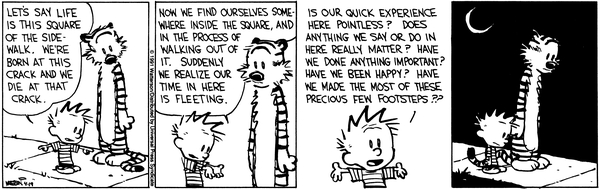
    If I had to adapt that to places and people, I could say that the creator might feel insignificant if we could discover all of it in a lifetime. However, the collective advance of humanity is not a complete solace when it comes to the individual’s existential angst. As one of my fave Calvin strips go

    until next time, insignificant choices too?

  • Stop. Watch.

    Playing music on the mobile as you drift to sleep is probably nothing new. I’m sure many people do it. The snag of course is managing to switch it off before you sleep. You could create a list and make sure it stops after x number of songs, but there’s some joy to be found in random shuffling. There’s probably an app somewhere that will somehow manage it, but I haven’t found it yet. What I would like is something that will sense my breathing pattern and switch off, but that might be wishing for too much 🙂

    ‘The Tibetan Book of Living and Dying’ brings up an interesting point, when it discusses sleep in the context of death and the state of consciousness. It asks

    How many of us are aware of the change in consciousness when we fall asleep? Or of the moment of sleep before dreams begin? How many of us are aware even when we dream that we are dreaming?

    From the music example, it is easy to guess that I certainly am not. In fact, my experiment on this failed too, as I completely lost track during a conscious attempt to ‘know’ the moment I fell asleep. I then realised that I should perhaps try being ‘conscious’ while I am awake without flowing from thought to thought unconsciously, especially since D is not very encouraging about me trying to sleep more. 😐

    Try recollecting the last 15 minutes minute by minute, and you’ll sense the unconsciousness 🙂

    until next time, asleep yet?

  • Autonomy.. or not?

    Much as filmmakers love to claim that there’s no formula, sequels happen. And when I see sequels completely spoiling the memory of the original (in this case, the Malayalam movie August 15, whose first edition ‘August 1’ released in 1988 was a scene by scene lift from Forsyth’s awesome “The Day of the Jackal”), I wonder if this approach is just the greed to milk the most out of a franchise or just the lure of a safe template. In the case of movies, it’s probably more the greed.

    But I realise that the latter goes not just for movies, but many decisions in individual lives as well – from where we go for a dine-out to the travel plans we make, and many other preferences that somehow seem to get a life of their own and run on auto pilot after sometime.

    The auto-pilot mode is quite comfortable really, especially if you’re not aware of it. The problem, I think, arises when templates are followed but expectations are not met. That’s when the questioning begins, and ‘awareness’ begins to dawn. Then, unless you allow yourself to fall back, it becomes an itch you can’t scratch away.

    And you see the mask you unwittingly made for yourself slowly slipping, and then begins that terrible phase when you realise that there’s nothing to hold it up and nothing to take its place.

    until next time, mask charades