Category: Life Ordinary

  • Kaumpromise

    There is nothing quite like death to shake a worldview. There is a reset that happens in one’s head, and the relationship or even lack of it, changes this only in degree, not kind. There is no immunity either, by now, I’d know.

    This one took me out of my comfort zone, in terms of physical location. In the last year or so, especially since the previous time I encountered death, I’ve felt myself become a tad more dispassionate about Cochin as relationships seem a lot more fragile. I am myself much to blame, decades of muscle memory of holding others at arm’s length is hard to shake off. And this is beyond Cochin, and in a place where I have avoided staying for more than a night. Each time I have tried to tell myself that my creature comforts can be skipped for a few days, there has been a rebellion within and I’ve been forced to say “I can’t.”

    I brace myself this time too, and stood in a corner, observing others. I think we all are capable of projecting an aura of “do not approach” when we so want. Mine is at full blast. And yet, one child (whom I first knew as literally a child, and is now about to become a CA) breaks through it, and asks me if I I am ok, if I need anything. Maybe it is that, maybe it is the death gut punch, or maybe it is my newfound willingness to look at (at least some of) the world without a ‘transaction alert’ warning, but the next evening, I am at the table for evening tea, doing stuff I do when I am comfortable with people – pulling their legs, except these are people I had never even said a decent hello to. The day after, I am pushing someone to accept something the family feels he should take, and he is reluctant. They’re all crying, I think I might have forgotten how to. Says a lot.

    But the larger facade broke before that evening at the table, as I watch folks of all forms walk through the door to catch a last glimpse of the one who had passed. It strikes me that I didn’t know more than a few people who would care to drop in to see me before I went up in smoke. The image of an old man, barely able to move a few steps, break down in grief, is still alive in my mind. Sometimes, I realise, it takes death to understand the meaning of life.

    A few days later, I am back in Bangalore. I see the unhindered adulteration in packaged food, in the things that restaurants do, and in general, the greed in every seller, I wonder if that is what has been lost when faceless people sell things to faceless others. It is easier to not care when you don’t see the people you harm. That is not an option in a smaller community or at least it gets punished faster.

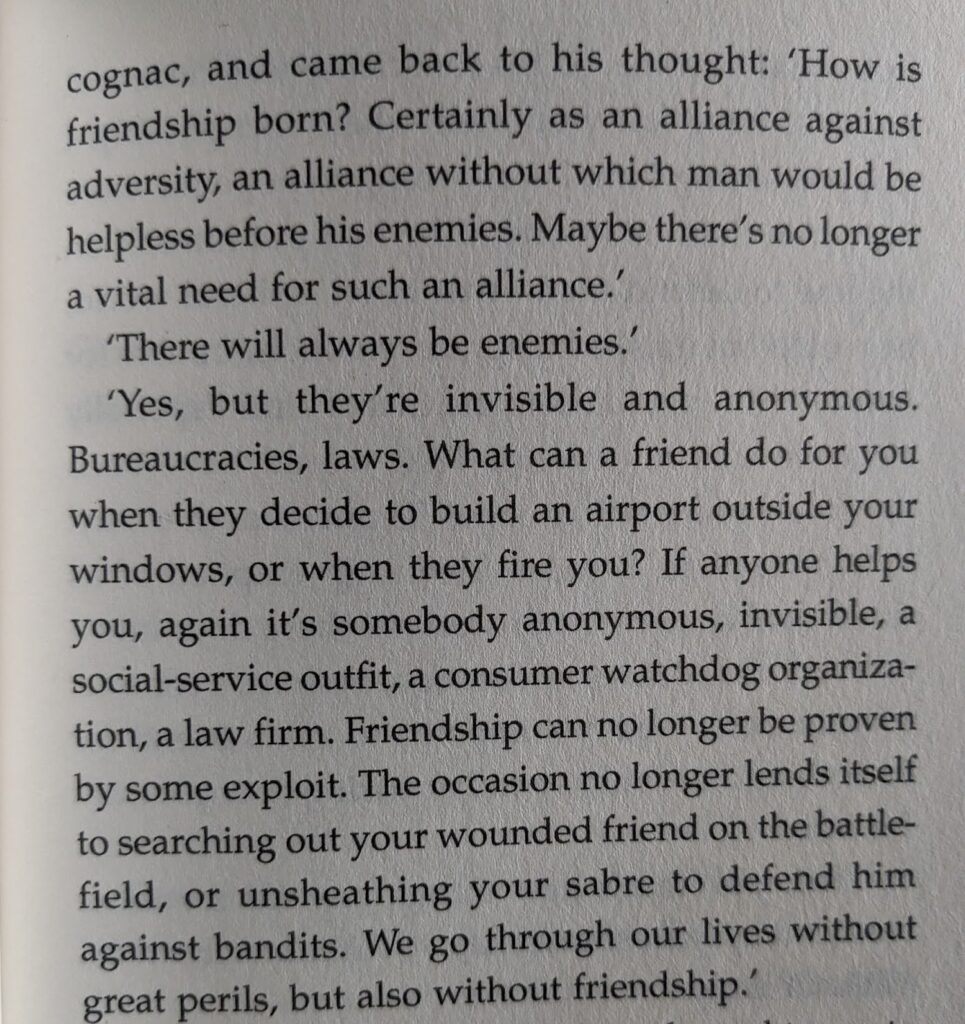
    I am also reminded of what else family and community can do when I read Milan Kundera’s brutal take (in Identity) on why friendship isn’t in vogue these days.

    Milan Kundera Friendship

    When I zoom out of my individualistic approach, I realise I had seen community the way it was meant to be. Life savings in cooperatives, because it’s a world in which everyone still knows everyone else or is just a degree of connection away. Local cable over OTT because births and deaths and important local news is covered in the former. It isn’t perfect, and I won’t romanticise it because I know I wouldn’t be able to tolerate the scrutiny beyond short bursts, but its manifestations are revelatory. As the insightful narrator in Gullak says, yeh trauma bhi hai aur therapy bhi. And I wonder what the proverbial middle path is.

  • Living a life of intentionality

    Context Setting

    Man can do what he wills but he cannot will what he wills.

    Arthur Schopenhauer

    Intelligent people know how to get what they want. Wise people know what’s worth wanting.

    Shane Parrish

    My typical simplistic approach to problem solving is why, what, and how. So here we go:

    (more…)
  • I am the absolute

    The translation of Ahaṁ Brahmāsmi. Don’t worry, it isn’t my ego talking.

    I was reminded of this thanks to this fantastic episode on Lex Fridman’s podcast – with Joscha Bach.

    I remember it was a while back when I first heard the postulation that Adam & Eve hurriedly covering themselves after eating the apple was an allegory for humans first developing consciousness about themselves. Joscha extends this and talks about how the Bible, specifically Genesis 1, has sections on the mind systematically creating a a game design that helps interact with the world. In his own words,

    where it’s being described that this creative spirit is hovering over the substrate and then is creating a boundary between the world model and sphere of ideas, earth and heaven, as they’re being described there, and then it’s creating contrast and then dimensions and then space, and then it creates organic shapes and solids and liquids and builds a world from them and creates plants and animals, give them all their names. And once that’s done, it creates another spirit in its own image, but it creates it as men and women, as something that thinks of itself as a human being and puts it into this world. And the Christians mistranslate this, I suspect, when they say this is the description of the creation of the physical universe by a supernatural being. I think this is literally a description of how in every mind a universe is being created as some kind of game engine by a creative spirit, our first consciousness that emerges in our mind even before we are born and that creates the interaction between organism and world. And once that is built and trained, the personal self is being created and we only remember being the personal self, we no longer remember how we created the game engine.

    This is basically the development of consciousness. And we cannot remember the time we made it. The game engine is the universe we keep building until we are no longer around.

    And the Bible is not alone in this. Remember Samudra Manthan from Hindu mythology, it is full of symbolism. An individual in this world seeking immortality. Transcendence. The mountain Mandara represents the human mind and the manthan is its churning in the vast collective consciousness. The devas and asuras obviously are the positive and negative influences. Vishnu’s koorma avatar (turtle) which stabilises the mountain during the churn point to how we should try to focus our mind. (on God, but I will abstain from that part :D)

    Halahala, the emergent poison that Shiva swallows (earning him the name Nilkanth) shows how we must confront our inner demons . From Kamadhenu to Airavata to Kalpavriksha, there are all sorts of distractions that are possible. Dhanvantari appearing with the amrit symbolises the importance of health. The amrit is what allows you to merge with the collective consciousness and thereby in a sense become immortal.

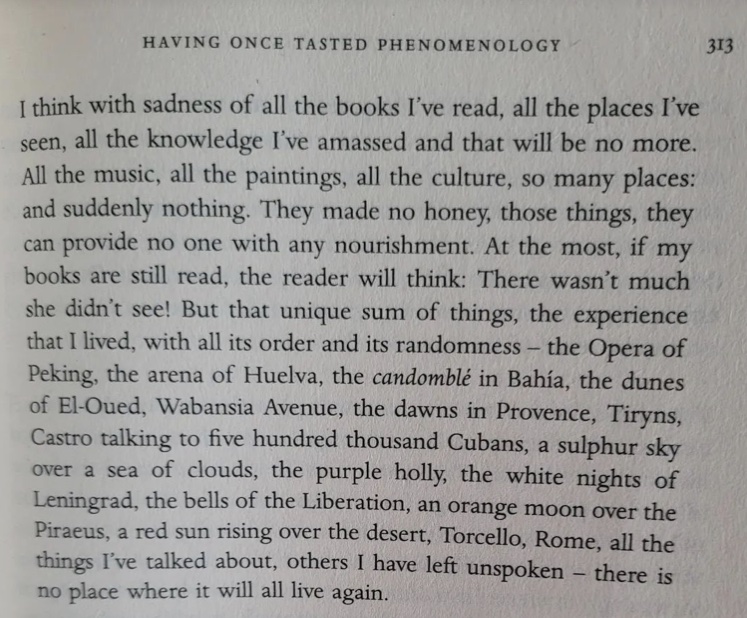
    Ok, snap. I don’t think I will get there. In The Flavours of Death, I had posted an excerpt from Simone de Beauvoir’s The Coming of Age

    Simone de Beauvoir Death The Coming of Age

    …’there is no place where it will all live again’. And that’s just it. Outside of photos, notes like these or maybe conversations with friends, the universe that was created in my mind will no longer exist when I die. It dies with me. And thus Ahaṁ Brahmāsmi. The universe that I made with all its affections and peeves and desires and animosities and fears and longings and expectations, disappears when I take my final breath. I will not be around in the aftermath to feel that sadness, but I am here now, and I do feel the twinge.

    Aham bummed asmi ? #okbye

  • Slowly and then suddenly…

    …because we’d like to have the best physical abilities that any species has in terms of moving, seeing, hearing, strength etc. From the mind’s perspective, an organ that could upgrade itself to store more, to experience more, to work faster, to be more accurate. And it doesn’t stop there – reading others’ minds, telepathy…

    We will see the beginning of all this in our lifetime. The progress might be slow, so slow that perhaps later generations wouldn’t realise how we’d lived without most of the artificial things that they would be taking for granted. How would this affect the experiences of life that we go through now – joy, sorrow, pain, ecstasy, spirituality?  How long before what we call human would give way to a being that would probably exist forever, possibly without living? Will they even realise it when it happens?

    The man… the machine

    This is from my first post on what I called the augmented human, back in 2009. And I continue to ask myself what the man-made man will be like.

    (more…)
  • Opinion poles

    A few months ago, D and I were talking about something at work making me angry. Since Yoda has said that it is fear that leads to anger, and is the path to the dark side, I needed to figure out the root of that anger, and then understand the fear. I knew it wasn’t job loss (I had already quit), but was stuck.

    I would learn later we tend to focus on negatives, because in the savannah, avoiding the things that might kill you was more important than seeking the things that will give you pleasure. Pleasure and pain are just feedback mechanisms, not an end. Whether it’s the pain caused by your body failing you, or mental agony. Psychological pain is an indication that our subjective map of the world needs a revision. (Cognitive Fitness, Anil Rajput) And that indeed turned out to be the case.

    D insightfully pointed out that my faith in my value system, which I mistakenly assumed others at the workplace also subscribed to, might have been broken by the incident. And that would make me afraid because that is the only one I am comfortable with, and any changes in it would be a compromise I couldn’t abide by.

    I would also learn later that there is a term for something like this, borrowed from physics. Hysteresis – the lingering values of a previous age continuing to guide our judgments.

    The last couple of months have been a great learning experience. About myself, the world at large, and the relationship. One of the important lessons has been that I am free to hold on to my values, and continue to negotiate with others, but as Marcus Aurelius rightly said, “the universe is transformation, life is opinion.