Category: Life Ordinary

  • Oh, my 90s

    A couple of years back, I had written this post about the golden years of Bollywood music in my life – the 90s. The search for a restaurant within JP Nagar before we watched Talaash (at Gopalan) took us to Kakori Kababs & Curries. The restaurant review is for later, but what really made the day for me was their instrumental music collection of 90s Bollywood music. I listened to songs from Sainik, Imtihaan, Damini and it was amazing how I could remember most of the lyrics despite not having heard these in years! Just goes to show the power of those imprints.

    Later, Talaash also took me on a sidetrack – memories, and I thought about how our reality changes massively over time. Many things that seemed to be the crux of our existence at one point in time slowly fade away into memories and then into archives of insignificance in the larger chapters of our lives. We can’t even mourn or be happy about them because we don’t remember them in the first place.

    So the next day, I started working on this playlist, just so that every time I go through my YouTube channel, I would remember, and could help myself to a blast from the past. Music has always been time travel for me. Probably, many years later, when the memories surrounding these songs and the times they existed in slowly begin to fade, and they seem like a dream from years back, (what they say when they come across the lamp post at the end of The Chronicles of Narnia Part 1) this would be my crutch to go hobbling on that path. 🙂

    until next time, the soul of music

  • Posture child

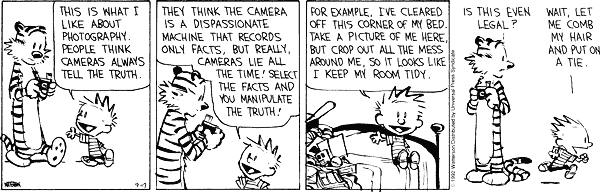
    I guess that’s the reason why Calvin & Hobbes is so utterly loved by so many folks. Profound, timeless, universal truths expressed in such a unique way!

    I had never seen this one until recently. Why blame Instagram for filters? They existed long before anyway 🙂 I thought this strip found great application in all kinds of posturing from time immemorial, and especially so now – in the social media context, when everyone is a publisher. Over a period of time, I wonder how fast we would forget who we really are (if ever we come to know it or knew it) It would probably be irrelevant in the real-time era. We would be the statuses and photos and everything else we like and share every minute. After all, I’m no longer the person who wrote it anyway, and who’s to say the non posturing self is the real deal?

    until next time, impostor 🙂

  • A life less rich…

    On Quora, there is a question which has been getting some very interesting answers – “Is getting rich worth it?” I remembered my post “Halve Notes” from sometime back when I saw it. Rich is of course a very relative term – relative not just in terms of comparison with others, but dependent on time, one’s location etc. Also, factors like one’s health, emotional well being etc have the potential to change the worth completely.

    I don’t think I want to get super rich. I still ride an Activa, live in a rented apartment and  my consumption patterns do not really conform to my income, or as some say, my age. 😀 I have been trying to analyse why. I do like to spend on things I enjoy doing – books, movies, food, travel to name a few – and would not want to forego these for lack of money. But I also do not want to get used to things/habits I might find difficult to sustain later without compromising on my belief systems. So it’s a balancing act, with a bias towards caution thanks to my middle class upbringing perhaps.

    My dystopian future is an old age where I cannot live life on my own terms. That’s probably why I found this story -of one Mr. PM Sahay – so distressing. It’s part of The Delhi Walla’s commendable 130000 portrait project. Mr.PM Sahay is a 74 year old retired bank manager who is forced to sell puppets in Connaught Place to  sustain his family. (I am hoping none of his Rohtak neighbours happen to see all this on the web!) He travels 50kms from his town every day. His legs ache, he says and he has to support himself on the columns and sit on manhole covers near rubbish bins. He is a victim of circumstances. The best laid plans can go wrong, after all. Being rich at least takes care of some things, it would seem.

    until next time, a rich life…

  • City Zen

    Sometime back, in a post, I quoted Paul Theroux “My own feeling is that city dwellers invent the cities they dwell in. The great cities are just too big to be comprehended as a whole, so they are invisible, or imaginary, existing mainly in the mind.” 

    The other day, during a cleaning exercise, I came upon an ‘old’ Bangalore map we had taped together from printouts. (I remember the site had separate maps for north, south, east and west 🙂 ) Back in 2003 and thereabouts, this used to be our reference when we had to travel to places unknown. Unknown at that point included Malleswaram, Cantonment, Jayanagar and such. 🙂 The city that we had created in our mind included Koramangala, Indiranagar and MG Road. Yes, just about that much. 🙂 But the outdoor media selection that my brand job entailed ensured that I soon became familiar with many parts of Bangalore. In an earlier job, my office was at VV Puram and those not familiar with the place would say that it was far. Actually, my travel time from Koramangala was quite less.

    A few weeks back, we decided to check out Haralur Road as part of the Realty Check endeavour. Despite the advanced features of Google Maps, and its time estimates, we thought it would take a while to get there from Koramangala. Not only did it turn to be near, we got back much earlier than expected. I’m sure the area will be unrecognisable 5 years down the line. Just like say, HSR has evolved. 🙂

    As Bangalore creates its own little self sustaining bubbles, it’s not just the city that will be created in the mind, it’s probably the distances too.

    until next time, cityscape

  • Plan C

    This post has been pending for a while, the date of publishing of the article that inspired the post is evidence enough. It is about people who leave their jobs to follow their passion, but instead of the success stories we are used to, it focuses on the difficulties on that path. Even if you’ve not taken that path already, it’s quite possible that you have contemplated it. It’s romantic – the freedom, being your own boss and doing the thing you like – Plan B. But it’s not easy, and it begins as early as even identifying one’s passion. (must read)

    Interestingly, NYT themselves had an article almost a year later that asked “What Work is Really For” and answered that with an Aristotle quote “we work to have leisure, on which happiness depends.” Though I didn’t know about this quote until recently, this is a perspective that I have often used to debate with people who say those who do not like their jobs should quit. There are many reasons why people don’t, and one of them is consciously making a choice to work (possibly on things they don’t enjoy) for the 2 days (and vacations) when they are able to spend their resources – money, effort and time – on things they enjoy.

    The reasons people don’t scale up those 2 days could be many, including the difficulties involved in the early stages of setting up, and then maintaining a positive balance – of money and life. Money is after all an essential resource. It buys things, it opens doors. But when your passion becomes your work and your principal source of money, does it feel the same? Or does it become a job?

    I liked the second NYT article also for its last 3 paragraphs. It addresses the money conundrum. It talks about how right from when we are born, we are taught to be consumers, thanks to capitalism, which though calls itself an open market where we have the freedom to buy is actually a system unto itself.  The choices are not really independent. It points out that education should be meant to make us self determining agents. True freedom requires that we take part in the market as fully formed agents, with life goals determined not by advertising campaigns but by our own experience of and reflection on the various possibilities of human fulfillment. But that’s not an easy path either. It calls for independent thinking and a subjective view of fulfillment and happiness. And that brings us to the familiar “to each his own”

    until next time, work it out 🙂

    Bonus Read: Six Rules to guide your career