Category: Life Ordinary

  • The narratives that we drive

    It probably started with the ‘narrative’ post, but a few things I read later made me wonder about our choices of narratives and where this could be leading to. Some narratives happen to us depending on our circumstances – time, geography etc, and some we choose of our own volition, or so it seems. Continuing from the earlier post, I think it’d be safe to say that with a more connected world, our ability to choose narratives has been heightened. Abundance of creation, and consumption. I think this was the related fantastic little piece of content that triggered this entire line of thought. It has some thoughts on material consumption, and though delivered differently, it has some profound insights as well.

    Partly thanks to that abundance, the noise around us has also increased, and has found better ways of being amplified. To quote Clay Shirky,

    It is our misfortune, as a historical generation, to live through the largest expansion in expressive capability in human history, a misfortune because abundance breaks more things than scarcity.

    In fact, one could argue that compulsive consumption (material, and otherwise) is one of the reasons for our ‘emptying out‘. (do read) As I was writing this, I had a sense of deja vu, and some searching pointed me to this, written 3 years back, in which I tried to figure out whether there was a middle path between a self that was driven by others’ perceptions and one that was driven by a moral compass dictated by few external stimuli. In that post, I had quoted from Paul Graham’s ‘addiction’ post,“we will increasingly be defined by what we say no to” I think that still holds true.

    In this era of abundance, what narratives should we choose to be part of? How can one be objective, is one even right by being objective? An excellent post whose advice I hope to implement more is this. I really couldn’t disagree with any of the 30 things mentioned, it just seemed intuitively right. But I think this would serve as an excellent first lesson..

    (via)

    until next time, an open and shut existence

  • The narratives of our lives

    This wonderful post at Ribbonfarm got me thinking about places as narratives. Specifically, it reminded of something I wrote a few years ago on the subject – Watermark. The conclusion of the post that got me thinking was this – The space we inhabit is more topological than ever as we locate our positions within networks instead of maps and this may be the most true narrative about the present age: No matter where in the networked world we’re coming from or traveling to, we’re already there.

    Indeed, places were probably the earliest narrative that existed – in our early days as a species, we probably didn’t move away much from the place we were born. As civilisation evolved, I think many more institutional narratives were added – religion, nation, culture, and so on. In the era of consumption, even brands (media and otherwise) have attempted to invade the space. For example, in our own lives, there are many narratives that we consciously or otherwise become part of – the kind of books we read, the music we listen to, the movies we watch – in short, popular culture. Each generation has its own set – from Ramayan on TV to Facebook.

    Sometime back, I had written about the internet being the zeroth place – the one that supersedes all the other places, including the physical ones, in our life. Especially with a social layer, it has the capability to accommodate all our narratives – individual and societal. The Ribbonfarm post talks about how the default nature of the digitised era is to store, and no matter how much data our society manages to produce, we’re even better at finding places to keep it. In that sense, it isn’t just geography that the internet seems to have removed as a driver, but time itself. The other day, when I was reading The Confusion, I happened to read a post from 2005 which summed up how I felt about The Baroque Cycle in general. Yes, I tweeted about it. 🙂 But I still can’t be sure about the evolution, and wonder if the abundance of storage might drive us to consciously seek out ways where the information will not be stored. eg. the rise of Snapchat.

    I have always felt that narratives are a way to fulfill our sense of belonging. Across time, this role has been played by several entities. The internet has made it possible for even the smallest of niches to have its own narrative. Where does it go from here?

    until next time, comment on the narration? 🙂

  • Frazer Town Feeding Frenzy

    On hindsight, it seems unpardonable that we lived in Cox Town for over a couple of years and didn’t really explore the Mosque Road – MM Road area, especially during Ramadan. But that story is more than half a dozen years old and the entire experience is way more mainstream now. In fact, such was the hype this year, that I became more or less convinced that TOI would do a brand takeover next year! Before time ran out, we had to visit, even if it meant traveling from Koramangala on a week day.

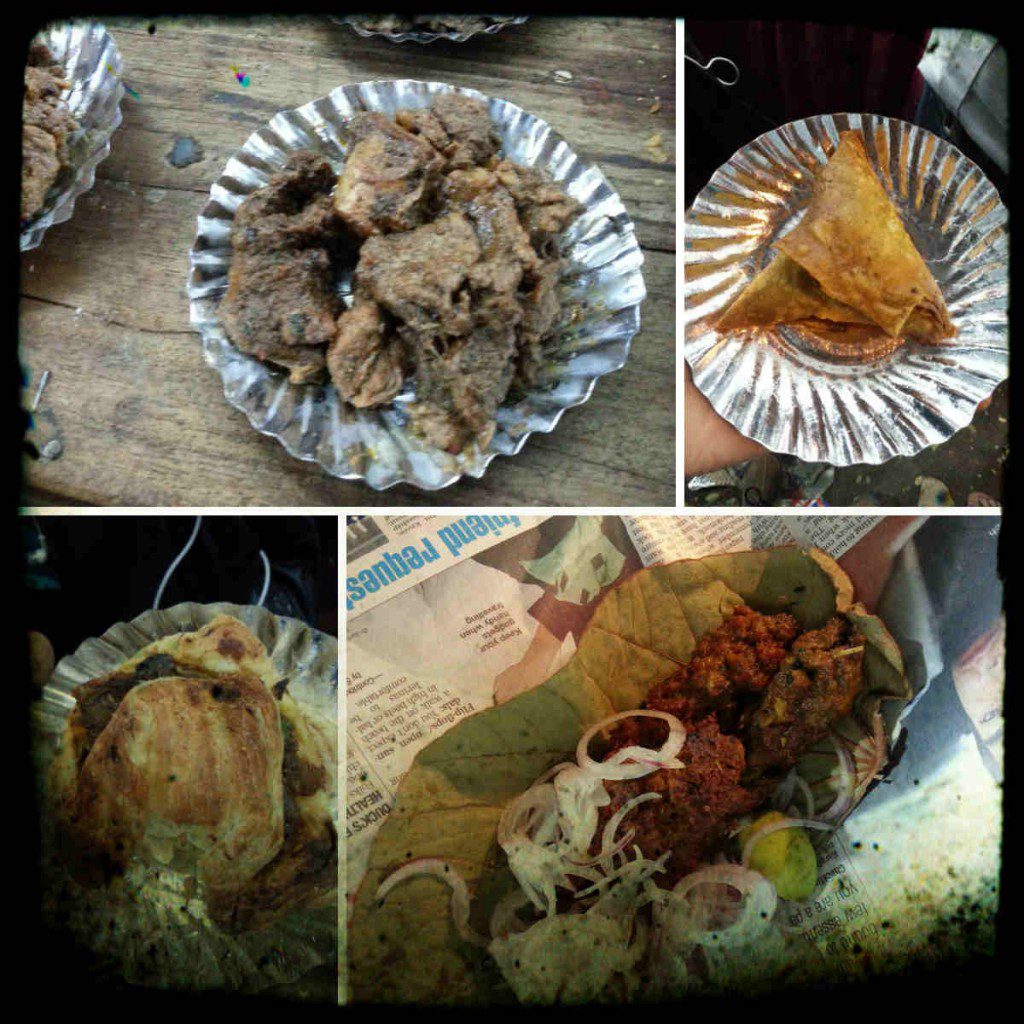
    Due diligence was done across the web for must-eat items.  We reached there by around 8 and found two organised ‘food courts’ in addition to the various stalls on the roadside. First on the list was Patthar ka Ghost, which had its share of chewy pieces but otherwise turned out to be quite splendid. While they were getting us plates, we managed to eat kheema samosas, which turned out to be delicious! Both of these were from the eatery smack between the food courts. Another item on the list of must-try items was the Bheja Puff, which we tried inside the first ‘food court’. This was only average, specially because it wasn’t really hot. So we quickly focused attention on the ‘camel meat’, arguably the biggest star in the list. This turned out to be more like mutton in terms of texture, and we wondered…..

    collage2

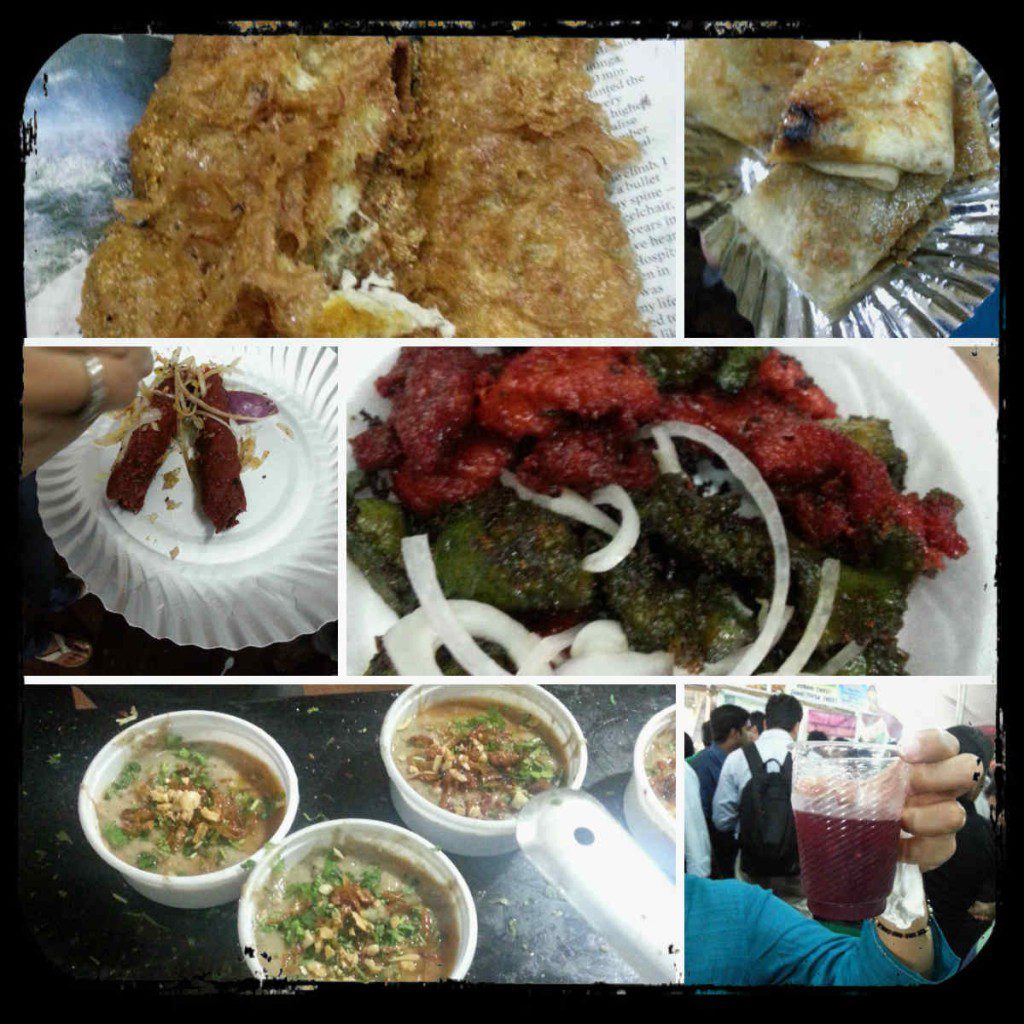
    Given that most of the items on the list had been checked, we decided to switch to crazy consumption mode. The rolls in the first food court turned out to be just average, but that “chick on a stick” (first image below) was fantastic. (and reasonably heavy) It has a layer of egg and a tangy masala within, and I’d rate it among the best dishes I had there. All of this was washed down with Arabian grape juice. We then moved on to the second food court, (moving in the direction towards MM road) which was slightly larger, but with a similar set of options. More mutton and beef was consumed, the former in the form of kababs and the latter in muti coloured versions! 🙂 Before we proceeded to the final course, the haleem had to be sampled, and the centre stall in the second food court actually had quite a decent version.

    collage3

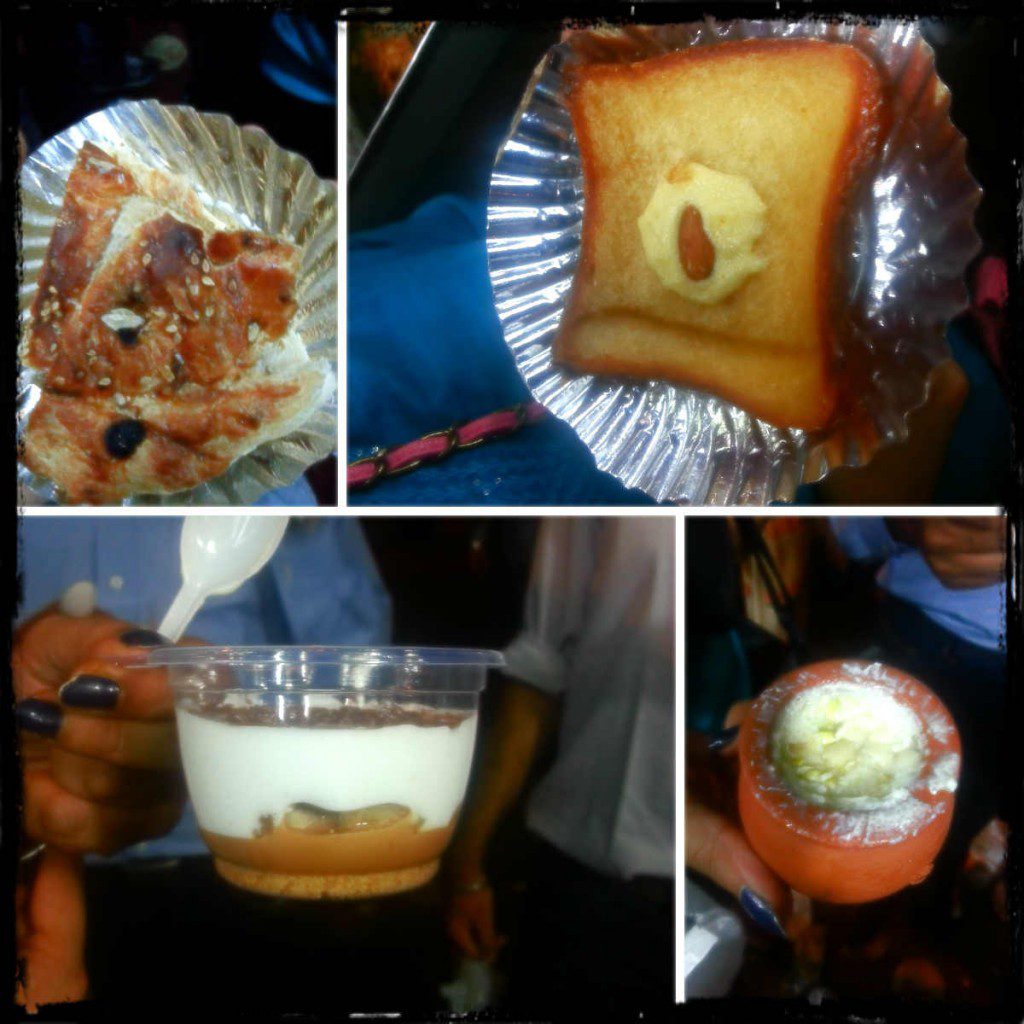
    Desserts are slightly non-intuitive in this context, and we had actually consumed a Khova Naan much earlier in the game. Unfortunately, not the famous Albert Bakery version, and was only just about ok. We went back to the stall between the food courts because we’d spotted quite a few options there. The Shahi Tukda was up first, and though reasonably good, was totally beaten by the fantastic Phirni, and the superb Banoffee Pie. Actually the ‘pie’ was replaced by a plastic cup, but it still tasted great!

    collage1

    We more or less crawled towards our respective cars, and this was not just because of the crowd! We were a group of 8, and at about Rs.350 per head had a feast that would have us burping well into the next day. This is obviously not fine dining and you have to earn (nudge – push – get irritated and shove) your way through equally fanatic carnivores to the food you want to consume, but it is oh-so worth it. You have 2 more days, go for it! 🙂

  • Awesomeness is homemade

    Three weekends and three Malayalam movies – different genres, different directorial approaches and a largely non-overlapping cast. But all of them underlying that this is indeed becoming a glorious age for Malayalam cinema! New stories, novel thoughts, fresh perspectives – this is a wonderful time to be a viewer. I decided to write this post, because as I’d mentioned earlier while on the subject, movies are a representation of an era, and years later, I’d like to read this and remember what a great time we had!

    On the first weekend, we saw ABCD, (trailer) starring Dulquer Salmaan, who with each outing impresses further, seems destined to be an actor and a star, and might not have to wait for years like his father (Mammootty) to attain either. Our decision to see it in the theatre was also heavily influenced by the presence of Jacob Gregory, whom we were fans of thanks to Akkara Kazchakal. The movie was not meant for intellectual stimulation and delivered its promise of entertainment quite easily. What it also did was look at contemporary issues in a non-preachy way. Despite a few niggles – the editing could have been better, Gregory’s accent could’ve been worked on and he could have been better utilised in the first half – Martin Prakkat has ensured that his success continues after his debut film Best Actor. Extra points for not trying to force fit a love story that could have spoiled the superb essaying of a script-backed character by Aparna Gopinath, the very anti-thesis of a traditional Malayalam movie heroine.

    The second weekend saw us in PVR for 5 Sundarikal – an anthology with stories of 5 different women in various life stages. 5 directors, with one of them making a debut. My favourite was Aashiq Abu’s Gowri, (despite not being a fan of Kavya Madhavan) thanks to the really sensitive story of a couple whose life goes through a drastic change after a seemingly casual remark by a visiting friend. Kullante Bharya was an equally strong contender, and quite unchacteristic of Amal Neerad, I might add. I place it second only because the story is an adaptation. Dulquer takes on the narrator role with ease and does a splendid job of making sure the nuances are caught just right. Shyju Khalid’s Sethulakshmi, based on a story by M Mukundan, is poignant and very disturbing! Fantastic treatment of the story in terms of catching expressions, and portraying scenarios. Anwar Rasheed’s Aami does not fail only because of the superb portrayal of the protagonist by Fahadh Fasil, who captures the flitting gray shade nuances of his character with ease, and the riddle based flow of the story. Sameer Thahir’s Eesha, starring Isha Sharvani and Nivin Pauly reminded me of a short story (not sure if it’s Archer) and was probably the only one which only worked marginally for me. But in all, it was an excellent compilation.

    The best was saved for the last – Murali Gopy teaming up with Arun Kumar Aravind after Ee Adutha Kaalathu – Left Right Left. The title of this post is inspired by its tagline – revolution is homemade. Fantastic casting, with Hareesh Peradi, (what was he doing in Red Chillies?!)  Murali Gopy and Indrajith making each character easily believable. So strong is the script that you feel the angst and pain that each of them have within – and that even goes for the ruthless character played by Hareesh Peradi. The political overtones are more than obvious, but yet manage not to take over the film. There is an immense amount of realism in the movie, and that is not because one could easily associate it with real life personalities, but because even the secondary characters have a clear DNA – why they are the way they are, what drives them, what is their rationale for doing the things they do. It is really difficult to choose between the three protagonists and that’s because of the strong script as well as the brilliant portrayals. Like I mentioned in a tweet, it was awesome to see the sons of gifted actors – Murali Gopi, Indrajith Sukumaran, Sudhir Karamana, and Vijayaraghavan in a single movie! If that isn’t new generation Malayalam movies, what is? 🙂 A powerful, hard hitting movie, and kudos to the director for delivering the script just right! For now, watch the back story of the characters in the movie’s potent anthem

    until next time, malayalam cinema #ftw

  • A different kind of more

    (image via)

    Sometime back, I read this excellent post titled “Your Lifestyle Has Already Been Designed“. A colleague shared it with me because he felt I’d like it. And right he was, because it echoed my own thoughts on how our consumption these days have little to do with our needs. The author in fact, goes a step further to say that the typical 40 hour work week (actually it’s way more) manufactured by big business has reduced our free time to such an extent that whatever we do get is spent less in meaningful, healthy activities and more in drowning ourselves in wanton consumption. While that may or may not be true, I think we have a choice, but one that involves winning a battle within. When we lose the battle, we begin indulging ourselves covering it up with the ‘deserve it/earned it’ argument, and the culture of random consumption lives to fight another day. The author sums it up rather well with “We buy stuff to cheer ourselves up, to keep up with the Joneses, to fulfill our childhood vision of what our adulthood would be like, to broadcast our status to the world, and for a lot of other psychological reasons that have very little to do with how useful the product really is.”

    In a larger sense, we tend to live a life that’s not really ours. I cannot help but remember the words of a near-immortal “Your time is limited, so don’t waste it living someone else’s life. Don’t be trapped by dogma – which is living with the results of other people’s thinking. Don’t let the noise of other’s opinions drown out your own inner voice. And most important, have the courage to follow your heart and intuition. They somehow already know what you truly want to become. Everything else is secondary.

    In essence, what we consider as motivation from our own self is actually not. I found an amazing/bizarre manifestation of this in the truly unique story of Mike Merrill, who divided himself into 100000 shares and ‘sold’ himself. Known as the IPO man, his investors would earn a profit out of activities he did outside of his job. In fact, his intent behind the entire activity was to raise funds for things he wanted to do, and felt he would make a profit from. What followed is a fascinating story that has resulted in the investors even getting to have a say in Mike’s personal relationships and sleep patterns!

    I couldn’t help but think of how similar it was to an ordinary person’s life. It is an extreme case, but when we’re driven by wants and motivations that have little relation to needs, the only difference is that Mike is conscious of his lack of control, while we are smug in our belief that we’re in control. I most definitely am not saying we should be living like ascetics, but the balance does lie in consciously separating needs and wants. That, I believe, is the way to a fuller life. A different kind of more from a different set of mores. I wonder if it’s a coincidence that the term ‘Utopia’ was coined by a person named Sir Thomas More. 🙂

    until next time, more or less over

    P.S. The good news is that increasingly these days, I see people making conscious choices across the board – lifestyle, media, time, relationships. The more the merrier 🙂