Category: Life Ordinary

  • The path to immortality

    I’d written earlier on how brands could use an individual’s data (the personal API) to fit themselves into his/her narrative and had used Nike as an example.  But this data could also be used by fitness and health companies to discover ‘fault lines’, gradually delay wear and tear, and one day, totally prevent a machine shutdown. This video – A Day in the life of Tim Ferriss (watch for a minute from 3:25) – gave me an idea of how we might be moving faster in that direction because of  data collection.

    Back in 2011, in ‘God in the details‘, I’d opined that over a period of time, when our data capture capabilities were evolved enough, and we had a lot of data on people on a lot of their behaviour, consumption etc, we would potentially be able to answer the most profound questions about our existence, purpose etc, and unlock further dimensions. I was extremely happy to read the same thought in this (long, but) amazing read called ‘Navigating Stuckness‘. “I could sit safely at my desk and write computer programs to gather vast amounts of Internet data, which I thought could finally answer timeless questions like “what is love?” and “what is faith?” with precision and clarity.

    On one hand, data could help us in our path to immortality, and on the other, it could provide us the answers to fundamental existential questions. I wonder what would happen first, because, as I wrote in PhilosoRapture, I also wonder if those questions would remain relevant once we became immortal.

    Meanwhile, the other track to immortality that is rapidly developing is that of the augmented human, where human parts (including the brain) will be replaced by mechanical replicas. We’re only a part of evolution, as this wonderful, humbling video would show, and it is probably only our ego that makes us believe (if we do) that we’re the endpoint. Maybe, there will be a species later, of whom we’d be probably be creators, for whom our questions will seem irrelevant and who will have their own sets of answers to seek.

    cs

    (quote via, image via)

    So it would seem that whichever way we approach immortality, by the time we get there, chances are, it may not be that significant.

    The year we conquer morality, by the way, is 2040, as per Ray Kurzweil. I’ll be 62 then, or maybe not, or maybe it won’t matter, or maybe…  🙂

    until next time, live long and proper 🙂

  • A long way away from home

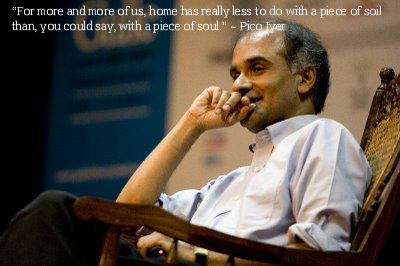
    The Global Soul’ is not my favourite Pico Iyer book (though he is a favourite anyway) mostly because I couldn’t connect to three out of its six chapters. I picked up the book because, in addition to it being a Pico book, it was about a subject that has fascinated me for a while now – the concept of ‘home’. This, in a multicultural world whose corporate citizens are rapidly making sure that ‘Everywhere is made up of everywhere else..’ I remember writing about this almost three years ago, in the context of another travel book and my visit to what I still consider home – Cochin. It was evoked by the presence of the same brands that I might see in a mall in Bangalore, the disappearance of familiar landmarks, and the residents referring to new landmarks that I really didn’t know of. It is perhaps unfair to expect that even as I changed, the idea of home would remain a constant. Maybe I will get used to that in a while too.

    I had wondered whether, in our pursuit of convenience and familiarity, we might end up creating a homogeneous world. Now I wonder if we might be one of the last generations to live in a truly heterogeneous world, as, in addition to the corporate imperialism, culture also becomes the most exported and imported product, courtesy technological advances – real and virtual. Home is, as the t-shirt goes, where the wifi connects automatically, and I’d be able to recreate it anywhere, with all the props made available to me.

    Every year, around this time, there is usually a home visit, and I would be chronicling it, this year there isn’t. Our regular visit targets are missing in action, and going there doesn’t make sense. I wonder if this is how it begins, and a couple of decades later, when I’m traveling, a bout of homesickness would hit me, and I would realise that it wasn’t Cochin I was thinking of. I’ll probably feel sad then, and guilty. But for now, I am closing my eyes, and recreating Cochin in my mind, with no props. I am able to, I can sense the wistfulness as I walk through the streets (without Google) and they haven’t changed. It’s heartening to know that while I have left Cochin, it hasn’t left me.

    picoiyersrilankaimg_0140

    until next time, homegrown can be grown?

  • Emotion as a Service

    More than a year back, I had written about institutional realignment and had briefly mentioned the institutions of marriage and parenting. ‘The currency of relationships‘ made me think of this, and family – immediate and extended – as a societal construct/contract/ institution, and probably even as a tradition. Where we are born, and whom we are born to, are apparently out of control, but we do have an illusion of control courtesy the choices we make as we go along. Thanks to these choices, our lifestyle and our perspectives may follow a trajectory that is totally different from the circumstances and people we grew up with/in. This is not just about the people from our childhood/youth, but is a continuous process through life. Each of us find our own ways to deal with the constant flow of people through our lives. These are again choices, and like most choices involves some amount of sacrifice and bring with them their own set of consequences.

    Clipboard02

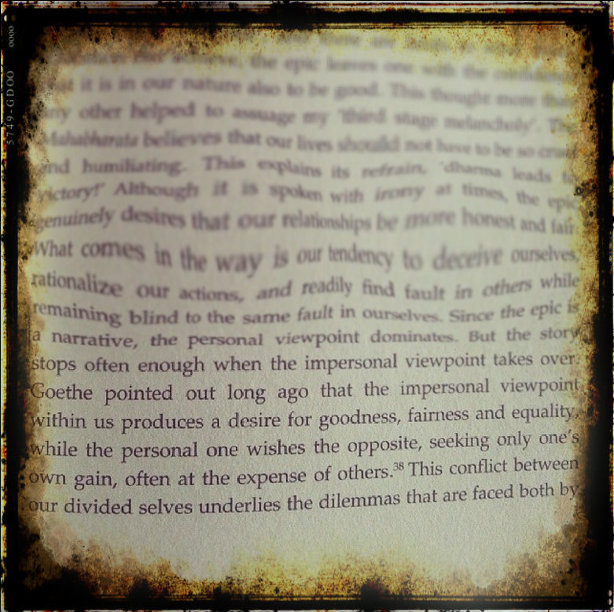
    I loved that Goethe paraphrase, because I think it sums up our relationships very well. At the risk of sounding cynical, (or receiving a ‘speak for yourself’ comment) I’d say that we’re increasingly becoming selfish as a species. I have always had the notion that most relationships are contextual, and it would be difficult to scale our emotions/feelings for others for an indefinite time frame. Yes, I do acknowledge there are exceptions, but that’s what they are – exceptions. Do a quick test and find out how many people across your life you’re still in touch with – bouts of nostalgia not included?

    It is with all this as the backdrop that I read Scott Adams’ “The Future of Marriage“. It articulates very well a thought that had crossed my mind earlier. (Of course, he obviously explores it way better than I could have) He deconstructs the institution of marriage and argues that marriage made sense “when the world was inefficient. You married a person nearby who could provide most of your important needs while hoping your lesser needs could also somehow be met.” Now, he says, the internet has allowed us to have a barter economy of relationships. In other words, a virtual spouse comprised of a dozen separate relationships. He tempers everything by saying that in the future, marriage may be one of the many options available. By sheer coincidence, and in a different context, I came across this quote attributed to Steve Macone “A tradition is a habit whose logic has faded“.

    I thought about this in the context of the expectations I had mentioned in the ‘currency of relationships’ post. If the institution of marriage can have a barter economy, why not other relationships? After all, isn’t every relationship a barter at its core? It’s just that we are rarely comfortable with voicing our expectations in the case of an emotional ‘transaction’, quantitatively or qualitatively. (generalising) Parents expect their children to look after them when they are old, in return for bringing you up; relatives expect you to return the favours they once did for you, and so on.

    So who knows, maybe our pace of life and our need to be (seen as) fair in all our relationships will conspire to form a barter ecosystem that offers emotion as a service. It is possible that an alternate path to prosperity might take us in a different direction, but in the era of the quantified self and the augmented human, when we slowly transition our selves into the cloud, maybe ‘Emotion as a Service’ (like)  is not an impossibility. What do you think?

    until next time, a qualified self

  • The currency of relationships

    Clipboard02

    Some people know me way too well! 🙂

    A few days ago, I received a message that gave a jolt to my perception of how I deal with other people and what they make of it. I had written this post sometime back on taking friends for granted, and while that was in the specific context of friendship, this is an approach I extend to all relationships, be it transactional or emotional. I like to think that I’m fair in my approach and try to give back more than I get. But apparently, at least according to one person, I am not, and am “Mr.Use and Throw”. It hurt because I have always acknowledged the help that I’d received, to that person and others. I have not had an opportunity to repay it in kind, but whenever I have felt that my presence would bring happiness, I have made it a point to be there. I did reply with my perspective on the accusation, but it led me to think of the subject and how our actions are perceived by others.

    In this case, for instance, there were possibly expectations from me that I had not known of – not of a monetary kind, I think, but some other kind of help or acknowledgement. (Generalising) We live in an increasingly transactional world, where we are able to quantify all sorts of things and are also able to throw money at issues/problems/situations to resolve them. In scenarios where that is not applicable, we use our judgment to repay a gesture of kindness/affection/love. Over a period of time, I have dealt with the latter by acknowledgment and thanks in word and deed, and by paying it forward. But there is no standard currency in relationships, and my lesson from this experience is to not to take for granted that my approach is the one that works for people at the receiving end. I should spend some time first in understanding expectations, and then meeting them. When the price and currency are not agreed upon at the outset, you will need to keep paying until both parties have agreed that there are no dues.

    20131117_163614

    until next time, emotional monthly installments

    P.S. and a happy Thanksgiving 😉

  • Guided by fear

    live1

    I have this habit of adding a bookmark fold at the bottom of the page when I want to refer to it again. It is quite a task when I have to figure out much later what line in the page I’d originally bookmarked for! These days, Instagram solves it. At some point, I’m sure I can search my feed with a #quote hashtag and retrieve all the ‘bookmarks’ easily. Yay!

    “And the Mountains Echoed” had many such bookmarks. (still an unconscious habit despite the Instagram method) But this one has to be my favourite – “..but most people have it backward. They think they live by what they want. But really what guides them is what they are afraid of. What they don’t want.” I can easily confess that a large share of my actions is to preclude some dystopian version of my old age. (one) Many a time, this leads me to choose cautious paths over (what I think might be) more emotionally fulfilling ones, and even ones that I think might be leading me to my purpose.

    But when I thought about it a bit more, I realised that it can be read positively too – after all I am afraid of being switched off without knowing why I was here, and that’s what makes it an obsession! Also, the ‘afraid-don’t want’ factor often drives me to do things that are out of my comfort zone, so it’s possibly even pushing me towards my purpose, albeit from a different direction. Just a form of reduction? 🙂 It’s probably not a coincidence that my second favourite quote from the book is “When you have lived as long as I have, you find that cruelty and benevolence are but shades of the same colour

    until next time, fear off