Category: Flawsophy

  • Stated Obsession

    A defining purpose, or rather, the lack of it, is something that has been gnawing at me for a while now. One can go about the daily motions of life without defining a purpose, and it need not affect professional objectives or progress. In fact life must, and will go on without a purpose, but once the gnawing begins, it is difficult to rid of. It might be the result of something that I am often accused of – extra doses of analysis – self and otherwise. 🙂

    A friend-in-law (coined to refer to the spouse of a friend :D) recently got probably one of the biggest highs possible in his domain – a result, I am sure, of the hard work he put in, and his unwavering belief in the self. The hard earned outcome of a well stated purpose and well directed passion. May he have many more.

    One of my favourite Malayalam movies in recent times (actually in the all-time list as well) is Ustad Hotel, about a young man and his choices – two paths and their implications symbolised by his father and grandfather respectively. The game changer in the movie is inspired by Narayanan Krishnan. (do read if you are not familiar with the name) In real life, Narayanan Krishnan has defined his purpose, and bravely soldiers on, helping those who have no one else to help them.

    Completely different scenarios, with completely different motivations, but linked by the presence of a purpose. I can cite excuses – primarily the business of living and an interest in way too many things to devote myself completely to one – but I know those are just excuses. I am still searching for the reason – the inability to find something that defines me or the inability to devote myself to pursuing it, or just sheer lack of guts. My only hope is that I have some time left, but the clock is ticking.

    until next time, a gnawing tick

  • An idea called home – 2

    Anjum Hasan’s “Difficult Pleasures” is borderline surreal, the jacket told me. She would be in my top 3 favourite authors list, and I am completely awed by her writing (check the last para here) but I wonder if even that can explain the surreal thought I had as I read the first few pages. Can a book be called a home? What is a home after all? Isn’t it just an idea that is sometimes real and tangible and exists physically?

    And that was the surreal thought – every time I read this author’s books, it’s like going home, as though I could reach inside, get into the story and talk to the characters and they wouldn’t consider me out of place at all. I could belong. Yes, it’s surreal, and I haven’t been smoking, but I just couldn’t get the thought out of my head.

    until next time, home away from home

  • Posture child

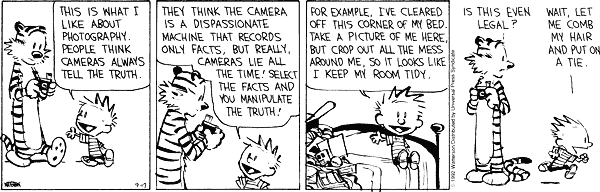
    I guess that’s the reason why Calvin & Hobbes is so utterly loved by so many folks. Profound, timeless, universal truths expressed in such a unique way!

    I had never seen this one until recently. Why blame Instagram for filters? They existed long before anyway 🙂 I thought this strip found great application in all kinds of posturing from time immemorial, and especially so now – in the social media context, when everyone is a publisher. Over a period of time, I wonder how fast we would forget who we really are (if ever we come to know it or knew it) It would probably be irrelevant in the real-time era. We would be the statuses and photos and everything else we like and share every minute. After all, I’m no longer the person who wrote it anyway, and who’s to say the non posturing self is the real deal?

    until next time, impostor 🙂

  • In Principle

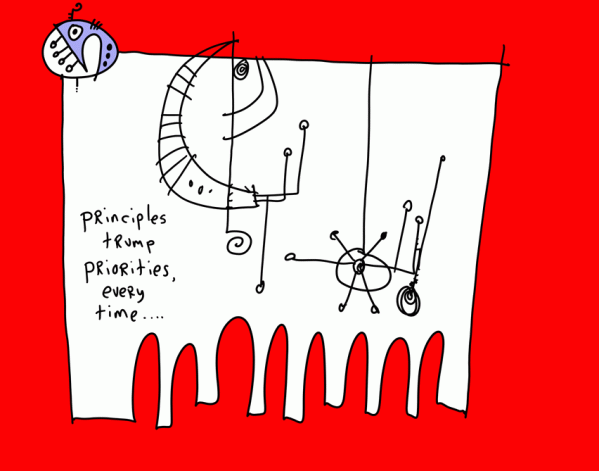
    Stannis Baratheon is probably the least charismatic among the contenders in the Game of Thrones, but I have liked him for his stubborn, unwavering sense of duty and justice – even in those situations when a compromise might have helped him meet his objectives. Even his claim for the throne is not borne by desire, but by his belief that he is the rightful heir. I am on Part 2 of Book 3, so I have no idea how this is all going to pan out, or whether his character will change later, but for now I can relate to it, though in my daily existence, I’m not able to shake off the pragmatist in me many a time.

    That is also why I loved this Gaping Void poster, and identified with it immediately.

    As I’d written in the 1000th post in another context, perhaps the joy is in doing something because it is the right thing to do.

    until next time, first principles 🙂

  • A larger plan

    Most of everyone who knows me would agree that I am a compulsive planner. This habit has been reinforced on several occasions when I have been better prepared than others in situations. However, I also believe that it is quite a trade-off – between the safety of knowing in advance what to expect and the thrill and joy of leaving oneself open to an experience. The middle path is quite difficult to achieve in this case.

    That was why I was very intrigued by the phrase – Negative Capabilitythe willingness to embrace uncertainty, live with mystery, and make peace with ambiguity. From experience, it is forced upon us too. The best laid plans can go awry often because even the best of minds cannot sometimes envision every possible scenario. That’s not the only time I have been humbled by the limitations of the human mind. From something as simple as understanding what’s really going on in another person’s mind (not to mention my own understanding of my mind) even as they tell you things to larger questions on purpose and destiny, we’d be fools to think that we can know the mechanism of everything around us.

    But as humanity progresses, is there a tendency to convert everything to science, or a skill/process that anyone so inclined can master? As we discover more, I wonder if there is a collective ego that develops and one that says we can understand and control everything around us. As a race, are we becoming increasingly intolerant towards uncertainty?

    But as this post says, the idea that the current version of our mind is only one step in evolution is very compelling. I wonder if, by increasingly closing our mind to uncertainty, we are moving in a direction opposite the one that will help us solve the greatest puzzle of it all – why are we here?

    until next time, what’s your plan?