Category: Flawsophy

  • The Kabali Experience

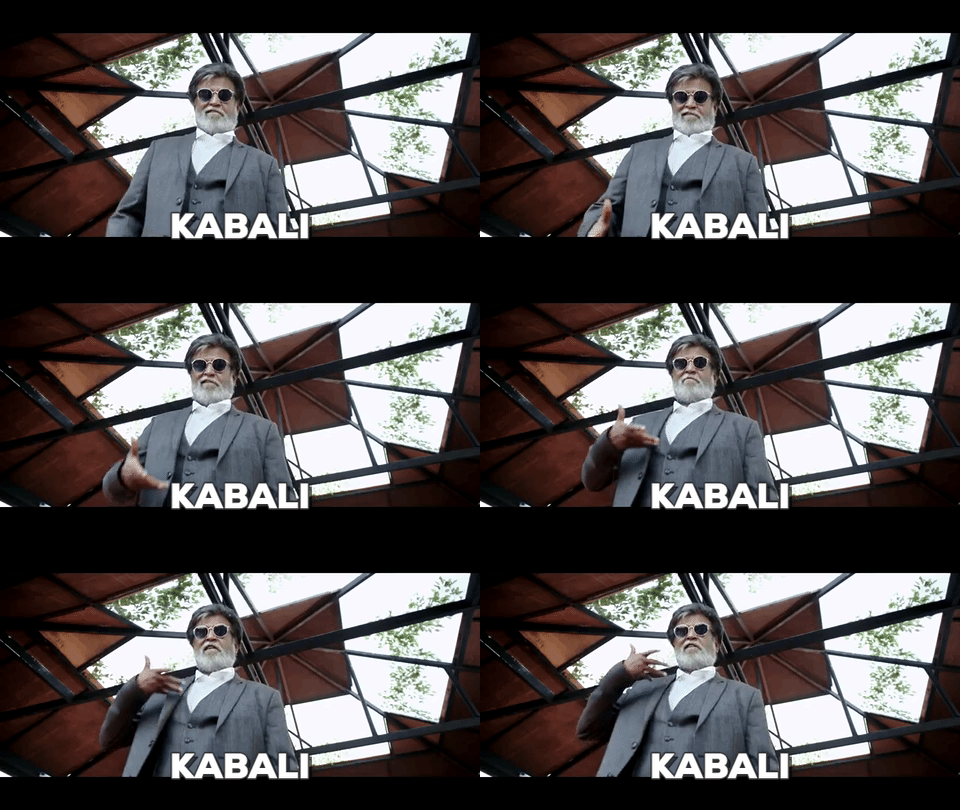
    Kabali had to be watched in the movie hall, I had decided as soon as I saw the first trailer. The hype that followed all but ensured that polarisation would happen, but I honestly didn’t care what the reviews said. Rajini’s “Kabali daa” in the trailer, to me, felt like a guarantee.

    jLIKGAvjm04lq

    (via)

    It isn’t a typical Rajini film, most people seem to agree on that. For instance, here I was, ready to jump up, whoop in joy, and throw a coin during the entry scene, and in an underwhelming introductory shot, he appears, the embodiment of calm in what’s touted as a gangster movie! And yet, in a few seconds, the movie started delivering on what I’d come for – the spellbinding swag that only Rajinikanth can pull off on screen! (“Koodave poranthathu, ennikkum pogadhu” 😀 #youremember) There are enough of those scenes in the movie to have kept the fan in me very contented. (more…)

  • “Both sides”

    A few months ago, when I wrote Hope Trope during what on hindsight seems like a particularly low phase of my mind’s wax and wane cycles, a relative wrote to me. She said the post almost made her cry, and as a person who has been reading my posts for a while, she felt that my tone was increasingly becoming personal and despondent. The first description was right, and I was conscious of it. The second I attributed to the struggle – when creating one’s own worldview and life that treads outside of the accepted standards, in things as diverse as work, progeny (or the lack of it) and faith. Teething troubles of a stoic outlook. (which I still strive for)

    I now realise that maybe she saw something I couldn’t because despite the best efforts, it is very difficult to remain objective about one’s own feelings. I cannot remember when I began to spend an inordinate amount of time on introspection. From experience, it is a double edged sword, it’s great to be conscious of one’s actions and words, but horrible when one judges the self as ruthlessly as I do, especially if the past gets dredged up. The amazing Book of Life has an excellent read on the subject using the folk tale of Androcles & the Lion as an allegory. I think I made all the mistakes the article points out – a wrong diagnosis, numbing the pain, and to a certain extent, applying the wrong medicine.  (more…)

  • Binary Code

    Facebook is in the process of updating its Newsfeed algo again so that we see more posts from friends and family, and less from ‘Pages’. Great news, except that when every person is media, and there is a limit to the pruning one can do, the feed will still consist of biases, prejudices, hoaxes, paid endorsements without disclosure, and yes, cat videos, Lincoln’s quotes on self driving cars, click bait and baby pics. My point above is less about filter failure and more about the continuing explosion of content and its distribution to set the context.

    But now let’s talk about filters. The sheer volume of content means that (in general) the reader will want quickly digestible information before he/she moves on to the highly entertaining video waiting in line. Absolutely connected to ‘the demise of the middle ground in the attention economy‘. The article talks about nuance in political debate getting lost, but I think its reach extends beyond that. As this fantastic Guardian article “How technology disrupted the truth” states, “..everyone has their own facts“. But why do this happen? (more…)

  • Prosperity’s moral code

    A few months ago, TechCrunch had a post debating the role of capitalism in a world that includes AI, where jobs are disappearing at a rate faster than new jobs coming in.  Capitalism has always been played as a finite game, focused on profit for a set of people, largely irrespective of the costs to others or society at large. As I wrote in “A shift in the world order“, its only real foe in the recent past has been the nation state, and its executive arm – the government. A foe increasingly struggling to even defend its own relevance, I’d say. As the dominant system of the world, we will then automatically (whether rightfully, is debatable) begin questioning capitalism’s morality codes. More than what we are doing currently, because the impact will not just be higher, it will also start affecting more people.

    Earlier this year, I had written on how if it intends to survive, capitalism needs to expand its scope, and play an infinite game – whose purpose is to continue the flow of the game, and bring in new players. Something similar to what Douglas Rushkoff calls digital distributism (read) a model that aims for the circulation of money rather than the extraction of money. An evolution that capitalism needs to go through, or it runs the risk of imploding. This, of course, is not really in line with the way an earlier generation of corporations, or Silicon Valley operates.  As Maciej Cegłowski writes in “The Moral Economy of Tech“, treating the world as a software project gives us a rationale for being selfish. We pretend that by maximizing our convenience and productivity, we’re hastening the day when we finally make life better for all those other people. (more…)

  • Informed Renunciation

    Around me, I see a few people who seem to have stayed put at a certain point in time in terms of their lifestyle – the clothes they wear, the homes they live in, the gadgets and vehicles they use, the content they consume, and so on. In many cases, I have attributed it to age. Maybe they just couldn’t perceive the incremental enjoyment that the new thing offered, or maybe priorities changed – either in terms of economics or interest. But there are also relatively younger folks who eschew a lot of things I might consider a need. In both cases, I wonder whether it is a conscious choice/ trade off, or something that just slipped in unobtrusively until it became a way of life, or something that circumstances forced.

    Untitled

    (Ben Frankin, via) (more…)