Category: Flawsophy

  • Finn, Tolstoy, and happy families

    “You’ve heard that line about all happy families being the same?”

    “War and Peace”, I said.

    “Anna Karenina, but that’s not the point. The point is, it’s untrue. No family, happy or unhappy, is quite like any other.”

    I read this in The Woman in the Window by A.J. Finn recently. I use the Anna Karenina principle quite a bit in many contexts and discussions. In fact, recently, while reading Guns, Germs & Steel, I realised he had used this framing too. To put it simply, there are x number of conditions that definitely need to be met for something to succeed. The ‘something’ could be anything from origin of life to economical supremacy, and the ‘x’ conditions would change with that context. But in a given context, only those who fulfill all the x conditions will succeed.

    Naturally, as a believer, I was miffed by Finn’s (character’s) statement. But, could he be right?

    As I write this, D and I are a day away from celebrating 21 years of being together, 15 of them in a married state. Speaking of state, Kerala in the late 90s and early noughties, much like other non-metros in India, wasn’t friendly to intimacy or dating. In fact, the reaction to our relationship was actually a combination of the two – intimidating! Especially since a couple of religions were involved. Anyhow, here we are, 21 years later – happy.

    The stage was set for a thought experiment. Are we happy in the same way other couples are? I’d think not. I don’t really have data, so I will use  a simple non social-media-posturing observation. There are a lot of happy families with kids.* We chose not to succumb to that genetic pressure. So we’re different from other happy families. Does that mean Finn is right, and Tolstoy was wrong?

    I think it just isn’t as binary as that. Tolstoy was right because if one figured out the conditions that need to be met for a happy marriage, I have a feeling the successful couples would be meeting them (children most likely will not feature in that list). Finn is right too, because the way in which the couples met them would be drastically different from each other.

    In any case, I don’t think we have found an objective framing of happiness to begin with!

    *There is interesting data (Google searches and experiments) to show how “kids bring happiness” is just belief transmission for evolution’s needs and not the truth it is portrayed to be. But people have their own narratives of what happiness is, so I’ll leave it at that. 

  • Choices & Automation

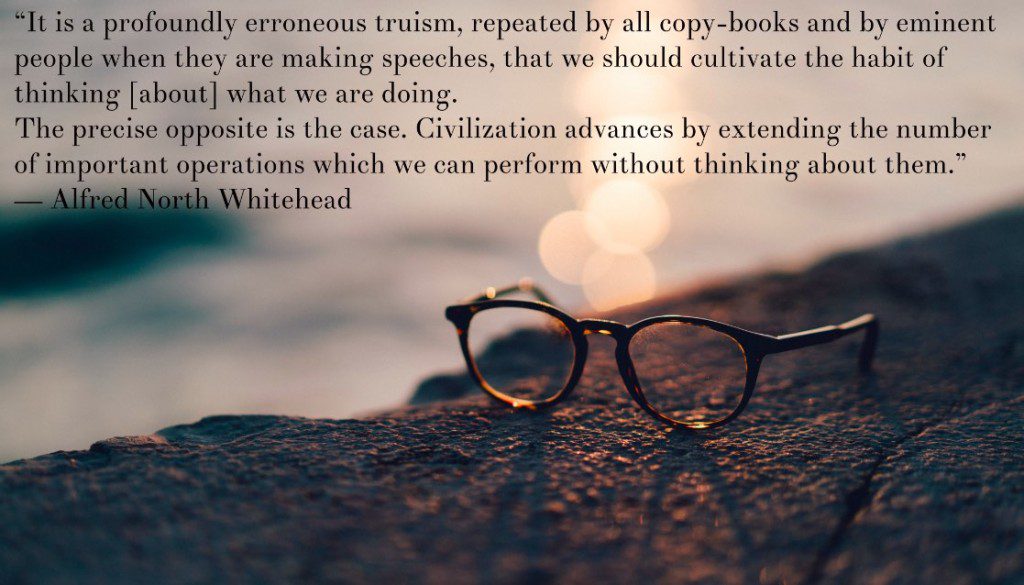
    Taylor Pearson wrote an excellent primer on blockchain a while ago. While explaining why blockchain matters, he quoted something by Alfred North Whitehead

    Untitled 1

    Photo by Joshua Newton on Unsplash

    (more…)

  • Peak Abstraction

    Saturday mornings are sometimes spent at the lake nearby – walking/jogging around it. A few weeks ago, I saw a few dressed-for-exercise folks spending the entire time doing an intense “exercise” – posing for selfies! To be fair, the lake is pretty, but..

    It led me to an interesting line of thought. Before I let you in on that, some context setting, or you might close the tab at the ridiculousness of it. Given that the species has lacked telepathy, we have been abstracting for a very long time. Sensations, emotions and thoughts that make up our subjective reality needed to be conveyed. We converted them into everything from facial expressions and actions to drawings to language – spoken, written and then published soon as we entered the machine age. You are now reading what I am thinking.  (more…)

  • Expectations? Surely you’re joking!

    Borrowed one part of the title of the book that sparked this thought – ‘Surely you’re joking, Mr.Feynman!’ Towards the middle of the book, Feynman talks about the time he got incredulous job offers and wondered how he could ever meet the expectations. A colleague explained to him how he (Feynman) was doing a good job of teaching, and any other expectation that the university would have of him was subject to luck. They might get it out of him or not, and they were ok with the risk. Freed Feynman from guilt, and gave me a thought on expectations.

    If I plot a me/others and meet/don’t meet 2×2 matrix, I get 4 boxes. Let’s take the easy ones first. I meet expectations, and so do others, life is awesome. I don’t meet expectations, others don’t, I think that would follow a natural progression of drifting apart. More on that in a bit. (more…)

  • In other fake news..

    Went by the title, did you? Ha! This is less about fake news, and more about what could be called its second order effect. In Against Empathy, Paul Bloom writes about how many beliefs are not the products of reasoning, and gives sports teams fans and even political support as examples. He also brings up the point that these views don’t really matter because of the minimal impact one person’s belief has on the world at large. The contrast offered is one’s everyday morality that affects those around. He goes on to say that because of this minimal impact, we should look at people’s views on global warming, health care etc in the same light. The difference between truth and their views does not really matter because it doesn’t really cause a huge impact. To be fair, he is not happy writing this. I wasn’t really happy reading it either, because I saw at least one horrible exception – think personal hygiene values (“I won’t use a deodorant because.. global warming”) and you’ll get the picture. That definitely has an impact!

    But moving on, he also explains how people are capable of rational thinking on things that matter. This is where I differ. I am not denying that people are capable. They probably begin that way, but I think the capacity is lost over time. Why do I think so? (more…)