
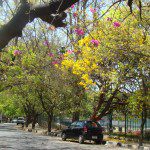
 They would’ve loved to live here. A relatively hidden area in the heart of Koramangala, such that the EMIs would karmically commit them to several rebirths. But they had a plan. A group deal involving like minded people – to dump garbage there everyday until the rates came down. This post is the first step. 😉
Category: Life Ordinary
-
Realty Check 1
-
1, 2….34
One of the characters in Preeta Samarasan’s “Evening is the whole day” asks, during a conversation, “Everyone is always so tired nowadays. I wish we could all be young forever, or whatever age we ourselves choose. What age would you be if you could choose..?“
It made me think of what my answer would be. At first, I wondered if I would like to be older than what I am today – to sit back comfortably with the perspectives I have gained. As the years pass by, and the memories accumulate, I seem to be viewing most phases of my life so far through a happy prism. Despite remembering a few specific instances that made me unhappy, and (paradoxically) being certain that I was probably frustrated/terrified/bitter on many occasions and would never want them to be repeated, I can now look back and smile at the overall scheme of things. Perhaps I am lucky or perhaps, this is the way it works for most of us.
And yet, even happy memories, I have noticed, can evoke contrasting sentiments within me. When melancholy strikes, and I remember happy times, it’s a bit like what Alfred Tennyson wrote (in a context I have no idea of)
“Tears, idle tears, I know not what they mean,
Tears from the depths of some devine despair
Rise in the heart, and gather to the eyes,
In looking on the happy autumn fields,
And thinking of the days that are no more.”until next time, “I’ll spend my future living the past“
-
Now Running
Already running late, and three minutes into the ride, she realised she had forgotten her purse…and the tickets in it. Cursing, he paid the auto driver, asked her to wait, and started running. Easier than getting the auto to go back. As he ran, the coincidence was unmistakeable. The tickets were for Paan Singh Tomar.
(Based on a true story. No really!)
-
Irascible
In Nayantara Sahgal’s “This Time of Morning” (review later), there is an episode (p 247- 250) where one of the characters recollects the first time he had seen the British’s Divide and Rule policy in action, in the context of religion.
To summarise, towards the end of 1919, a Swami Satyanand, who had a reputation for his protests and fiery speeches against the British, and was a hero figure in all communities, once began a speech on the steps of the Juma Mosque in Allahabad. He said he had chosen the location because he wanted to emphasise that the name of the faith didn’t matter. With the mullah standing behind him, he began to speak of the messages in the Bhagvad Gita as a rapt crowd listened. The policemen arrived suddenly, and even as the Swami kept saying that the police were ‘our’ brothers and the crowd should stand still, he was attacked, finally collapsing beneath the arch. The mullah wept as he was carried inside, and later, when he came out to announce that the swami was dead.
The next day, the English dailies carried the news that the Swami had died at the Juma Mosque and insinuated that the Swami had deliberately tried to incite the Muslim community and had died as a result. It also chose to emphasise that mutual seclusion was the only way to peace among the communities, and this was what the government was trying to do. The regional dailies were warned against carrying the news at all. And though Muslims and Hindus joined the procession which ended with the Swami’s pyre being lit by the mullah, none of the dailies covered it.
The book is a work of fiction though historical figures also play minor roles. But many incidents and scenarios are based on real events, and the above incident seems highly possible. It made me realise that the only perspective we can derive of the events that happened then are from newspaper reports and in some cases, journals/books written by people who lived then. But the latter is not so easy to find, and we mostly rely on the former.
I read this book during the time that Mr.Sibal was making his infamous censorship statements, and the internet began its #outrage. (Yes, I did 2) The above episode gave me a glimpse of what the internet has achieved in terms of documenting data and what we, and the generations to follow, would be missing out, if censorship came to life. Thankfully, even George W Bush has said “You can’t put democracy and freedom back into a box” 🙂
until next time, Jaise Har Ek Baat Pe Democracy Me Lagne Lag Gaya Ban 🙂