Category: Books

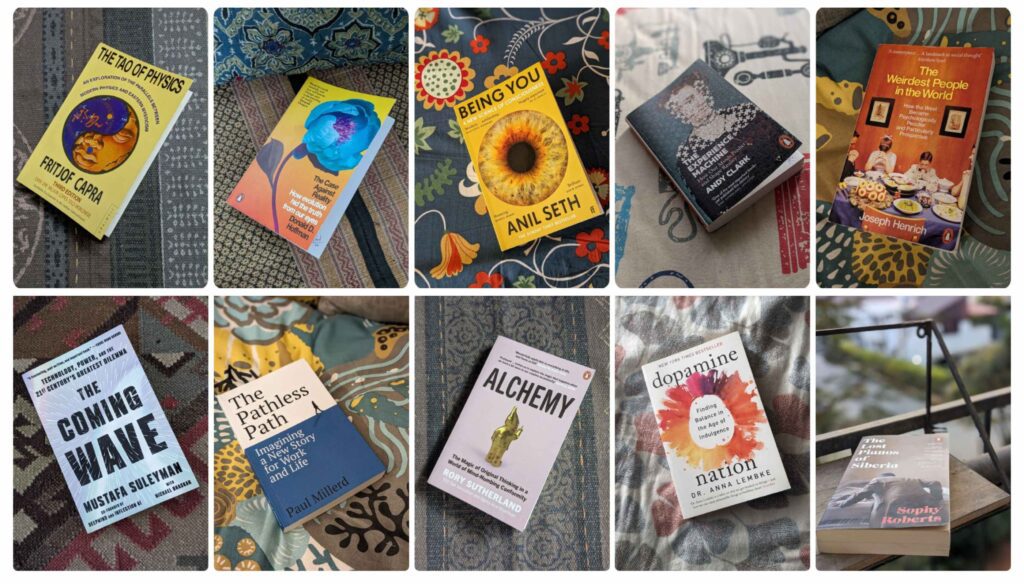
  • Dopamine Nation: Why our Addiction to Pleasure is Causing us Pain

    Anna Lembke

    A book that made it into my recommendations list in 2022 was ‘The Molecule of More‘ by Daniel Z. Lieberman & Michael E. Long. That book, as I wrote in my review then, made a complex subject very accessible and even entertaining, with interesting experiments, real-life scenarios and very less jargon. And it got me interested in the subject. I discovered Dopamine Nation thanks to a podcast, where Dr. Anna Lembke gave a very lucid explanation of the relationship between pleasure and pain.

    Dopamine Nation is divided into three sections – The Pursuit of Pleasure, Self-Binding, and The Pursuit of Pain. Each of these is further divided into three chapters giving the book a structure that is easy to follow. In her introduction, she writes about the overwhelming amount of stimuli around us and calls the smartphone ‘the modern-day hypodermic needle delivering digital dopamine for a wired generation.’ So how does one find balance in this age of indulgence? A big risk-factor in addiction is ease of access and across digital and reality, that has very less mediation. ” I was struck by how much hotel rooms are like latter-day Skinner boxes: a bed, a TV, and a minibar. Nothing to do but press the lever for a drug”. A dopamine economy or ‘limbic capitalism’ (David Courtwright).

    Continuing this thought, she writes about how we run from pain. She throws light on how “the pursuit of personal happiness has become a modern maxim, crowding out other definitions of the “good life”. Even acts of kindness towards others are framed as a strategy for personal happiness. Altruism, no longer merely a good in itself, has become a vehicle for our own ‘well-being’”.

    To illustrate the pleasure-pain balance, she imagines our brain having a balance – a scale with a fulcrum. When we experience pleasure, dopamine is released in our reward pathway and the balance tips to the side of pleasure. (the first in a packet of chips) But the problem is that the system wants homeostasis. The self-regulating system now starts functioning. Meanwhile, with repeated exposure to the pleasure, the initial deviation of the scale towards pleasure becomes weaker and shorter, and the response from the self regulation gets stronger and longer. This is neuroadaptation. Now you need the second chip from the packet, and the more you eat, the bigger the craving and more the irritation if you don’t get it. You consume the chips though it no longer gives you pleasure, just to avoid the pain. It doesn’t end there. The biggest paradox is that hedonism leads to anhedonia, the inability to enjoy pleasure of any kind. The good news is that abstinence can lead to a natural homeostasis.

    In short, “science teaches us that every pleasure extracts a price, and the pain that follows is longer and lasting and more intense than the pleasure that gave rise to it. With prolonged and repeated exposure to pleasurable stimuli, our capacity to tolerate pain decreases, and our threshold for experiencing pleasure increases.”

    In the Self-Binding section, she charts out the escape path with an acronym for dopamine – data, objectives, problems, abstinence, mindfulness, insight, next steps, experiment. Broadly, abstinence can be aided by space (physically creating barriers to access, or even reminders), time (restricting consumption to a certain time, or only as a reward) and by finding meaning in something, to replace the pull of the craving. In the last chapter of this section, she points out how anti-depressants can actually go beyond their call of duty and limit the ability to experience the full range of emotions. Making us a person different from our natural self. A difficult trade-off.

    I found the third section of Dopamine Nation very interesting on two counts. One, a new idea in the first chapter of this section. What if we reverse the pain-pleasure balance by pushing on the side of pain? “With intermittent exposure to pain, our natural (self regulating) hedonic set point gets weighted to the side of pleasure, such that we become less vulnerable to pain and more able to feel pleasure over time”. Cold water baths is an example used. So are extreme sports. Obviously too much of anything will result in addiction.

    Two, some excellent connections in the second chapter of this section, titled Radical Honesty, which also touches upon the trend of ‘disclosure p0rn’. The connection is on a favourite topic of mine – scarcity and abundance mindsets. The author’s hypothesis is that truth-telling engenders an abundance mindset, and lies, a scarcity mindset. She explains this both in terms of us feeling more confident about the world when people around us tell the truth, as well as how when resources are (perceived to be) scarce, people are more invested in immediate gains. I connected this to something I read in The molecule of more – the two kinds of activities we do. Agentic, formed for the purpose of accomplishing a goal and orchestrated by dopamine, vs affiliative, formed for the pleasure of interaction, driven by oxytocin, vasopressin and others more interested in the here and now. The connection I made? Scarcity mindset – Lies – Agentic activities – Dopamine pathways for quick rewards. I am still thinking of direction and causality, but I intuitively sense a thread.

    In essence, I found Dopamine Nation a very interesting read. And if you’re intrigued by behaviour – yours or others’ – I think this will be an engaging read for you as well. Best paired with the book I mentioned in the beginning.

    Dopamine Nation
  • Strange Rites: New Religions for a Godless World

    Tara Isabella Burton

    Strange Rites is another book I discovered only thanks to a podcast. I found it a fascinating exploration of how the (almost) post-religion United States is evolving. Folks who call themselves Christians have been steadily decreasing, and ‘Nones’ who claim no affiliation to any organised religion is the fastest growing group. One-third of millennials (and one fourth of all adults) have no affinity to religion. Tara Isabella Burton tries to find out who (or what) is filling the God-sized hole.

    She begins with her personal experience at the McKittrick Hotel, home to the British theatre company Punchdrunk’s production – Sleep No More, an experiential phenomenon that she describes as “equal parts video-game, voyeurism and religious pilgrimage”. It’s a retelling of Macbeth but every part of it is subject to interpretation by the performers and the audience, with the latter also having the option to be part of the ‘play’.

    This serves as a preview of the world of SoulCycle, Korean beauty routines, Gwyneth Paltrow’s juice cleanse, Crossfit, Internet fan fiction, Headspace, and so on. A long list of options from which people can mix their own religious cocktail of spiritual, philosophical, aesthetic and experiential dimensions. It influences not just individual lifestyle but societal politics too.

    The author broadly classifies the non-affiliated into SBNRs (Spiritual but not religious), Faithful Nones (who hunger for something larger than themselves) and Religious Hybrids (who practice a portion of their religion, and supplement it with things outside it). All of them (and us) are looking for what religion originally delivered – meaning, purpose, community, and ritual.

    She then spends a chapter on the war that has been fought on religion within America – the institutional (centred around Church and society) vs the intuitional (centred around the person). And that progression and the heterogenous mixes that happened reflects in the changes in culture and mindset within society during the 60s, 70s and so on.

    And thus, while the new forms of religion aren’t new, the author cites three factors that makes this era different and likely to stick around – the absence of wider demographic pressure, the power of consumer capitalism, and the rise of the internet. While millennials are caught between their lack of belief in their parents’ religion and the political conservatism on societal issues, capitalism finds a way in, helping them create identities and tribes. It will sell us meaning, brand our purpose, custom-produce community, tailor-make rituals and commodify our humanity. That includes a spiritual entrepreneurship course at the Columbia Business School!

    This new age version of religion (spiritualism) has an interesting parallel – the role that the printing press and the spread of mass literacy played for Protestantism is what the internet is doing today for new age movements. From Yahoo Groups for The X Files and Xena to Harry Potter and World of Warcraft, people were no longer bound to their geography to find their tribe. Fan fiction boomed. The author cites two watershed moments which show how ‘fans’ started taking ownership – the call for Rowling to step away from the Harry Potter universe after her fall from grace, and Gamergate, when there was a backlash against a section of gamers who wanted video games to address the interests and concerns of minority players. Though it wasn’t the first of its kind, the movement was the first to get into a large cultural conversation. Many of the players on the reactionary side (against the demand) would later become alt-right/alt-lite celebs.

    Another evident phenomenon is wellness culture, which focuses on self improvement and commoditises self care. It has the fandom and the ‘theology’ of purpose and meaning to back it. The philosophy of SoulCycle, Goop etc have their roots in New Thought, one of America’s earliest spiritual traditions that blended liberal Christianity with Transcendentalism, and the path includes folks like Norman Vincent Peale (The Power of Positive Thinking), and the discourse in the contemporary era even included self care as a revolutionary act against Trump’s America! The other phenomenon that the author brings up is the revival and rise of witchcraft. The number of adherents are over a million. Here too, Trump served as a nemesis, with the larger narrative connecting the rituals of witchcraft to a higher social and spiritual purpose – dismantling toxic and oppressive structures associated with patriarchy, white supremacy and other unjust hierarchies.

    Another massive shift is in social-sexual identities. Though swapping, kink etc existed in the 1900s, many interests and groups were in the closet are now lifestyles accepted by the mainstream. A key role was played by the internet in transforming the modes and rituals of these communities too, accelerating access and consumption. Simultaneously monogamy is receiving a pushback. The 1970s and 80s were the peak time for divorces in the US, that means children growing up then have a fairly dismal view of marriage.

    74% of American millennials now say that “whatever is right for your life or works best for you is the only truth you can know”. While fandom, wellness, witchcraft, sexual utopias all play out, are there organising thoughts that can take the place of religion? The author works out three of them. The first is ‘social justice culture’ – a progressive mix of self care, moral determination through lived experience, and a fight against racism, sexism and other forms of bigotry and injustice. The second is a Silicon Valley based version who work towards an optimised self. Libertarian techno-utopians, rewriting biology and society through ‘hacking’. Despite their cosmetic differences, both groups have much in common. They both have a disdain towards society’s mores, maxims and rules. And both seek self actualisation. And yes, both are viable consumer categories for capitalism. Wokeness, self care and more!

    However it is the third that the author considers the most viable contender, and the most dangerous. Authoritarian, reactionary, materialist, and one that valourises submission to a higher political or biological truth. They find spiritual and moral meaning in primal, masculine images of heroes past. Yes, mostly white. They believe that biological determinism, gender binary, and natural hierarchies are what leads to progress. Not progressivism and political correctness. Jordan Peterson is one of the high priests, and r/TheRedPill forum is an active shrine of the movement. They provide a sense of brotherhood. Meme magic in 4chan, Pepe and Kekism all were connected to the Donald Trump campaign. Many mass shootings and other acts of violence are by graduates of this school of thought.

    Religion and politics have been connected throughout history, but is remarkable to watch the narrative in the contemporary era unfold as the author connects the pieces and lights up the path that got us to where we are. But then again, to learn of something and to learn from something are two different things. In my favourite reads of 2023, and highly recommended if you have any interest in modern society and/or religion/ and/or culture.

    Notes
    1. In 1890, a businessman Elijah Bond patented a “talking board” for mass use. That’s the Ouija board.
    2. Apparently Fifty Shades of Grey started out as fan fiction – based on Twilight’s lead characters!

    Strange Rites
  • Cognitive Fitness: Pain Is Inevitable. How to Alleviate It and Use It to Your Advantage

    Anil Rajput

    Some books just happen to me, this is one of those. It found me. I really liked the framing – cognitive fitness. An analogy based on physical fitness. If I had to sum it all up, I’d say this is a scientific (with a little bit of philosophy) take on mindfulness. Though I am not sure that word is even used once, in the book. In the author’s words, “cognitive fitness is the leadership that holds perceptions, thoughts, emotions, actions, motivations, imagination, and illusory intelligence in such a way that suffering is minimal and happiness is possible.

    Indeed, as with the Buddha, Anil Rajput is also of the opinion that pain is inevitable. As the second part of the title states, the idea is to alleviate it, and even use it to our advantage. It is interesting that an obsessive desire for pleasure, or an inability to endure pain, are both conducive to pain, not pleasure. Also, the absence of pain is not enough for happiness.

    The book has seven chapters which goes into several related areas. In the first chapter, the author points out the purpose of pain and pleasure – both pain and pleasure are feedback mechanisms, and they aren’t really our end goals, though we don’t always perceive it that way. In general pain motivates you to think, act, and solve a problem, while pleasure tells you that you’re on the right path. This feedback can be flawed too, for instance, the instant pleasure of drug abuse actually creates long term pain! This chapter also brings up the complexity of individual, social, and natural aspects of life, as well as nihilism and its inherent contradiction.

    The second chapter shifts focus to our bounded brain and its component parts, pitched against the world of infinite information it can never completely grasp. And thus, the inevitability of illusions and ignorance, including ones in perception, cognition, and emotion that emerge from the imperfect information processing of the neural circuits. We fill in details where we don’t have any, and our ignorance also makes us overconfident. He points out how animals never commit suicide. Our evolution beyond survival seems to have given us this unique concept.

    The third chapter is about the psychology of pain and pleasure, the deception of our own emotions, and how pain can be actually used to get clarity. This chapter has a very interesting portion on the life cycle of pleasure – desire (wanting) that might lead to happiness (if we end up liking what we desired – we need not), and how that happiness decreases over time due to habituation and might even disappear, which then leads to the next desire. The hedonistic treadmill. “Desire is wanting, not liking, and that makes all the difference.

    Psychological pain is an indication that our subjective map of the world needs a revision. The good news is that the brain does have a powerful cognitive immune system, which reduces the effects of suffering – self-affirmation, self-deception, positive illusions, dissonance reduction and defence mechanisms. But it is interesting that the brain focuses more on negatives than positives -because it was essential to save us in the early days of humanity, as compared to say, the pleasure of say, a better mate. We could always have the latter later!

    The important point raised in this chapter is how the ability to endure pain is a requirement to minimise it! Think of it exactly like the muscle you exercise, so as to strengthen it. Except, you wouldn’t go looking for pain, but enduring it and learning from it when it appears is important. The key antidotes to pain are hope, equanimity and courage, which take us away from the fear and panic that lies behind the pain. When we think coolly, we realise that from a survival perspective, the latter is needed only in a physical fight or flight. The rest is emotional, and we can learn to manage it.

    Chapter 4 is about how the brain can be its own worst enemy, and we need to be able to control it to some extent to flourish. This chapter has an interesting portion on conditioning – classic, which is a response to a stimulus (a soldier who returns from war has anxiety when hearing a helicopter even within a safe city) and operant, which is learned by punishment and reward (kid being rewarded for good behaviour). We also learn from observation, and it can be implicit or explicit.

    This chapter also points out how the sub-conscious brain is built for speed and is therefore also prone to wrong judgment. Interesting that our memory can be implicit or explicit. The former is the collection of procedural memory (cognitive and motor skills) and priming (perception enhanced by stimulus). Explicit memory is divided into episodic memory (your experiences) and semantic memory (your knowledge). We make our maps of the world early – a subjective, simple and limited map of the objective, complex and infinite universe. A map critical to make sense of the world. But many times, we find it difficult to change in the face of a challenge, and facts supporting it.

    The next chapter is about the psychology of physical action, the efficiency of cognitive action, and the importance of a subjective purpose and meaning, which motivates us to face the chaos and uncertainties. This also prevents our emotions being hijacked by fear and panic. In this context, it is interesting that rewards are of two kinds – consummatory (moment) and incentive (better future). It is also interesting that when mechanical skills are required, thinking about the reward betters performance, whereas when cognitive skills are required, that thinking might derail us. This is especially so because in many cases, the rewards are not completely in our hands. Only the effort is.

    Chapter 6 is about the importance of focus and how meditation can help. And the final chapter is about how knowledge acquisition on a regular basis is the first step to taking some amount of control over all this.

    As he rightly points out, “we live in a socioeconomic world with a biological body, among other known and unknown things, and problem in our life can be because of multiple factors in multiple domains, many of which may or may not be in our direct or indirect control.” And that is why cognitive fitness is important.

    I really liked ‘the book Cognitive Fitness for the material and perspectives it contains. However, I do think, it could have done with a better editor. That doesn’t take away from the content though. It’s in my long list of 2023’s favourite reads.

    Cognitive Fitness by Anil Rajput
  • Status & Culture: How Our Desire for Social Rank Creates Taste, Identity, Art, Fashion, and Constant Change

    W. David Marx

    I love it when a book matches the expectations set by the cover. In this case, a very intriguing “how our desire for social rank creates taste, identity, art, fashion, and constant change”. As GenX , and a marketer, I have often tried to make sense of the changing nature of culture courtesy the effects of the internet. This book is extremely insightful as it navigates what culture is, how it gets fashioned, and then, how it has changed in the last couple of decades.

    The premise is that beyond functionality and pleasures, most things we do is for status-seeking. And this sparks creativity, which in turn, creates culture. David Marx uses a bunch of sciences, including anthropology, neuroscience, economics, philosophy and meshes them with art history, and media studies to answer why things become popular, why that changes over time, and how it shapes our identity and our behaviour.

    The book is divided into four parts, beginning with understanding status, conventions, signalling, and how this relates to taste, authenticity and identity. It then delves into classes and sensibilities, subcultures and countercultures, how status-seeking feeds creativity, and fuels culture, and its changes. Further, it uses fashion cycles as a means to understand how cultural changes happen, and the role of mass media in it. This section also studies the part that history plays in shaping culture, and how frequent blasts of ‘retro’ are inevitable. All of this puts us in a great place to understand what the internet age has done to culture, and some direction on what is ahead.

    I found the book engaging and accessible, and very useful in understanding my own behaviour and ‘tastes’, as well as that of people I know, and society at large. Highly recommended.

    Notes
    1. The Beatles mop top haircut’s origin story is Stu Sutcliffe’s (the original bass guitarist of the Beatles) German girlfriend trying to imitate the French mode, which was becoming popular among the local art boys. After their reluctant conversion, it became their signature, and a global trend!
    2. Status denotes a specific position in the social hierarchy. Every status comes with specific rights and duties, the most desirable benefits coming to those at the top (more attention and rewards, deference, access to scarce resources, dominance – make others do things against their wishes). Status is bestowed by others, it is social. Status is contextual – local, global. And it is zero-sum, when one gains, someone else has to lose.
    3. Achievements get embodied in particular forms of capital – political, educational, economic, social. This capital determines our memberships in different groups.
    4. Different status levels have different conventions. At first conventions of social interactions regulate behaviour at a conscious level, then we internalise them and they become habits. And then they set our perceptual framework for observing the world, and our expectations. Our sense of meaning and order. Lifestyle is thus a requirement of social rank and an expression of it.
    5. Just as we internalise conventions, status value acts on our brains at a subconscious level. Conventions with high status value appear to us as beautiful, and vice versa. But we attribute this liking to other things like practicality, cost, sentimental value or just personal preferences. (vacations)
    6. The moral duty of self actualisation is a status duty – individuals at the top of the hierarchy must pursue unique behaviours and distinctive choices.
    7. Status symbols are a signal that allow a quick reading of and by others. But they offer alibis (quality, aesthetic features etc) so it is not just a symbol.
    8. There are five signalling costs – money, time (PhD), exclusive access, cultural capital (knowledge of conventions by spending time among high status), norm breaking
    9. Taste, as reflected by multiple signals, is how status appraisals happen. To have good taste means making better choices than others.
    10. Lifestyle choices must reveal congruence – an internal consistency with the target sensibility. Deep knowledge opens the door to better taste, and congruence reveals our commitment to high status sensibility. The highest status people make distinctive choices through bounded originality.
    11. In signalling, we build personas – observable packages of signals, taste, sensibility, immutable characters and cues absorbed from our upbringing and background. Others use this persona to determine our identity. And we have a ‘self’, known only to us.
    12. Our ‘cultural DNA’ = hidden elements, immutable characters and cues, conventions for normal status, emulations (of higher status) and individual distinctions
    13. iPod won as a status symbol, though Microsoft Zune had better features
    14. Old Money taste focuses on patina, visual proof of age in their possessions (vintage) They uses this as an advantage over New Money.
    15. The professional class (70s onward) built a balance of economic, social and cultural capital. Impressing old money and embarrassing new money’s ‘loud’ tastes
    16. New Money’s use of economic capital in signalling spurs the creation of expensive luxury goods – sports cars, summer homes, designer clothes etc. Old Money’s countersignalling and focus on patina and cultural capital get companies to make classic, modest goods with functional appeal. The professional class’s signalling through information creates a market for middlebrow/consumer media guides, functional goods, artisanal goods, and copies of Old Money lifestyles. Underprivileged individuals’ desire to be part of culture outdo peers pushes companies to offer kitsch and flashy entry-level consumer goods.
    17. Immanuel Kant a sorted 3 authoritative criteria for artistic genius – the creation of fiercely original works, which over time become imitated as exemplars, and are created through mysterious and seemingly inimitable methods.
    18. Individuals make adoption decisions within the framework of human interaction. They consider how when and from whom they receive information, how they view uncertainty about switching and how they will be judged in the community for making the switch This creates five distinct groups, innovators, early adopters, early majority, let majority and laggards. The diffusion process – high status adoption of new convention for distinction, early adopters’ embrace of that convention as emulation of their status superiors, early majority reinvention and simplification to follow an emerging social norm, late majority imitation to avoid losing normal status , laggards’ passive adoption without intention
    19. Elite flock to three particular categories of items that fulfil their needs. Rarities, novelties and technology innovations.
    20. Four related phenomena, in the internet age – the explosion of content, the clash of maximalist and minimalist sensibilities accompanying the rising global wealth, the rejection of taste as a legitimate means of distinction, the over evaluation of the past in Gen X’s retromania and the abandoning of the past in Gen Z’s Neomania.
    21. “You can’t just walk around and be visible on the internet for anyone to see you. You have to act and the main purpose of this communication is to make yourself look good.” Social media also enables us to quantify our status like never before in like retreats comments and followers.
    22. Before the internet, elites could protect their status symbols behind information barriers and exclusive access to products. The internet broke that.
    23. Another elite group has stepped in to countersignal gauche extravagance, the professional class tech billionaires who are forming their own taste culture. They created wealth without shedding their professional class habitus. Skeptic of glamour and respect for thoughtful thrift, they make their choices based on functional rationales rather than the open pursuit of status symbols.
    24. Omnivorism (consume and like everything) has had major effects on culture over the last few decades. In the past taste worked as a decision classifier by drawing clear lines between social groups. Omnivorism drains this power by declaring nearly everything suitable for consumption.
    25. Collectively reaching the stage of meta knowledge we come to understand the arbitrariness of our own preferences taste and culture. The proclaimed superiority of preferred styles over others is accordingly and arrogant and bigoted act.
    26. Omnivore tastes then can be used to dismantle the status structures that prevent the equitable distribution of respect. In a world of celebrity wealth-gospel, and millennial financial anxiety, young entertainers face little backlash for aggressively courting likes, subscribers and advertisers. Follower counts and gross earning appear to be the only relevant sign of cultural import.
    27. Youth find ‘self expression by enlisting in a global army (e.g. BTS)
    28. Hysteresis – the lingering values of a previous age continuing to guide our judgments

    Status & Culture
  • The Wisdom of Morrie: Living and Aging Creatively and Joyfully

    Morrie Schwartz, Rob Schwartz

    Such is the impression left by Mitch Albom’s “Tuesdays with Morrie” that more than a decade later, the moment I realised it was the same Morrie, I had to buy The Wisdom of Morrie. Rob Schwartz, son of Morrie Schwartz discovered the manuscript, written during 1988-92, in the early 2000s and with the help of his mother, edited it.

    While the book is full of insights that are useful at any stage of life, by the author’s own admission, it speaks to the sixty five year old and beyond. But I am glad I read it now. One of the things that I have complained about is the way mid life almost blindsided me, with the physical, mental, and emotional changes it brought. This book is a great primer for the next stage, and I will most definitely read it again in another 15-20 years.

    The book is divided into nine chapters, each of which delves into a specific domain. It begins with one’s own awareness of aging and impending death, and the contradictions one faces at later stages in life – some things become easier, and some more difficult, you want some things (solitude) and their opposite (company) – and how one can find an emotional balance.

    It then moves on to how we can expand our awareness, which according to Morrie is the summation of the many tools one requires to age well and become the best version of oneself. He also calls out ageism and agecasting, and notes how one can do it to self as well.

    The next chapter is where the book gets into great detail on the actual issues people face as they age, and how to handle them. This is the longest chapter, and rightfully so. The following chapter continues this theme – how to come to terms with all the baggage we have accumulated thus far. The last two chapters are perspectives on how to age well, and become the best version of oneself.

    Morrie not only uses the knowledge he had amassed from his work as a psychologist and teacher, but effectively channels the empathy and reassurance of someone who is himself living through it, and knows many others who do. This puts him in perfect position to not only understand the challenges, but also provide ways to overcome them. Not in theory, but in actual practice. He delivers this with sensitivity and compassion, using logic as well as anecdotal examples.

    In the Hindu ashrama concept, we have vanaprastha and sanyasa. This is a great resource for anyone in these stages. And for those others who want a sneak preview.

    Insight
    Fear is often the mirror image of need. For example, our need for self-preservation is the other side of our fear of physical injury.

    The Wisdom of Morrie