Category: Books

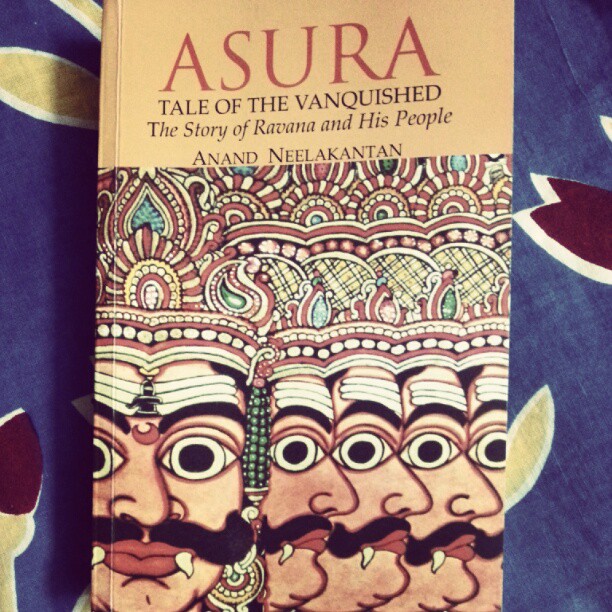
  • ASURA: Tale Of The Vanquished

    Anand Neelakantan

    Asura is partly a Ravana perspective on where his life intersects with that of Rama, (and thus Ramayana) and partly a social commentary of his life and times. (how society treats women, the caste system etc) The tale is narrated by Bhadra, an asura who fought under Mahabali and several others before becoming a recurring (and key) figure in Ravana’s life from the time he led a ragged army against Kubera. The narrative begins with Ravana’s last moments, as he lay dying on the battlefield.

    Predictably, the book shows Ravana in a good light, whose only fault was that he defied the prevalent societal norms and lived life on his own terms, as opposed to Rama, who was deified by the higher castes and made into an ideal image. For all we know, this is probably true, since history is after all, written by victors.

    While most of the story is essentially known, the author deserves credit for demystifying the myth – from the big picture details of which region was ruled by which king to smaller details like Pushpak as a flying machine prototype and Jatayu becoming a bird that got caught in its rotors. This does require that he has to gloss over some of the events, but that’s easily something we could forgive because the author largely keeps it true to the original tale. Varuna as a pirate, Kubera as the merchant king, Yama as the drug lord, various Indras, are all superb renditions of familiar mythological characters. There’s some intelligent use of Bhadra in the final events, and the author leaves ample clues for the reader to predict it. The author tries to show that in many ways, things have remained unchanged – the generation gap between Bali/Angada and Ravana/Meghanada is a classic example, and this is something that gives the narrative a lot of credibility. (+5 points for the Jabali mention)

    But I did feel that it could have been edited better. Bhadra’s character, though used well to show how the life of a common man changed, or remained unchanged as the ruling class switched, is prone to long winded discourses which slackens the pace. The working of Ravana’s mind too becomes preachy once in a while, but thankfully not too often. If I had to nitpick, I’d say that mistaking navel for naval while describing a woman’s anatomy is not a sign of good proofreading. (-5 points for not connecting Chandrahasa to Shiva and relegating it to a blacksmith origin)

    But in essence, it is a fresh take, and was good enough for me to visualise how it really must have been – as something that really happened, and not just a myth.

    asura

  • The Forest of Stories

    Ashok Banker

    Book 1 of Ashok Banker’s Mahabharata, MBA if you will. It is an exact rendition of the saga written by Krishna Dweipayana Vyasa. The narrative begins in Naimisha-sharanya, where Ugrasrava, son of Lomarsana and better known as Sauti, arrives to convey the news of Vyasa’s transcendence to the next life, and to narrate the grandest tale ever created.

    The tale begins long before the descendants of Kuru faced each other on the battlefield at Kurukshetra. Kurukshetra, famous long before as Samantapanchaka where Parasurama created five lakes of blood from the decimation of kshatriyas, and famous long after as the venue for the sarpa satra conducted by Janamajaya, descendant of the Pandavas.

    Sauti explains how Jaya, the original tale swelled from 8800 slokas to 24000, named Bharata and then over several narrations, to Mahabharata, made of one hundred thousand slokas. A narration that Sauti himself was the recipient of, from Vaisampayana, as well as Vyasa himself, at the satra.

    The narrative is anything but linear, like a tree with a multitude of branches, and does stick to Vyasa’s original work. It flits from story to story, occasionally coming back to what can be loosely described as central narrative, in this case, a sort of index built by questions being asked to Sauti during his narration. Thanks to this, from creation of the world and the origin of different species to the reason for the Mahabharata war and the stories of many antecedents of the Pandavas and Kauravas, there are stories and stories. This book ends with the introduction to Bharata – the emperor, son of Dushyanta and Shakuntala, after whom the country is named.

    As someone deeply interested in mythology, this is a very interesting read, despite the elaborate prose, but what you will get from it completely depends on your level of interest in the epic.

    Clipboard01

  • The Sins of the Father

    Jeffrey Archer

    The second part of The Clifton Chronicles. Harry’s plan to erase his past and start a different life in America has unfortunate side effects, as the last page of the first volume indicated. Emma, the mother of his son, meanwhile, refuses to believe that he is dead, and sets out to find him. Giles, after some hesitation, joins the army and fights the Germans in World War 2. The book also follows a few other characters from ‘Only Time Will Tell’ like Hugo Barrington, Maisie Clifton, and thanks to Emma’s trip to America, and Harry’s own adventures, introduces a few interesting new characters as well. The different-people narrative approach has been used effectively to zoom in/out in this book too.

    The pace, as usual, is perfect, and that’s a skill I always admire Archer for. He now reminds me of Sachin Tendulkar actually. ๐Ÿ™‚ Once upon a time, Sachin was known for his aggressive mauling of bowlers, but as he aged, he made changes to his technique. He was still a master, but in a different way. In another era, Archer was famous for those amazing twists in the tale/tail. But after a while, they became predictable. In the last few books, I’ve seen a distinct change in his style. The wit is still there, but more subtle, as are the twists. A different kind of story telling mastery, and I, for one, am enjoying it.

    Archer has captured the WWII life in Britain very well. There are interesting references to real life events and people – for instance Harold Macmillan. The US/British differences are also touched upon in a very humorous way. All these are little nuggets which add flavours to the story.

    There is an old world charm to the characters, it’s probably because of the time in which the story is set. But Archer does like it this way, as I’ve noticed in other books. They also have everything falling into place for them, ahem, but things aren’t so bad that I can’t ignore. They are clearly good or evil, and there are practically no gray shades. I am curious to see how Archer will carry this on in the later parts, specially when he has characters in the contemporary era. I wonder if he will retain this clear division, and if he does, how he will get us to relate to it. ๐Ÿ™‚

    I enjoyed the book, and massively crossed the self imposed limits of pages/day – that’s a testament to the hooking capability of Archer’s narrative.

  • Empires of the Indus: The Story of a River

    Alice Albiniaย 

    I am showing signs of travelogue addiction, and this is the kind of book that creates it! It’s not just the content of the book, which is marvelous and makes for a treasure trove of information, but the sheer tenacity and guts the author displays, that has made me a fan. Spanning four countries, this book is the story of the river Indus, from its source to its destination, though not in a linear way. What it succeeds in doing, like the best travelogues do, is to also allow us to travel through time, in this case, even to the time before man existed. From Hindu mythology to the Harappa civilisation to Partition and the Kargil conflict and China’s occupation of Tibet, the book is not just the story, but the history of a subcontinent (at least a part of it) and the civilisations that rose and fell.

    The preface gives us an idea of the expanse of the river through its various names, given across lands and by everyone from Greek soldiers to Sufi saints.

    There are nuggets everywhere right from the beginning – the comparison of the arrangements of the Quran and the Rig Veda, the integrity shown by a citizen in the early days of Pakistan’s formation, a modern day citizen blaming Jinnah for the country’s authoritarian culture, a nation’s search for identity, and the vision of its founder, who was only human. The first chapter ‘Ramzan in Karachi’ is a book in itself, and this can be said of all the chapters! ‘Conquering the classic river’ is a slice of the Company’s India exploits, ‘Ethiopia’s first fruit’ shows the amazing ‘presence’ of Africa in the subcontinent’s history and present, and the facets of their absorption into the mainstream. ‘River Saints’ is about Sufism and its modern day remnants who are not beyond politics, religious conflicts and feudalism.

    ‘Up the Khyber’ is about the exploits of Mahmud of Ghazni, the sexual preferences in the frontier province, and the beginning of the author’s more difficult challenges as she zigs and zags through Taliban and smuggler territory. ‘Buddha on the Silk Road’ is an awesome chapter on the meeting of 3 great religions – Hinduism, Islam and Buddhism and how they influence each other in the area, down to the destruction of the ancient Bamiyan statues more recently. In ‘Alexander at the outer ocean’, the author stubbornly walks, despite very serious hardships, the route that the Sikunder-e-azam took. ‘Indra’s Beverage’ takes us back to Rig Veda times, the Aryans and ancient Stonehenge like relics that survive to this day, along with the Kalash tribe, which follows a religion that goes back beyond Hinduism. Some areas, as the vivid prose describes them, seem to exist the same way they did in Rig Vedic times. The incredibly advanced Harappa civilisation is showcased in ‘Alluvial Cities’, though the reason for their fall is still contested. Kashmir’s archaeological treasures are the focus in ‘Huntress of the lithic’ and it’s interesting to see how the same ‘painting’ has been reinterpreted across time by various people to suit their needs. In the final chapter, the author captures the startling contrast of man’s attempts to conquer nature and at the other end of the scale, his ever decreasing ability to live in harmony. This chapter is also a testament to her commitment to the book, and the mentions of Kailash and the possibilities of Meru were extremely interesting to someone like me, who is interested in Hindu mythology. The book’s final words, which makes us wonder how long the river which spawned civilisations will be around, is a melancholic gaze into the future.

    At 300 odd pages, every page of this book is packed, and there is no respite. But it’s completely worth it!

  • The Fiction Collection 2 (Penguin)

    This book was a little ‘Inception’ of time travel. It’s been 6.5 years since it was published and commemorates 20 years of Penguin in India. It consists of excerpts from the many works the publishing house has brought out, many of them from several years back. There were a few from books I had already read, a few by authors whose other works I was familiar with, and then there were authors and works I had never even heard of – and that’s why reading this was a wonderful experience – like rediscovering a few old friends and making new ones. ๐Ÿ™‚

    In a few of them, I did miss the larger context, but those were a rare few. There are a few translated works too, and I was surprised by the justice they seemed to do to the original work – ‘after the hanging’ by OV Vijayan being a perfect example. The other interesting part was reading a different rendition of something I had read earlier – Indu Sundaresan’s ‘the twentieth wife’ on Mehrunnisa and Salim (the early part of which I could associate thanks to Alex Rutherford’s “Empire of the Moghul”) or Khushwant Singh’s ‘delhi’ (‘nihal singh’ is set during the first war of independence and some of the events I remember from William Dalrymple’s “The Last Mughal”)

    My other favourites included works that gave a glimpse of places as they once were – Bombay in Eunice de Souza’s “dangerlok”, (a wonderful piece of work) Delhi in Navtej Sarna’s “We weren’t lovers like that” and more tragic ones like Punjab in Neel Kamal Puri’s ‘death toll’ and Kerala in Jaishree Misra’s ‘from ancient promises’.

    The best part is that with more than 50 different works, you are practically guaranteed to find many glimpses that you’d like and might make you want to explore the canvas further. It also took me to a different era of story telling – before IITs, IIMs, call centres, urban angst with corporate backgrounds and cliched marital ‘crises’, packaged mythology and such. For all of these reasons, a must read.