Category: Books

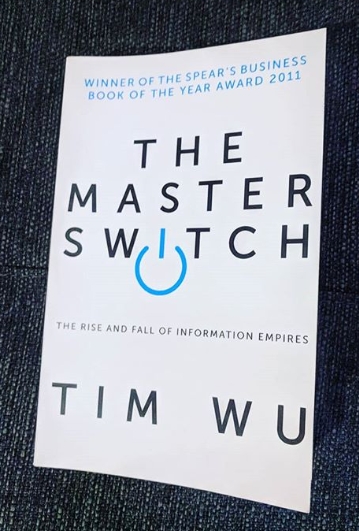
  • The Master Switch

    Tim Wu

    Wow!
    Two of my favourite books in the recent past have been The Moral Animal and The Sovereign Individual. I liked them because they brought out the fundamental patterns that underlie the evolution and behaviour of humans and the system of the world respectively. The Master Switch does the same with communication and information empires.

    His premise is this – history has shown that communication/information technologies follow a predictable path : it starts as an idea in a mind/group of minds typically in a small room, is then brought to life in the most rudimentary manner, and keeps itself open to improvements and changes until it becomes a solid proposition. It then shifts to industrial scale, predictable outputs, and controlled by a corporation which then decides to make it a closed system. He calls this the Cycle.

    The author’s contention is that all information businesses go through the cycle. The question he seeks to answer is “which is mightier : the radicalism of the Internet or the inevitability of the Cycle?” He gets there by taking us through the history of information empires.

    The story begins in the 1870s, when Alexander Graham Bell’s small telephone company goes up against the ruler of the times – Western Union. A classic underdog story that resulted in the continuing empire that is called AT&T. Is At&T still the hero? Will get to that in a bit. Similar stories with its own heroes and villains then play across radio (AM & FM), television, movies and now, the internet.

    It is not just the magnificent scope that makes the book interesting. The author retells history in the mould of a thriller! There are anecdotes and (not so) trivia that make the book really engaging. Multiple inventors of the same technology (and uncredited firsts), towering personalities from JP Morgan to Steve Jobs who left a firm imprint, fascinating origin stories of movie studios like Universal and Warner that are now household names and how movie making is now less to do with the movie and more to do with the business of the franchise (a movie is a 2 hour advertisement of an intellectual property which makes money through a franchise that sells everything from tshirts to DVDs to theme parks), companies that rise again like phoenixes in revenge arcs that span a century (GE buying Universal)!

    The author obviously does not give a definitive answer to whether the Internet will beat the Cycle. He suggests a constitutional approach (not regulatory) and a “Separations Principle” to make sure that the ownership of information creation, distribution (networks, infrastructure) and access control remains with different parties to prevent it from corporate or governmental misuse. The nuance he highlights is that the monopoly actually begins and even continues with noble intentions and utopian values, but loses the plot subsequently. Almost like “you either die a hero or live long enough to see yourself become the villain.” (Remember the question earlier about AT&T)
    He also points out (and this is where it meets The Sovereign Individual) that the user has the power to control how this plays out – “Habits shape markets far more powerfully than laws”.

    A fantastic read on multiple counts!

  • Tales From Firozsha Baag

    Rohinton Mistry

    A literally crappy beginning does make you wonder how this book is going to play out, but in a few pages, you understand this was only literally. However, what it also points out is the author’s ability to make the mundane very interesting. Eleven intertwined stories that create a vivid world whose unique characters the reader is able to identify and relate to, though they might be far different from the self or those around.

    A theme that I felt was running strong through all the stories was one of identity – at both collective and individual levels. There is obviously the Parsi way of life, and their interactions with the world at large. Without really resorting to stereotypes or tropes, the author is able to bring out the way of life and the struggle between its past and future through various characters, and their relationships and interactions. At an individual level, for example, Jaakaylee who was Jacqueline identifies herself as the former after 49 years of working among Parsis who called her that. Many stories bring out the tussle between generations as children grow up and understand the need for changes in their way of thinking and living if they are to survive in the world, even as parents cling on to traditions and cannot understand the need for change. The author uses Kersi’s character at both the personal and collective levels to show how life shifts with time.

    Two of my favourite stories are “Of white hairs and cricket” and “Lend me your light”. Both star Kersi and are points in his life that make him realise how the world he inhabits is constantly shifting, and he cannot always hold on to the things he thought were eternal. The last paragraph in the first story is something I could wholly relate to – when one feels precious things slipping through fingers and is powerless to stop it. I think anyone who has had to leave a place they considered home will be able to relate to the second story – the array of mixed feelings when one has to leave, when one has to visit even for a short time, and the idea of being a stranger in one’s own home.

    There is an excellent skill of observation that has been put to good use in all the stories, and a remarkable sensitivity that is evident in the writing. The writing technique somehow feels rich even when writing about the ordinary days of a life, and somehow, despite that, or maybe because of it, one feels that these are people one might actually know already.

  • Never Let Me Go

    Kazuo Ishiguro

    This is only the second Kazuo Ishiguro book I am reading. But I found at least a few parallels from The Remains of the Day. For starters, both books left me incredibly sad. Some of it is for the plight of the characters, and some of it is do with the other commonality in both the books – the awareness of what could have been. Another thing I noticed is how the principal characters of both books develop a different perspective when they drive through the English countryside.

    Barring this, the books are quite different. (mild #spoilers ahead) This one is set in quite a dystopian future – humans are cloned for organ harvesting, raised in environments that don’t allow a lot of interaction with the outside world, not really made aware of their future, and are not even considered to be real humans capable of feelings and emotions. The focus of the book, though, is on three characters , their relationship with each other, and the world around them.

    It doesn’t really start off with a lot of intensity. The beginning, though it alternates between different phases in the narrator’s life, has a very Malory Towers feel to it (I thought) with different teachers (guardians), the institution and its myths and norms, and the relationship between them and the students, and between the students themselves with their friendships and rivalries. But even that early, one can catch the difference – a clear one being the exhibitions and the “gallery”, both of which are a forum for the students’ creative expression – and this does turn out to be an important theme in the book. The book then traces the life of these students as they step out into a different environment and progressively take up their prescribed roles in society.

    It left me thinking on quite a few things – these humans cannot have children of their own. Is their art supposed to be a means of immortality? But contrast that with how the author dismisses the value of art a couple of times. What are the ‘carers’ and ‘donors’ an allegory for? Is there some sort of parallel for our roles as children and parents, and how both of them, in a way, contribute to us not being a version of ourselves that we could be if they weren’t in our lives? And to end, the bittersweet irony of humans without emotions becoming carers and donors, and exhibiting a complex set of feelings that are on par, if not rival that of the humans they are ‘serving’.

    This is one of those books that drew me in, and without a lot of fuss and theatrics, engaged me in a deep way. Loved it.

  • Against Empathy

    Paul Bloom

    As far as the title goes, he was preaching to the choir. My thoughts on empathy have been shaped over the last few years based on some excellent books like The Selfish Gene, The Moral Animal, Thinking Fast and Slow, Who’s in Charge? and even How Adam Smith Can Change Your Life, which is quoted by the author quite a bit. These thoughts are not kind to empathy being the best guide for decision making of the moral or even sometimes the day to day kind. They also favour rational compassion. So, theoretically, this book should have worked for me, especially because it has been recommended by some of my favourite thinkers.

    But it didn’t to the extent that I had hoped it would. This, I think, is largely because the premise of “against empathy” required little validation for me, it was the case for rational compassion that I was more interested in. After all, disproving one thing is not always automatic proof for another, even if the “another” is part of the title of the book! Unfortunately, the book spends just spends the last 10 pages (of 241) on rational compassion. Or at best 25, if one extends a benefit of doubt to occasions where the author argues for it in related contexts.

    I did come across a few interesting things though. Some framing for example – how both folks for and against gun control/immigration are possibly driven by empathy. The only difference is who they are empathetic to. And quotes – this one being my favourite – “Scratch an altruist, and watch a hypocrite bleed” ~ Michael Ghiselin. (I really believe in this one, and the selfish interests that drives erm, selflessness) I realised that I was in the august company of Thomas Hobbes and Abraham Lincoln in this. There are also interesting concepts like the moralization gap – how we discriminate between the immorality of acts done to us and done by us (exaggerate the first, downplay the other).
    The arguments are a mixed bag, but the writing style is witty and accessible and I would recommend it to folks who are intrigued by the thought of being against empathy. If you’ve already arrived at it via thinking/reading, this could help you in validation, but only on the first part of the title.

  • Freedom

    Daniel Suarez

    If you’ve read Daemon, I suspect it’d be very difficult to not read its sequel. If you haven’t, you know where to start!
    Freedom picks up right where Daemon left off with the kind of intense action that dominated the last portion of the latter. Even as the Daemon systematically tears apart the corporations and financial systems that rule the world, its enemies prepare to launch a counter attack. What makes it all interesting is that the different players in the game have divergent agendas.

    It is also interesting that the book brings to life at least a few concepts that I have read in non-fiction in the context of how unemployment, extreme capitalism and the wealth divide will cause fundamental shifts in civilised society. Neo-feudalism, trust based community networks, and the irrelevancy of state borders are a few examples. In doing that, it also shows the possibility of how new systems could end up just like old systems because the basic human tendencies remain constant.

    The narrative sets a scorching pace, and one is tempted to just zoom forward a few pages just to know how a plot point is going to end. Excellent read!

    P.S. I somehow felt that it was written with a movie or two in mind. Almost like a screenplay.