Category: Ideas

  • A People Person?

    Scott Adams’ post titled “People who don’t need people” (via Surekha) reminded me of Asimov’s Spacers, the first humans to emigrate to space, and their life on Aurora, the first of the worlds they settled. Scott Adams predicts that “we will transfer our emotional connections from humans to technology, with or without actual robots. It might take a generation or two, but it’s coming. And it probably isn’t as bad as it sounds.

    In the huge canvas that Asimov had created, the Spacers chose low population sizes and longer lifespans (upto 400 years) as a means to a higher quality of living, and were served by a large number of robots. As per wiki, “Aurora at its height had a population of 200 million humans and 10 billion robots.

    These days, as I experience the vagaries of the cliques and weak ties – not just Malcolm Gladwell’s much flogged social media version, but even real life ones, I can’t help but agree with Scott Adams that it won’t be as bad as it sounds. I probably wouldn’t mind it at all.

    When I feel like a freak
    When I’m on the other end of someone’s mean streak
    People make fun I’ve got to lose myself
    Take my thin skin and move it somewhere else

    I’m setting myself up for the future
    Looking for the chance that something good might lie ahead
    I’m just looking for the possibilities
    In my mind I’ve got this skin I can shed

    Scott Adams began his post noting that humans are overrated. Sometimes, I wonder whether humanity is, and whether losing our current perceptions of it would actually make a difference. (earlier post on the subject)

    Lyrics: Invisible, Bruce Hornsby

    until next, bot.any

  • Evolution of Enterprise 2.0

    In the last post  – on defining social collaboration – I had also applied it in the context of social business. It was a brief mention and I did describe it as a utopian thought at this stage. However it reminded me of a debate late last year on Social Business and Enterprise 2.0, because ‘collaborative tools’ found mention then. The reasons for the debate notwithstanding, it was still interesting.

    It began with a post from Andrew McAfee, written in favor of Enterprise 2.0 and in which he pretty much called ‘social business’ geriatric. 🙂 Stowe Boyd shot back with this post, giving his definition of social business and insisting that the nomenclature was important.In keeping with my generally agreeable nature, I subscribe to parts of both thoughts. Social business as an idea is indeed old, but its adoption has been patchy at best. The ‘social’ tools of this era can enable greater, better and more consistent adoption, as there is indeed much potential for synthesis when people, processes and technology meet. Because of this, the manifestation of ‘social business’ would be new.

    But in my mind, there is quite a dichotomy between Social Business and Enterprise 2.0 anyway, primarily because of intent, and therefore the way they’re pitched as ideas. To use them interchangeably would be doing injustice to both. Enterprise 2.0 focuses on using social technologies to address the objectives of the organisation. But Social Business has a larger role and (for the purpose of a direct comparison) would involve setting organisational objectives with a social-societal perspective and a purpose that people can identify with. In Hugh MacLeod’s words, “the need to belong  to something that matters”.

    Is one better than the other? I don’t think so and it is perhaps not an apt comparison. Enterprise 2.0 is perhaps a better fit (relatively) to the current organisational frameworks, while Social Business is much more radical. But it is quite possible that over a period of time, an organisation that adopts Enterprise 2.0 will transform into a Social Business. As for social collaboration, it is a process that can fit well into both.

    until next time, a social enterprise 🙂

  • Farm Vile?

    While two movies, despite not being remotely connected in terms of geography or genre, are perhaps not a trend, it did remind me of a conversation from more than a year back – something I blogged about too. An excellent conversation with S, that started with the dystopian scenario of 1984 and human farms and moved on to time travel, all in the context of advancement of society and the species.

    The movies in question are Gamer and Peepli Live, and the one thing that links them – the value of the human life. While the former is set in a word of the future, in which a new technology allows replacement of brain cells to allow full control of a body by a third party and finds application in gaming (one game in which gamers control a real person in a proxy community, a far more ‘real’ version of Second Life, and its more violent avatar, a multiplayer third person shooter game in which death row inmates fight for freedom), the latter is seemingly less complex – a farmer is ‘encouraged’ to commit suicide for the betterment of his family – more specifically, for the money they’ll get as compensation.

    And the question they make me ask – at what point in the future does mankind stop treating human life as sacrosanct? One could argue that it never has been, with the amount of killing that happens around regularly, but what I mean here is as a species. So, when someone says ‘human farms’, there won’t be gasps or expressions of horror/disgust. With population figures soaring, virtual lives competing with real ones, rise of machines, increasing gaps between the haves and have-nots, do you think it will happen? Just in case you think I’ve completely lost it, we’ve already started experiments with living beings – microorganisms in games.

    until next time, knotty question.

  • Back to eternity

    Despite being a Star Trek fan, I happen to think that Time is the final frontier, at least in the horizon that I can see. I find it quite intriguing that, though it might be looked on as a tool for tracking, I can perhaps not account for most of my lifetime. I don’t mean the large picture, I haven’t lost it totally yet, but specific minutes. Take for example, the last hour and account for all the thoughts that rushed in. I would find it difficult.

    If you close your eyes, and allow your breath to be the only meter, the perspective of time undergoes a shift. Meditate a bit, and its easy to see. Easy to see that even the measurement of time – years to seconds and beyond is our  construct. But it is so ubiquitous and enmeshed in our lives that it seems as though it is a constant and only we change. It requires dramatic events for us to pause and note the passage of time. Kahlil Gibran has said, ‘Perhaps time’s definition of coal is the diamond”

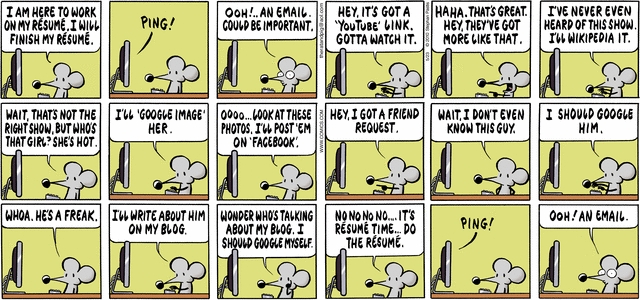
    Meanwhile, I wonder if all the information about those unaccounted for minutes is stored somewhere in my brain, and is just not deemed enough to be of any priority for me, and hence seems inaccessible. The tools that consume me these days – most specifically Twitter, and more recently, Foursquare, also help me keep track of what I’ve been up to, and when it works the same way for everyone is when there is an information deluge, and that seems to be something we find difficult to handle. Something that we have discussed before. There is a toon I found (here) that correctly describes the way a lot of us seem to be functioning now

    Clipboard01

    And in another example of how man is shaping his own evolution, I read about companies like Lifenaut, which  ultimately aim to create humanoid robots powered by a backup of the original human’s brain. (via @pkaroshi) The first step is to create a digitised version – an avatar, and give it enough data for it to mimic the original human. It makes me wonder whether we will be able to create ‘consciousness’.

    And that makes me think a bit more – by the time, we are technologically advanced to create it, will we have forgotten what consciousness is? Which also begs the question whether we have ever understood it at all, when we are not even mindful of the minutes of our lives? How does one define it? So many reactions which seem pre-programmed when one thinks of it, actions and reactions more out of habit than any conscious choice being exercised.

    So yes, with all of the work happening at a rapid pace, (do read) I think its more ‘when’ than ‘if’ – that we will become immortal, and time, from a future point of view, will become immaterial, because the future will be infinite. But we still may not be able to undo what we did a minute back. Where does that leave us? To quote Pico Iyer (from Abandon) “God has to be understood in the context of everything that is not Him”. But that is a different discussion, I guess. Its only that with every advancement that humanity makes, and in that process also usurps things once attributed to divinity, I begin to wonder where that leaves our versions of God?

    until next time, time.ly links 🙂

    PS. I tweeted sometime back, even if you never read an Asimov work, or never plan to, this is one that you should read. The Last Question.

  • Process pool..

    “You’re such a hypocrite”, said D, as i drummed on the laptop impatiently willing the folder to open faster. Not getting the usual retort from me, she continued, “On one hand, you want to slow down life, and on the other hand, you want things to move real time fast” A valid point, but rather than hypocrisy, I’d prefer calling it a paradox. After all, who likes to be labeled a hypocrite? 😀  I wondered whether it is possible for the two to co-exist.

    There’s another tangential constant running debate in the household. It is again related to time and time saving. It is also related to the one above because it is to do with processes. The impatience above is because I know the comp can do it faster, having seen it done before. So if it is a process, i believe it should run that way and that fast (if not faster) always. Yes, I realise that’s a simplistic way of looking at it, and there are variables involved, but yet.

    Now this is something I carry outside the comp too. And so it is that when D is doing a chore, I immediately strive to enlighten her on the exact process to be followed for maximum efficiency. My logic is that if I have walked a certain path, and learned from it, I should bring her up to speed, so that she can build on it, rather than start from Step 1. D hates it, especially when I can remark that as a software professional, i can understand why she should absolutely abhor processes. Cheap thrill, you guessed! Meanwhile, it doesn’t help that sometimes D discovers more efficient means of doing the chores. I shall, of course, have my revenge soon, when I become a home maker and master that ancient mysterious art, that in spite of several examples to the contrary is still considered a playground dominated by women – cooking. 🙂

    And its not just D, I inflict this behaviour on poor unsuspecting folk who appear on my chat window and want to discuss things I would be interested in. Thanks to the blogs, it sometimes turns out to be something I have written about, and so I immediately share a link. Its a way of sharing my perspectives before we discuss the matter. I look forward to a time when i can do it in real conversations too. A ‘Matrix’ like USB port in your head, so that i can feed in the knowledge, and you can say ‘I know Jujitsu’ and factor in my arguments when we discuss. I believe this will save us both time. But of course, I’ve been warned by quite a few people that its positively rude, so these days I politely manage to repeat what I have written earlier.

    But now comes the clincher, I sometimes have a problem when someone does this to me. I irritably say “Let me do it myself/my way” and also add for good measure, “Don’t you have any respect for my subjective experience?”

    No, its not erm, hypocrisy, I still think its a paradox, or perhaps two ends of a spectrum. On one hand, processes  help crunch time and on the other, the subjective experience is important, and perhaps might help discover better ways. The choice, I guess, depends on the situation, our interest, and our intent. Or does it run deeper and tell us how we want our life to be? As Morpheus said in a different context “..there’s a difference between knowing the path and walking the path”

    until next time, don’t respond with links in comments!! :p