Category: Augmented Human

  • God Plus

    The thread that interested me most in Neal Stephenson’s Quicksilver (Volume One of The Baroque Cycle) was on Predestination vs Free Will, something I’ll continue to read up on. The book has a conversation between Daniel Waterhouse, a fictional character and Gottfried Leibniz, in the chapter Daniel and Leibniz Discourse (II), in which Leibniz puts forward a thought that there is an incorporeal organising principle, which organises and informs the body. He calls it the Cogitatio, and later uses it interchangeably with Mind, but different from brain, which is a mechanical phenomenon. With this, he attempts to find a middle ground between free will and predestination by stating that Mind and Matter grew out of a common centre and “I have complete freedom of action… but God knows in advance what I will do, because it is in my nature to act in harmony with the world..” (seems close to Molinism)

    While the recent exploits of humans would dispel this last thought in a jiffy, it did set me thinking on another subject of fascination – Singularity, “the hypothetical future emergence of greater-than human intelligence.” I still wonder whether it would be a ‘Skynet’ version (a superb post by Chris Anderson) or a an augmented human. (something I wrote earlier)

    The thought is whether God’s design had anticipated a Singularity for humans. A state in which the human being will understand and create things far more ‘advanced’ than God can? What would be the relevance of the idea of God then? And in parallel, what would be the human’s role if machines are the way to technological singularity?

    On the flip side, as i wrote in the earlier post, if augmented humans are the way to singularity, would the human mind as we know now exist then? Most probably not, and that would explain why if indeed God did make us in his form, we have no recollection of him or his idea of Singularity.

    Or maybe, some among our species already have reached it, without artificial augmentation, and that’s what we call nirvana, when you can bend the spoon, if it exists. 🙂

    until next time, the God complex is also a possibility 🙂

  • Back to eternity

    Despite being a Star Trek fan, I happen to think that Time is the final frontier, at least in the horizon that I can see. I find it quite intriguing that, though it might be looked on as a tool for tracking, I can perhaps not account for most of my lifetime. I don’t mean the large picture, I haven’t lost it totally yet, but specific minutes. Take for example, the last hour and account for all the thoughts that rushed in. I would find it difficult.

    If you close your eyes, and allow your breath to be the only meter, the perspective of time undergoes a shift. Meditate a bit, and its easy to see. Easy to see that even the measurement of time – years to seconds and beyond is our  construct. But it is so ubiquitous and enmeshed in our lives that it seems as though it is a constant and only we change. It requires dramatic events for us to pause and note the passage of time. Kahlil Gibran has said, ‘Perhaps time’s definition of coal is the diamond”

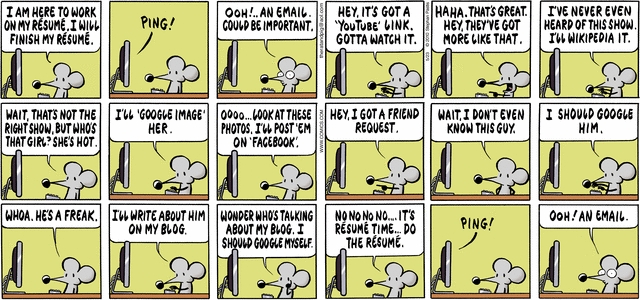
    Meanwhile, I wonder if all the information about those unaccounted for minutes is stored somewhere in my brain, and is just not deemed enough to be of any priority for me, and hence seems inaccessible. The tools that consume me these days – most specifically Twitter, and more recently, Foursquare, also help me keep track of what I’ve been up to, and when it works the same way for everyone is when there is an information deluge, and that seems to be something we find difficult to handle. Something that we have discussed before. There is a toon I found (here) that correctly describes the way a lot of us seem to be functioning now

    Clipboard01

    And in another example of how man is shaping his own evolution, I read about companies like Lifenaut, which  ultimately aim to create humanoid robots powered by a backup of the original human’s brain. (via @pkaroshi) The first step is to create a digitised version – an avatar, and give it enough data for it to mimic the original human. It makes me wonder whether we will be able to create ‘consciousness’.

    And that makes me think a bit more – by the time, we are technologically advanced to create it, will we have forgotten what consciousness is? Which also begs the question whether we have ever understood it at all, when we are not even mindful of the minutes of our lives? How does one define it? So many reactions which seem pre-programmed when one thinks of it, actions and reactions more out of habit than any conscious choice being exercised.

    So yes, with all of the work happening at a rapid pace, (do read) I think its more ‘when’ than ‘if’ – that we will become immortal, and time, from a future point of view, will become immaterial, because the future will be infinite. But we still may not be able to undo what we did a minute back. Where does that leave us? To quote Pico Iyer (from Abandon) “God has to be understood in the context of everything that is not Him”. But that is a different discussion, I guess. Its only that with every advancement that humanity makes, and in that process also usurps things once attributed to divinity, I begin to wonder where that leaves our versions of God?

    until next time, time.ly links 🙂

    PS. I tweeted sometime back, even if you never read an Asimov work, or never plan to, this is one that you should read. The Last Question.

  • The Immortal’s reality

    ‘1984’ is a subject that has appeared in many conversations, no, not Indira Gandhi’s assassination, George Orwell’s book. And every time it did, I have smiled politely and pleaded ignorance except for ‘Big Brother’, nothing to do with Shilpa Shetty’s adventures or Sunny Deol’s movie, in spite of my Bollywood fixation. I read the book a while back, and was absolutely fascinated by the dystopian world Orwell has created.

    Though I found many facets of the book interesting, there were two that were more equal than the others. 🙂 One was the idea of a few people controlling the minds and actions through unrelenting propaganda (among other things) and the sentence ‘He who controls the past controls the future, he controls the present controls the past’. History being written by winners, and it being what’s recorded (either in books or other data storage devices), or people’s minds. The second interesting thing is to do with the latter, of how reality is such a deceptive thing, and is of our own making. If there are two of us, and both of us agree that one is flying, then that is reality for us. Yes, you might laugh at the simplistic approach, but in the context of the book, absolutely possible.

    The human mind, its storage capabilities, and its evolution is a subject that keeps popping up regularly in this blog. Recently, the concept of singularity has interested me a lot, and I’ve been reading up material available on the net. While I’ve been interested in science fiction for quite a long time (from watching Star Trek and Sigma on DD, okay well, that’s a start to Doctor Who and the Foundation series in school and college, with minor setbacks like not being able to like Clarke, and recently, not able to enjoy Doctor Who on the BBC) and I saw singularity as a natural progression of that basic interest. Except, as I read more, I realise the lines between fiction and reality are beginning to get blurred.

    I had an interesting conversation recently with a friend S which was a sort of mash up of both these subjects. We were discussing the effects of these advances on society. I brought up the argument from 1984 that whatever happened the three tier classification of society (high, middle and low classes) would be retained in some form or the other. S was of the opinion that the have- have not divide would widen, he even brought up the concept of human farms, harvested for body parts. (a human controlled version of the Matrix). The 1984 premise of thought control would be perfect for that.

    And then, after teleportation, time travel, whether teleportation would be significant if we are able to replicate all sensations before that (as of now, we can see and hear across distances, smell, taste, touch remain) and similar interesting stuff came the subject of immortality. I said , one of the things that sadden me when I’m reading science fiction is that I’ll not be around to witness science fiction becoming reality. But I also  wondered whether, even if the body were capable of lasting for an infinite amount of time, would the mind be ready for it. All of our life, we base on finite time – things to be done, objectives to be achieved, what if we had all the time in the world, how would we adjust? S pointed out that these things happen gradually, and by the time we become immortal, we would have already grown used to really long life spans. Like many things now, we would take it for granted, and would not appreciate the significance. We were only having coffee but discussed how there might still be loss of (memory of) experiences so far, and how there would perhaps be preloaded SIM cards one could install, and how the immortal’s “will” would have instructions of the “I don’t want a Windows OS for my body, Chrome is where my heart is” variety. Ok, cheesy, but can you imagine the possibilities?

    My biggest concern was the revenue model. If i lived forever, how would I afford it? What would be the economics of such an existence? Writer this century, sportsman the next, will natural ability be of any value or significance? And the final question, will we able to control time enough to have alternate realities? S says never, but i get back to the 1984 premise of reality, of controlling sources of information to ensure that the past is consistent with the present, and I wonder what humanity will end up doing.

    until next time, morality and mortality…

  • Life…streamers

    Sometime back, I read an extremely interesting post by Chris Messina – how we’re now hit by a plethora of data and information on the real time web, which our brains have not adapted to, and how, in order to process this, we’d require an augmentation of our existing abilities.

    The information overload has been happening for a little while now. Between reading blogs, writing them, microblogging, Facebook and all the shiny little tools that keep coming up, it’s a constant juggling act. I’ve been on Twitter for over a couple of years now. I can see a drastic change in the relationships there already, as compared to the banter of the initial days. New people, new thoughts, old people who’re changing with time, old thoughts recycled.  A simple @ tag connects lives. Meanwhile, its not just relationships and thoughts that change, but also behaviour – the need to share an experience, attention deficit, and so on. These would obviously vary with an individual’s usage of Twitter, facebook etc, but I’m sure there are more like me.

    While I’ve been dimly conscious of the vastness of the Twitterverse, I had a more tangible realisation only after i came across a tool (from an article shared by Shefaly). As I sat watching the pictures streaming across the screen on Twitcaps, I felt I was somehow connected to all of them across the world sharing images – from parties to churches to landscapes to death to raunchy stuff to coffee mugs and so many many other things. There are multiple images being shared every second, and I had an acute realisation of the magnitude of change happening, in terms of connectedness and sharing. The population of the world, the population of your own city, the number of people working in your office/living in the apartment complex- as the numbers come down, the people slowly change from a blurred intangibility to a focused person. But as we get more and more networked, the number of persons who become tangible are increasing, the arguments about their relative importance to self notwithstanding. As Chris says in the article, can human beings cope after a point?

    Sometime earlier this year, I remember writing a post about speciation – the evolution of the human species, and how replacement of body parts and advancement might finally end up in a being that may not match our current concept of human, or even living, like the Cybermen in Dr.Who. In that post, I had also mentioned Homo Evolutis, one of whose characteristics was networked intelligence.

    As the information deluge gathers momentum, there may be those who choose not to be part of it, who are comfortable not being part of this vast stream of consciousness, while there may be others who use their abilities and the augmentation to embrace this. These are obviously two extremes, and its quite possible that humans would figure out a middle path. But I already see this divide happening – some leaving it by choice, some left out by circumstances. The learning curve is becoming so steep that after a few years, it might be difficult or even impossible to catch up. And that’s how I begin to wonder whether we’re rapidly approaching the point when the species will diverge. Maybe not in my lifetime, but within a couple of generations?

    There’s another aspect of all this that I wondered about. With the increasing amount of information and the speed at which we’re forced to process it, will we have time to acquire more perspectives, or continuing that cycle, accumulate more baggage? Will that change the way we behave with people, and the way we live life? Will we become more objective? Or will we become more biased, relying on notions we don’t have time to change, and behaving accordingly?

    As I write this there is a stream of thoughts running in my head – of times, friends and relationships. Poignant moment as I realise the vast yet connected nature of the universe and its inhabitants. In the miniscule amount of my lifetime that I have spent on Twitter, I realise that people and relationships have changed, perhaps irrevocably. The lifestream will be an interesting read for me later, if I do manage it. Meanwhile life flows, faster, faster, until each second and beyond is accounted for, with streamers in between, so that we might remember…just..

    until next time, you’re here..now..reading post #700..thank you 🙂

  • The man.. the machine

    A while ago, I’d written about my fascination for lifestreaming, and the role it could play in storing our memories and giving it context. In fact memories and the possibility of losing them have always been food for thought for me.  One memory from a long time back, when I was an avid reader of Doctor Who books,  is of one of the Doctor’s villain sets – Cybermen – a fictional race of cyborgs. From Wikipedia

    Cybermen were originally a wholly organic species of humanoids originating on Earth’s twin planet Mondas that began to implant more and more artificial parts into their bodies as a means of self-preservation. This led to the race becoming coldly logical and calculating, with emotions usually only shown when naked aggression was called for.

    The connection. I saw an article recently on what has been called Homo Evolutis (original video here). Human beings have been the dominant species on the planet for a short while now, and as the author explains, there’s no guarantee that the current situation is a stable one. And in this context is seen the beginnings of speciation, in broad terms the evolution of our own species.

    The author talks about three different tracks of speciation -prosthetics (from limbs to hearing aids and beyond), stem cell and tissue engineering (where we are reaching a stage when a single cell can be rebooted back to its original factory settings and can rebuild any part of our body,  and lastly, a track to improve the brain. The author says that the last track will be the slowest to evolve, but the one with the maximum impact.

    And these tracks would create a new race or races- in fact a prosthetic body part, a plastic surgery etc are all the common manifestations of this process. As technology becomes more advanced, it will become affordable to a lot more people. From a physical perspective, who wouldn’t like body parts whose wear and tear can be controlled, an end to pain and suffering. And it doesn’t stop there, because we’d like to have the best physical abilities that any species has in terms of moving, seeing, hearing, strength etc. From the mind’s perspective, an organ that could upgrade itself to store more, to experience more, to work faster, to be more accurate. And it doesn’t stop there – reading others’ minds, telepathy…

    We will see the beginning of all this in our lifetime. The progress might be slow, so slow that perhaps later generations wouldn’t realise how we’d lived without most of the artificial things that they would be taking for granted. How would this affect the experiences of life that we go through now – joy, sorrow, pain, ecstasy, spirituality?  How long before what we call human would give way to a being that would probably exist forever, possibly without living? Will they even realise it when it happens?

    until next time, a man made man….