
Category: Work & Org Culture

  • Social Scalability

    When I see brands and organisations take a piecemeal approach towards social media – either the token presence or the department focus-based approach, I sense that the need for a cultural shift is ignored by many. Cultural shifts are a difficult proposition (good post by David Armano) and need a buy in from all parts of the organisation before even starting out. I have really begun to wonder if the scale of global corporations have made this impossible, and whether splitting up the usage of social platforms as per functional areas is this is their way of keeping the scale under control.

    The scalability of social media has always been a topic of interest to me. The link that I had ended last week’ s post with mentions that ‘socialising cannot scale’, although that is in the context of individuals. But I read this line – “Once a group reaches a certain size, each participant starts to feel anonymous again, and the person they’re following — who once seemed proximal, like a friend — now seems larger than life and remote…..It becomes old-fashioned broadcasting.” and wondered if that would apply to brands too.

    I’d discussed this topic here earlier – whether smaller organisations are better suited to social media and more recently, the possibility of a Dunbar’s number for brands. Last week’s post  – on the preferential approach by brands towards customers with more social influence also creates a context. A smaller scale and lesser number of consumers would mean all the conversations could be treated the same, and the business/brand could remain true to its soul. (good post by Chris Brogan) Again, is it possible for a large organisation to go back to the basics outlined in the post and if necessary re-define itself? What about all the investments made and the processes sculpted over a period of time? Simplistically put, will a Starbucks, for example, ever consider doing this counter intuitive yet brilliant ‘Disloyalty Card‘? (for a moment, forget relative positions in the marketplace)

    So I still believe that unless large organisations go through fundamental cultural shifts, small brands have a better chance of using social platforms to their full potential. Is it possible that the spread and dominance of social interactions will force businesses to scale down? Unlikely, even I have to admit, and its more likely that small and big businesses will co-exist in social platforms as they have so far in the real world. Their treatment of consumers will differ because large brands most often appeal to a mass audience. They have to tread many middle paths and rely on solutions that are a compromise. Smaller brands can perhaps be truer to their soul and will attract audiences simply because of the customised tone and attitude. (a great product is taken as hygiene here) So how will consumers react to the different way they’re treated by these brands of different scale?  Will they have expectations according to categories too – product vs service, considered purchase vs commodity? I doubt that. So, shouldn’t brands develop their social media plans only after understanding the specific expectations of the crowd from their category, rather than generic category case studies?

    until next time, weighing scales 🙂
  • People, Organisations, Media

    Shashi Tharoor. Sachin Tendulkar. The connection is not just the initials, but also VISA. Get it? 😀 So, anyway, Tharoor’s tweets (again) created a minor ‘controversy’ and I observed a few interesting tangential stories.

    Tharoor’s boss commented that such issues ” should be sorted out within the four walls of the two ministries”. So there was a good debate online and offline on how, as an elected representative, his responsibility was to the public, and whether the government, like many private organisations, might have some sort of non-disclosure norms. Tharoor, while having to go by official policy, had a view on his own and was expressing it. It reminded me of communication policies in organisation and a post recently on gaping void titled “If your boss tells you ‘our brand must speak with one voice’, quit.” The point to note is that SM Krishna is not a stranger to Twitter, but his usage of it was as a platform during the elections. A bit like an organisation using social media as a broadcast platform with least strategic intent. Tharoor, on the other hand, uses it in a completely different manner, and uses it well, IMO.

    I doubt that this is the last ‘Twitroversy’ that Tharoor will find himself in, because I sense his larger agenda in this – forcing transparency on a system which clearly lacks it. (Generalising) In some ways, the similarity (of the government’s functioning) with organisations is quite evident. So, you could say that Tharoor is a pioneer in India’s version of government 2.0. But the internet with rife with stories, usually with bad endings, of employees talking about their employer. Facebook and Twitter have contributed largely to  this too. No, that’s not a warning of any sorts, I think this trend will only increase, and the endings will have to change. Employees would have contractual obligations, but as organisations move towards social business design, the nature of these also would have to change. In India, where the net is yet to achieve (mass) maturity, a member of the government working towards transparency in what can be called ‘THE system’ is bound to have an effect on culture. The other effect of transparency I am looking forward to is accountability. As Seth Godin says ‘Put a name to it’. I think accountability will have a huge role to play in Social Business Design, and the faster organisations adopt it, as opposed to seeing employees as army ants following a diktat, the better it will be for all concerned.

    I also saw a debate on Times Now, which, to me,  exposed the difference in the way bureaucrats and even old journalists see Twitter, as opposed to the users of the service, in this case represented ably by Prem Panicker. Someone commented on Twitter that the media creates these controversies around Tharoor because he has moved a layer between the government and public. I’d agree to a certain extent, because though India’s internet penetration is still in single digits, even media houses realise its the future. The media, print or television has seen itself as the ‘middle man’ and services like Twitter are just ripping away that fabric. Meanwhile, Vir Sanghvi (on Twitter) commented that “If Shashi Tharoor said same things to journos he would be hailed as frank. When he tweets he is called irresponsible” To me, this is another manifestation of the same sentiment.

    Ironically, Tharoor, a few minutes before the controversy started had tweeted about the future of journalism – about the influence of stringers and bloggers, but the need for educated and knowledgeable editors as well. I read recently about the rise of TMZ, and the new form of reportage. The way I see it, along with transparency and accountability, there will be a variable trust factor in the reader’s mind for every source. The source might be an individual, a group, an organisation, a company, the trust factor and context will dictate the relationship. Even as individuals like Tharoor become ‘media’ in themselves thanks to (in this case) Twitter, newspapers and organisations will have to work out very quickly on how to adapt to this change in status quo.

    until next time, mediators 🙂

    PS. Shorter posts and an announcement – next week 🙂

    PPS: True to style, Jyoti Basu virtually ‘died’ yesterday, on Twitter.

  • Social Inside

    There’s quite a funny video that has got almost 50,000 views by now on YouTube. It is titled ‘The Social Media Guru’, and in case you haven’t seen it by now, you should take a look, though you might want to keep the audio levels down thanks to the language

    httpv://www.youtube.com/watch?v=ZKCdexz5RQ8

    While the video does generalise and could cause some heartburn among some who work on social media and do good work, the reason I found it funny was because I see around me, a lot of what is shown in there – a preoccupation with the tools/platforms in vogue, and the lack of something as basic as an objective. As always, the tools are less important than the philosophy of sharing, collaborating, and 2 way communication that’s happening not just on social media sites, but across the web, though the former, because of their inherent nature, have taken it to a different level altogether. The combination of a client who has decided his brand needs to be on twitter, thanks to some article he read somewhere (or an even more vague reason) and the social media guru whose answer to any client is a templated Facebook page + twitter account + you tube, is quite lethal – to two sets of people – the agencies/individuals who are doing/interested in some genuinely useful work on the social media platforms and the brands who decide not to take the plunge basis the results of the poorly thought through/executed programs of other brands. It doesn’t help that the medium is still in its nascent stages and everyone is still learning.

    While social media practices and practitioners might be fewer in India, as compared to the US, the challenges faced show very little such skew. I read two posts recently on the subject. Karthik wrote about ‘selling social media engagement in India‘, where, with the experience of working in a PR firm and pitching social media, he looks at the changes he’s seen in the acceptance of social media among clients over the last couple of years, and the key attributes for making the sale. He mentions how an existing communications partner has a ‘door opener’ advantage as compared to say, an exclusive social media agency, which helps them get the right  people from the client side involved in the pitch, and the need for proper articulation and simple guides which could be used by the client team to sell to their bosses.

    In another extremely interesting post, Sanjay writes about “Advertising Agencies and Social Media: The Challenges“. He notes fundamental differences in the way an advertising agency looks at communication, and how communication actually happens in social media. The observations on ‘campaign’ focus, the obsession with perfection (copy), the mechanics of how communication is rolled out, are all spot on, and something that I too have experienced several times while dealing with creative agencies. He ends by mentioning that in the current scenario, agencies keep treating these platforms as broadcast media. That last thought is something I keep deploring regularly here, so I completely agree.

    Now the thing is, while these are all perfectly valid points, I was looking at it from a different perspective. I wonder if, in the entire spiel, social media’s proximity to marketing/communication/brand as a function completely overshadows the cultural transition required by the client organisation. Does it get discussed at all? Even in my post rant some time back, I had only emphasised the usage of social media in the PR, research, advertising disciplines and the different stages of the product life cycle – including sales, customer care etc, and barely mentioned the culture change.

    The subject of a shift in culture is something I have written about in several contexts – from basic thoughts on transparency in organisations and controlling employee communication internally and with the outside world, to the need for organisations to understand themselves and the value they provide before going overboard with listening and acting on consumer feedback, to whether the size and scale of the organisation dictates its culture and its internal and external communication processes,  and the necessity to tackle business problems and look at it as something that needs to be addressed at an enterprise level too and not just at a brand level. The Dachis Group presentation – ‘Social Business by Design‘ illustrates this extremely well.

    I examined it further in the framework of the Awesomeness manifesto, which i regard as an excellent set of fundamentals for organisations, if they want to operate profitably in the evolving business scenario, and in all four of its pillars, I could see the need for a more holistic approach to social media. Its obviously easier said than done. It involves a vision, the zeal and guts to translate that into internal and external business practices- from environment to employee friendliness, training of personnel, readjustment of business goals, hiring people who understand this new design – like say, P&G’s technopologist, who can operate across functions to evangelise it and help apply it in different contexts. And that’s just a few things. Look at an application of this across your organisation, and you’ll see how massive an endeavor it is. Maybe only a few organisations are thinking about it now, but I think it might become an imperative very soon, decided by external forces beyond the organisation’s control. Whether this is spearheaded by the organisations themselves or an external agency would be a decision based on several subjective parameters. Maybe then, organisations will be able to figure out the ‘gurus’ better. 🙂

    So while, it is good to see great social media efforts from brands, I wonder whether more needs to be done to integrate it more fundamentally within the organisation.

    until next time, social nirvana 🙂

    Bonus Reads:

    Customer Twervice by Social Media Explorer (10 examples of companies using social media for customer service)

    Social Media Policy Database (Via Six Pixels of Separation)

    Why its time to do away with the Brand Manager 🙂

  • Social Office

    A couple of days back, I happened to read this report by Jakob Nielsen (via RWW) on social networking on intranets, that throws light on the enterprise use of 2.0 tools. From the RWW article

    Neilsen’s 168-page report includes case studies from 14 companies in 6 countries, including Sprint, Sun, Intel, IBM, and Johnson & Johnson. Several times throughout the summary, he points out that when he asked these companies about their enterprise 2.0 strategy, they told him to come back in a year.

    The report, a result of research done across 14 companies in 6 countries, highlights the pitfalls of both the quick adoption as well as slow track methods of using web 2.0 in the enterprise – risk to corporate culture and loss of employees who expect quick adoption respectively. The study points out that while the tools are important, it is what it lets people do and how it helps them solve business problems that actually matter, an emphasis on the sometimes forgotten fact that the new shiny object on the www need not be of use to the organisation and even the reverse – an old tool might work best for the intent/objective. It also highlights the different aspects that need to be taken care of, while implementing the tools in the enterprise – content, training, encouraging the community, speed of integration, open communication, the need for corporate communications to adapt to the reality of real-time and so on.

    And in the end, were raised two things that I thought were the most important components in this discussion – the change in corporate culture it entails (especially the ‘knowledge is power’ tenet) and the time the implementation would take, precisely because of that (and hence the need to start right now).

    The social media strategy (if any) of many companies is either the brand’s Twitter/Facebook presence and the ROI discussions for the same, or the use of these and networks like LinkedIn for actual sales (yes, broad generalisation). When compared to the corporate culture change discussed above, these are tactical uses of social media – utilising tools, for (usually and unfortunately) broadcast or direct selling. Yes, in some rare cases, the channels are used for two way communication too. (a story on Indian IT firms)

    While many efforts are commendable, in many ways, the tactics resemble a building with a gleaming facade whose insides truly reflect the state of affairs – peeling paint, bad plumbing, poor service etc. These are bound to come out. As the Ad Contrarian wrote a couple of years back in his post titled ‘Brand Tinkering‘,

    ……………tinkering with the brand is way more fun than solving real business problems. Solving problems requires unpleasantness. Floors have to be swept and walls have to be painted. People have to be fired. Systems have to be changed. Products have to be redesigned.

    The need for a more comprehensive approach to social media, and the need for internal change is something we often discuss here. On one of the LinkedIn groups I am part of, Pallavi Bhardwaj asked a question recently. It happens to be quite pertinent to this post, albeit in a tangential way. The question was ” Do you keep a track of employees’ personal blogs?” And its not just blogs these days – microblogs, social/business networking sites, and a tribe of self expression and sharing platforms that grows daily.

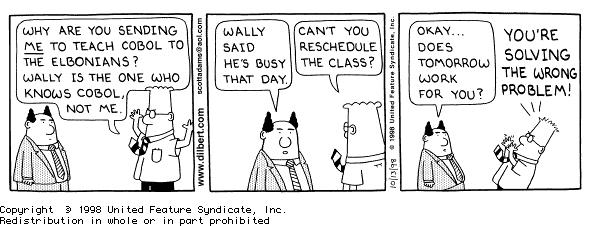
    It made me wonder if this is related to the enterprise not keeping pace with the evolution of the web and its tools? Assuming that a company monitors employee activities, does it then (in addition to/instead of) ‘deal’ with the employee or question why something was posted/shared, and address that? Does it again show the need for control, rather than understanding the need for a change in the way business is done? A short term view instead of real strategic vision? I’m not saying that the immediate ‘fire’ does not need to be handled, but is a thought being spared for what lies ahead? Maybe, if the enterprise had a thriving communication and sharing network, and an efficient response mechanism, the need for ‘policing’ would be drastically reduced? As one of my favourite Dilbert strips says,

    wrong-problem

    (meanwhile, down with the syndicate!!)

    Perhaps, the brands who are just listening on the tools like Twitter, and using the information to change the fundamentals of how they do business are the ones who stand to gain more in the long term. As part of this, they could also be creating a culture, where each person is aligned to the organisation’s goals, rather than only the narrow focus of the department he works in. We really need more like Zappos, and more ‘culture creators‘.

    until next time, enterprise..start the trek 🙂


  • Brands – Maturity, Transparency, Objectivity

    On the day that gay sex was made legal in India, I had wondered aloud on Twitter, whether condom brands like KS, Moods or even a deo brand like Axe – whose communication is all about attracting people (the female gender so far, since its a deo for men) – would use the occasion to provide a bit of a twist in their standard advertisements. As expected, none of them did. Which led me to wonder on the maturity of audiences and those of brands. (‘maturity’ for the lack of a better word, a more elaborate description follows)

    From an experience in an earlier place of work, when we had played on the visuals of Sai Baba and Jimi Hendrix and talked about music and religion, I have seen the fear that marketers have about how the consumer will react to a communication that could be taken as offbeat. In the case above, one could argue about hurting sentiments of followers (Sai Baba’s, according to the client, Hendrix’, worried the copywriter 😀 ), but there really wasn’t anything derogatory. Now that may be a subjective reaction, so let’s go back to the initial example. I’m reasonably sure that even if KS/Moods/Axe had thought of this, they might have decided not to pursue it.

    Is that because of a simple positioning mismatch that they perceive, or is it a fear to push the boundaries, of what they perceive as acceptable to their audience? Something that goes against the image they have created. But, as we keep discussing here, consumers are moving on. They talk to each other, and share their experiences about the brand, which may or may not work in advantage of the brand.

    Meanwhile, I recently read an article in the New York magazine, which got me thinking quite a bit on this subject. The article was titled ‘Say Everything‘, and talked about what the author perceived to be the largest generation gap since the hippie generation. While the extreme scenarios outlined in the article- of the kind of photos and complete transparency, of thinking of themselves as having an audience, of archiving their adolescence, of having a thicker skin than earlier generations- may not be what the average youth indulges in in his community, it does point to a generation which is growing increasingly uninhibited with sharing more and more of themselves with others on the net. The author points out that with surveillance cameras, transaction tracking etc becoming the norm, this complete transparency approach might be a saner route.

    In fact aren’t FB/Twitter status updates, and even online journals that many in my generation indulge in, also cases of living for an audience? The details of what they share might vary when compared to a younger user set, but this seems to be a trend that may not be scaled back, and in all possibilities, would increase. With the social tools that keep improving the ways to communicate, and share, can brands afford to cling to the kind of communication that they are used to delivering to the audience?

    In another article I read, YouTube blogger Kristina Horner, who was criticised for working with Ford Fiesta, makes a wonderfully simple, yet passionate argument that for “both bloggers and brands to be successful they need to accept that traditional advertising is not-effective (and even rejected) and that publishers like Kristina can find a win-win situation where a brand supports their work without compromise.”

    Would being completely transparent (yes, that is a bit of a redundancy, i guess) ensure that brands get a fair deal from the people they communicate to? Like I read in another context, would transparency fulfill the function that objectivity is supposed to?  But as always, transparency is not something that can operate only in communication, it moves to product, and many other functions within the organisation. So, as more and more consumers realise what Kristina has articulated so well, shouldn’t brands also take some initiative in changing themselves, and collaborating with their consumers?  That would take some maturity, i guess. 🙂

    until next time, audible audiences

    PS. For those missing the Tool Aid that is the blog’s staple diet, here are a few interesting reads

    The Sysomos in depth Twitter study that places India in the top 10 countries in which Twitter has been growing.

    The Razorfish Social Influence Marketing report.

    The Wetpaint/ Altimeter list of the world’s most engaging brands, and how there might be a link between engagement and financial performance