
Category: Work & Org Culture

  • Agility and Scale

    One of the things I'm trying to understand is how a rapidly growing organisation achieves scale and retains (or develops) agility simultaneously. When there's not much money in the bank/ revenue being generated, the organisation is forced to focus, and even if it does scale, it would do so in a particular domain in a given time frame, before moving on to another.

    But what happens when there's no dearth of financial resources and/or the organisation is in a business environment that demands scale for survival? One way I've seen organisations do it is to go on a hiring spree and get as many people on the floor as possible. But I've also seen it being counter productive, as either people lose clarity (of their role) in the medium term and quit or they get frustrated with organisational will getting in the way.

    To elaborate, in the first case, the organisation is not able to define roles, let alone c

    areer paths beyond basics, because the business domain/environment is still nascent. The employee may not be able to cope with it after a while. Also, rampant hiring many a time leads to massive role overlapping. In the second case, the number of decision makers and dependency across the system increases so much with scale that things do not move as fast as the employee would desire.

    To me, a good senior management team that is able to articulate the changing dynamics, lay out rules on what decisions should involve whom,  and align middle management and further so everyone pulls with the same end goal (need not be in the same direction, but that's a different debate 🙂 ) in mind is probably what can help help achieve/retain agility with scale. In all of this, communication is key, but that's easier said than done.

    Anything you'd like to share from your experiences?

    until next time, weighing scales
    zp8497586rq
  • Purposeful

    Last week, my co-conspirator on the ‘culture’ discussions on twitter- Harish – shared a Forbes article on why top talent leave organisations. This was a distilled version of another article that had 10 reasons! So, “Top talent leave an organization when they’re badly managed and the organization is confusing and uninspiring.” As the author notes, the 10 reasons in the earlier article could be roughly divided into managerial and systemic reasons. My 2 cents is that bad managers exist because the system allows them, and sometimes even rewards them. When good professionals see ‘wrong’ behaviour rewarded, they realise it’s time to leave.

    The second of two pieces of advice that the author gives firms involves purpose and culture. Though it would seem that the former drives the latter, culture is capable of working towards or subverting an organisation’s purpose.

    As is becoming a regular occurrence, I had an article waiting for me on Reader – Umair Haque’s “Overthrow Yourself“, in which he draws out the fine nuances between an organisation’s vision and its ambition. The former is an egoistical version towards which resources toil, and the latter is a portrait of the human consequences that your enterprise (not just your “company”, but your ideas, effort, time, ingenuity) creates. Semantics, you might say, but I think ambition also acknowledges the sense of purpose of the individuals involved.

    To add to last week’s post, good professionals love to be empowered, and when they are, they love to be held accountable for the decisions they make, decisions that drive them towards achieving a purpose they can identify with. Probably every startup begins that way, but sometimes the vision takes over, just as in the case of social platforms.

    until next time, purpose.ly

  • Empowerment

    In ‘Is Kindness a Strategy?’, Jeffrey F. Rayport shares the story of an American Airlines employee who ingeniously helped a passenger catch a flight though he was late, by using the express lane for ‘invalid’ guests. He mentions that many colleagues of the employee might not be happy with her way of dealing with the passenger. He also writes about Ritz-Carlton’s use of “service recovery” – a company’s ability to respond quickly, decisively, and effectively to a service problem of its own making — is a powerful way to increase loyalty among existing customers. He rightly draws the distinction between the two approaches – they vary on who’s at fault, the customer or the company, and asks what any business might stand to gain if it oriented its associates to look out aggressively for opportunities to perform true acts of kindness for their customers.

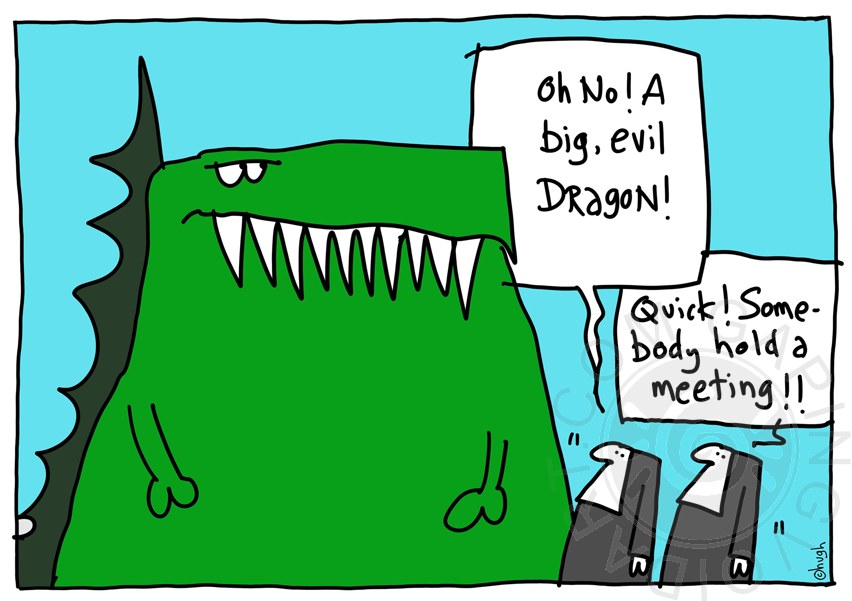
    In my mailbox, a few minutes earlier, I had seen this, in which Hugh MacLeod takes a (what I considered a) legit shot at meetings. As always, the toon says it all. When confronted with a business problem, (generally) the organisation’s first impulse is to meet, discuss, analyse and arrive at a consensus… probably 24 hours later. Yes, even when it involves a real-time platform.

    As I was writing last week’s post on culture, I was asking myself on the ingredients that make up a great organisational culture. Based on the above, I’d say Empowerment. When you have hired a professional to do a job that he has skills in, he/she should be empowered to apply his judgment to situations and not have to go through red tape or meetings involving people with minimal perspective on the matter. The first tenet of Zappos’ famous core values is “Deliver WOW through service”. In the same breath, Tony Hsieh also talks about “investing in a corporate culture that allows employees freedom and space” and follows it up with “If you get the culture right, then most of the other stuff, like great customer service or building a brand will just happen naturally.” On a related note, their unique hiring policy ensures that their sales staff don’t need scripts, they are trusted enough. It also ensures that an excellent culture is built by finding a fit between what makes the individual and the organisation tick. Empowering the employee so that he grows and so does the organisation.

    until next time, power trips

  • Culture.org

    For quite a while, I have believed that culture is the most underestimated and underutilised tool among the organisation’s means of gaining strategic advantage. A few like the much venerated Zappos have used this lapse to maximum effect and by assembling a group of passionate and aligned individuals generated profits and publicity, all while retaining a culture that continues to thrive. Remember “Anyone can do what we do, but nobody can be who we are.”?

    Last week, Maneesh wrote an excellent post titled ‘The Importance of Culture‘ that started off a discussion on twitter involving him, Harish and me. Having experienced a few instances when the influx of money into an organisation (not necessarily a startup) changed the internal landscape completely, I wondered whether scale (that many a time follows money) and culture are usually mutually exclusive. It’s not always so, but it takes not just a very skilled management team, but also an empowered employee bunch down the line to make it happen. It takes communication, rewarding the right behaviour and a lot of clarity to ensure that the culture is not lost. To quote from the post, “Culture is attitude, it is not behaviour. Everyone knows this, but we all get it messed up.

    When he linked professionalism and culture, I smiled because I remembered an incident from a couple of years back. That (very interesting) discussion, which prompted this post, was on whether passion or professionalism could better help the organisation scale. For various reasons, at that time, the two were mutually exclusive in the organisation. I argued for professionalism, because to me, it represented consistency and reliability. We both refused to accept the easy compromise of ‘both are necessary’. Towards the end, the management guru equated a professional to a mercenary. To me, the difference, was in alignment. In that sense, I agree with Maneesh that professionalism is practically non-negotiable. To quote from the post again, “You become a professional when you care. Your culture defines what you care about.

    A couple of days after this discussion, this tweet appeared on my TL

    Posts across years, across industries, across lines of work, but if you read them, you’ll sense the similarity.

    To me, culture is not a fancy set of perks and trappings that money can buy. It’s a sense of belonging, a feeling of being connected to a set of objectives and activities that give the individual a sense of purpose. A sense of enjoying the ride even when it’s a tough one, because you know there are many who will be your parachute in case you fall off a cliff that you didn’t anticipate. When that feeling is lost, the light in the cubicle is switched off. More often than not, permanently.

    until next time, culture counter

  • Monkeys, Rules and Insurgents

    There was this forward that did the rounds about 8 years back, about how businesses are run. It involved 8 monkeys, bananas and a ladder. I’m going to repeat it here for the benefit of those not familiar with it. Those who know it already, skip and read the rest please.

    Put eight monkeys in a room. In the middle of the room is a ladder, leading to a bunch of bananas hanging from a hook on the ceiling. Each time a monkey tries to climb the ladder, all the monkeys are sprayed with ice water, which makes them miserable. Sooner enough, whenever a monkey attempts to climb the ladder, all of the other monkeys, not wanting to be sprayed, set upon him and beat him up. Soon, none of the eight monkeys ever attempts to climb the ladder.

    One of the original monkeys is then removed, and a new monkey is put in the room. Seeing the bananas and the ladder, he wonders why none of the other monkeys are doing the obvious, but, undaunted, he immediately begins to climb the ladder. All the other monkeys fall upon him and beat him silly. He has no idea why. However, he no longer attempts to climb the ladder.

    A second original monkey is removed and replaced. The newcomer again attempts to climb the ladder, but all the other monkeys hammer the crap out of him. This includes the previous new monkey, who, grateful that he’s not on the receiving end this time, participates in the beating because all the other monkeys are doing it. However, he has no idea why he’s attacking the new monkey.

    One by one, all the original monkeys are replaced. Eight new monkeys are now in the room. None of them have ever been sprayed by ice water. None of them attempt to climb the ladder. All of them will enthusiastically beat up any new monkey who tries, without having any idea why. And that’s how any company’s policies get established.

    What reminded me of this? Tom Fishburne’s recent post on ‘low interest’ categories, in which he talks about how “marketers often limit ourselves by the conventional rules of a particular category”. The induction and experiences thereafter changes us from, to use Seth Godin’s words, insurgents to incumbents.

    In these times of “hit the ground running”, is it too much to ask of companies to allow new hires to just give their perspectives on the brand and organisational processes in the first month? I too believe that for the brand team, these perspectives are a great representation of the end consumer. With all the money spent on data mining and consumer research, this ‘free’ sample is given a pass, perhaps because, just like the industries itself, even businesses internally fear disruption.

    Over a period of time, the brand’s custodians tend to lose their objectivity and processes unfortunately have a way of becoming the ends rather than the means. And that’s where ‘culture’ can make a difference. Know any companies who foster this?

    until next time, this is the way things are undone 🙂