Category: Work & Org Culture

  • Agile @ Scale

    Prelude

    I think I used ‘dis-aggregated social network‘ on this blog for the first time in 2009, referring to Google’s basket of services that were connected relatively flimsily then. IMO, Google has always been that way, even including Google+. (read) I remembered it when I tweeted this about Facebook – around the time news of their Fan Audience Network started trickling in.

    It got me thinking (again) on ‘scale’, a recurring theme here. In a less complicated world, where the trends in the business landscape were significantly more linear, (growth, competition, consumption, economy) scale was a powerful weapon to wield. But it’s a different world now. Artificial Intelligence, 3D Printing, Internet of Things, Wearables  and a hundred other things might completely disrupt the status quo and the need an incumbent brand satisfies. These are the known ones, and then there are the conceptually invisible (at this point) ones. Surviving (let alone thriving) in this shifting scenario requires agility, and it is difficult (though not impossible) to see scale and agility together. I looked to Google and Facebook for an approach towards this because not only are they surviving, they seem to be thriving. Yes, we’ll get to Amazon in a while.

    What does it take to be agile at scale? I can think of four ingredients, the last three repurposed from the title of this post by JP Rangaswami.

    Purpose

    I remember talking about re-defining of scale at the Dachis Social Business Summit. The thrust of the presentation was that brands could engage consumers at scale only if they use currencies that create value for the user in the context of a shared purpose. I have elaborated it in this post at Medianama. Recently, I saw that Hugh MacLeod has brought it out beautifully here. Simply put
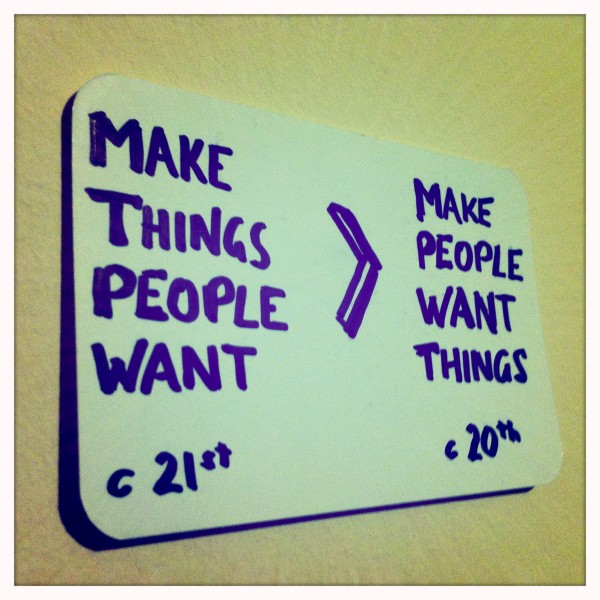
    Make-Things-People-Want-600x600

    (via)

    Possibilities

    The purpose need not have one constant rendition. As the landscape changes, a business will need to adapt it to suit changing circumstances. For that, a business needs to understand the possibilities. I saw a very good line in this post about being a maker – the more you work in the future, the less competition you will have. How much into the future a business needs to be working is subjective and depends on its dynamics, but if it doesn’t disrupt itself, someone else will gladly do it for them. (“The Jeff Bezos School of Long-Term Thinking” is a good read in this context)

    Platforms

    While purpose and possibilities are all good at high altitudes, a business also needs strong operational  platforms to back it up. As organisations scale, I have seen two things that affect agility. One, the processes that are introduced to create efficiency @ scale more often than not, become the goal instead of a means, slowing things down and taking away from actual goals. Two, as processes and manpower increase, silos are created. The good news is that it is easy to see technology platforms bringing more efficiency into processes as well as an iterative way of thinking in the near future. It is already happening in marketing. This, and many other factors are also dictating a consumer experience driven approach and are forcing organisations to break silos. As the entire brand/organisation becomes a platform (read) that regularly revisits its context and purpose in the life of a consumer, ‘everything becomes a node on the network

    People

    HuffPo had a post sometime back, citing Zappos, calling 2014 the year of workplace reinvention. It is interesting to note that parent company Amazon has apparently aped Zappos’ ‘pay to quit’ policy, even as more and more stories about working there being a ‘soul crushing experience‘ are coming out. Meanwhile, the two points it mentioned for this to happen are purpose and trust. These I’d say are the bedrock of culture. It’s intuitive that a workforce mindful of the organisation’s purpose and their role in it would keep an eye out for the business’ possibilities, be ready to work beyond silos towards a great consumer experience, and bring in others who would help the business scale. This, along with purpose, has to be the glue that holds it all together, enabling the organisation to move fast without cracking.

    While different sectors are at disparate distances from a radical shift necessitated by technological developments, it is, I think, inevitable. In this fantastic post titled ‘Knowledge is faster than mortar‘, which looks at scale through a different lens, the author makes the point that ‘the old mechanisms don’t fit the new social structure.Old mechanisms were built to scale stability, new ones will have to be built to scale despite instability. Anti-fragile, so to speak. Indeed, we will see many manifestations as existing structures try to adapt – internal mechanisms like Amazon’s 2 pizza rule, consumer facing disaggregation like Facebook that have a corresponding internal wiring, or brands tweaking their 4Ps even further for different contexts. But whatever paths businesses choose, this will hold true
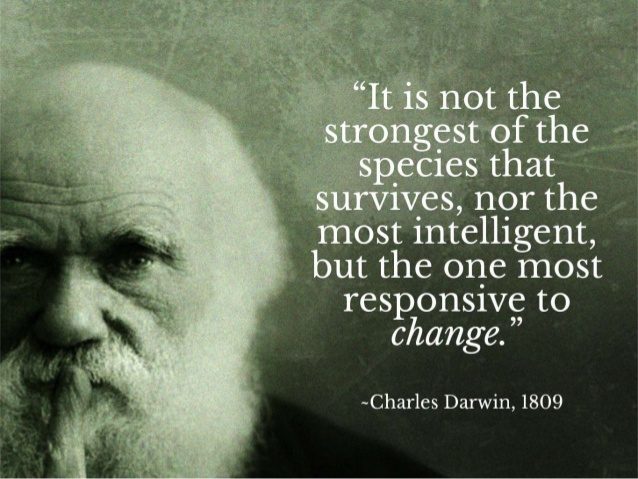
    responsive-to-change

    until next time, the fast and the curious
  • Social’s second chance

    For context, I believe the first chance was brand/marketing. That potential has pretty much been converted into a banal, mostly campaign oriented, traditional media (with better targeting thanks to various contexts) approach, though thankfully, we have do some rebel strongholds. I can clearly see this within the Big Shift construct – the third wave is about how organisations/institutions respond to knowledge and the flow of information, and what I see now is the typical marketing organisation conveniently converting social into a media framework that it seemingly understands and has worked with for a long while. The big boys – Facebook, Twitter, YouTube – have all created advertising products that cater to this thinking. Viva la broadcast!

    But I’d like to think that all is not lost. Social changed to social media when it approached brand in the same way its media predecessors did. I see this as a phase which will last until social media saturates itself and becomes just another standard media platform. That leads me to think – if each domain (HR, Product) treats social in the same piecemeal way, it is bound to fail across them all.  When this does happen, at least some organisations will realise that a larger structural change is afoot and the institutional response needs to be more strategic. “The Next Social Imperative” made me realise that social has been attempting to work on top of business processes, but it needs to work the other way to even begin this journey. (also, strongly reminded of Tac Anderson’s post in this context back in 2010!) The driver will be market dynamics but the good news for organisations is that many in the existing workforce have the potential to become navigators of this change.

    How does the workforce systemically play a part? Stowe Boyd’s insightful “The Future of Work : 4 trends for 2014” has at least two trends (consumerisation of work and me-isation of productivity and performance) that clearly point to this shift and its harbingers. Consumer technologies (and more so, the philosophy behind them) and a different kind of workflow can actually make an organisation more consumer centric than the silo approach currently followed. Steven Sinofsky’s long but superb post on the theory and manifestation of this paradigm shift is a must read on this subject. A very interesting manifestation of this shift I saw recently is Zappos’ move towards holacracy – a comprehensive ‘operating system’ for organisational governance that focuses on purpose and accountability without a top-down, hierarchical management structure.

    This could be the first step towards ‘social business’, and I’m thinking of social business as a platform. (a fantastic read on platforms) The organisation and its purpose would actually work as a platform to channelise and augment the connection between employees and consumers. This purpose would also convert a job into work than an employee is connected to, and on the other side, it would help the consumer get closer to a brand he believes in. This is also when epics happen. Social (and other) technologies would play enablers for a more fundamental change in the structure and nature of work, and allow organisations to harness data, connections and transactions towards a shared purpose. More a transition than a disruption. Different organisations, I think, would evolve differently – some would not evolve at all. This is more hope than anything else, but I do believe that social technology has it in itself to be transformational, and not just transactional.

    until next time, back to a socialist, communist workforce 😉

    quote-Peter-Drucker-so-much-of-what-we-call-management-108215

  • The evolution of work and the workplace

    I spent Rajinikanth’s birthday  at Jaipur, all thanks to one of my favourite bloggers – Kavi, who, in his official avatar, invited me to his organisation’s annual HR conference. The theme of the conference was Evolve Connect Enhance, and I can honestly say that many of my perspectives were enhanced during discussions about the real  implications and challenges for organisations, brought about by radical changes in the business environment.

    For now, I’ll let the talk do the talking!  (transcript below the ppt) Do comment with your thoughts!


    Final Talk Points by manuscrypts


    until next time, work it out

  • The utility of a brand

    After the ‘social product‘ post, the brand guy in me wanted to reconcile this evolution of the product with the brand story. After all, ‘network effects’, ‘purpose’, ‘community’ etc are essential parts of the brand story as well. But I thought of stepping back a bit before moving forward.

    The ‘tyranny of the big idea‘ is oft discussed here and the more I see platforms evolve, the more I feel the need (for brands) for nuanced strategy and propositions that are relevant in various contexts and take into account the radical change that is two-way communication. (as opposed to broadcast) I think this is an inevitability of consumption fragmentation as well as changes in attitudes/behaviour/expectations, and sustained nuanced propositions is one of the key ways to create ‘network effects’ across platforms.

    In this context, I thought the ‘Moving Forward’ section in this insightful post titled “Killing Big Strategy” captured it perfectly. Also, through it, I came across something that helped link the product-brand stories – “Finding the right job for your product“, a fantastic alternate perspective on traditional market segmentation, and some excellent lessons in defining competition and positioning. Not to forget this gem from Drucker “The customer rarely buys what the company thinks it is selling him.”

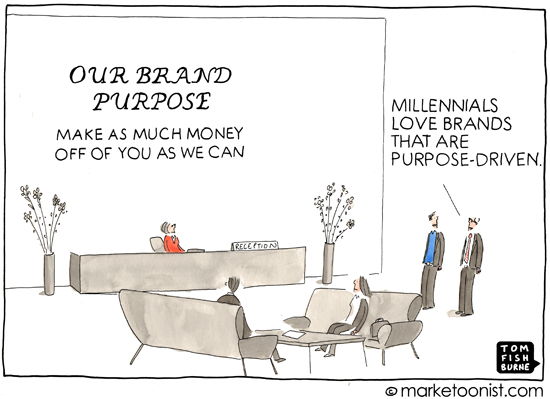
    So where does this all begin? Though ‘purpose’ is increasingly being used as a buzzword  and also espousing a corporate-centric view (unfortunately) I still get to see a lot of relevant literature that does more than lip service. At a broad level, this little framework of Purpose – Delivery – Resonance, for instance, is a good start. There are many needs that brands fulfill and many reasons why they are loved, and these could start as pointers for a brand to figure out its purpose. John Hagel’s “The Untapped Potential of Corporate Narratives” offers some excellent perspective on how user-centric narratives gets several ‘pull’ factors to work in tandem and offer numerous sustainable advantages. The examples include my usual favourite – Nike, and this is a subject I have touched upon earlier as well, (1,2) though not as eloquently. 🙂 If you think about it, this is also another way of ‘finding the right job for your product’.

    brandpurpose

    (via)

    On delivery. Russell Davies’ “Activities not audiences” draws the distinction between users and user needs and calls for focusing on the latter. Again, another rendition of a product doing its ‘job’. This post, titled “Brands: One System Of Touch“, explores the misalignment of brands which view customer experiences in isolation, by channel, whereas customers of course view and grade their experiences cumulatively. This is a good starting point to think about what needs to be changed internally to deliver a cohesive, relevant and useful experience to the consumer.

    In the meanwhile, I came across quite a few examples of brands adopting the ‘product doing a job’ approach even though it might be an isolated exercise at this point –  Hermes’ silk knot app, Volkswagen’s and Audi’s Augmented Reality apps to repair/know the features of their cars. While they might seem too self serving to qualify for the concept under discussion, they’re definitely a step in the direction. Uber’s response to a bus driver strike with free rides might be a more evolved example. Another one might be Ford’s platform to ‘hack’ its car hardware and software. Many more examples of ‘branded utility’ can be seen here. I think that in the looming collaborative economy, platforms like Google Helpouts will help brands become a real time utility in their domains.  Interestingly there are also examples of brands (Citi, Kleenex) which are trying to create value beyond their core purpose/utility. Levi’s’ ‘School of Make our mark‘ is another example.

    The last bit in the framework (though the framework also mentions differentiation, I see it as something that needs to be built into purpose and delivery) I referred to earlier is resonance. I think these above experiments will not only help brands learn what it takes to build sustained resonance in various consumer contexts but also how to amplify this to potential consumers who might share similar needs. This will require learning and application beyond the conventional mass reach tactics employed currently. The corollary is that measurement paradigms would also need to change. I could see this being aligned to all the points mentioned in this superb post –  ‘The Future of Marketing‘ – messages to experiences, rational to passion, adaptive strategy, simulations, brands to platforms.

    To bring it all back to the link between the social product and the brand, I now (again) see technology (including social) as an enabler in the product and marketing road maps – working in tandem to deliver the brand’s purpose and help it augment resonance.

    until next time, utilising brands

  • A culture of innovation

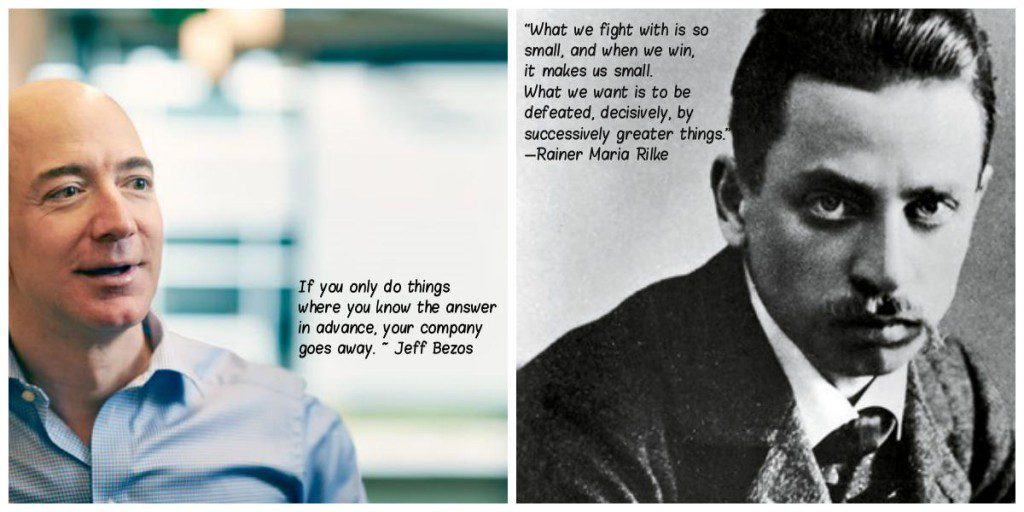
    More than four years ago, I’d written a post juxtaposing product and consumer life cycles wondering how products could evolve, yet be relevant to users at various stages of their usage maturity. Personalisation as a theme has advanced much since then, and web based services are definitely closer to cracking this. I also got a perspective from Jeff Bezos in this post All businesses need to be young forever. If your customer base ages with you, you’re Woolworth’s” though I’d take it with a pinch of context.

    But when disruption is the norm and technologies like 3D Printing and themes like the Collaborative Economy (and others) are poised to have an impact on an increasing number of business models, how does a brand pace its innovation? Branding Strategy Insider asked a relevant question on this premise – Can brands innovate too soon? The post quotes Michael Schrage in providing a good perspective “Your own rate of change is determined less by the quality or price/performance of your offerings than the measurable readiness of your customers and clients … Their inertia matters more than your momentum.

    This post I came across cites a research by Forrester which points out that most innovations remain incremental in impact, rather than being radical innovation..Companies often ‘innovate’ things customers don’t even want. The post suggests a simple cyclical framework of Learn (strategy) – Make (technology) – Test. (design) A more nuanced view (and framework) of innovation can be found at Digital Tonto. Bezos once again has a take on it “We innovate by starting with the customer and working backwards. That becomes the touchstone for how we invent.

    Social technologies provide multiple ways for an organisation to simulate scenarios and structure their innovation pathways in ways that will optimise customer benefits and business objectives. In fact, I believe that the responsive organisation (via) will soon become a strategic imperative. As quoted in that post “If the rate of change on the outside exceeds the rate of change on the inside, the end is near.” I also think that the biggest challenge in this entire movement is a mindset-culture lag. In a sense, all the so-termed disruptions happen because incumbents were not agile enough to adapt to a rapidly changing environment. There is some wonderful learning from the founder of Sonar in this post titled “Postmortem of a Venture-backed Startup” One of may favourites is “Think of culture as a cofounder that is present when you are not.” The thing is, it can work both ways! A cultural mindset to experiment, fail, pick yourself up and work harder, and win is probably what will define the winning institutions of the future.

    collage1

    until next time, “It is not the strongest of the species that survives, nor the most intelligent, but the one most responsive to change.” ~ Charles Darwin