
Category: Social Media

  • Social v2.0.1.3

    I really avoid writing “trends for 20xx”, but towards the end of last year, I jotted down a few things for an article. Same thoughts, but I expanded a bit.

    Barring a game changing phenomenon that further complicates the already shifting landscape, these are the 3 areas where I see the needle shifting more than others, in 2013.

    1. Content is (also) Advertising: Branded content will continue to rise as the worlds of publishing and commerce collide. Brands will invest (talent, money, time) more in content creation and curation. Also, paid media (traditional and social) will be used to promote owned media (blogs/twitter/FB page content etc) and we’ll continue to wonder how much was earned by publishers in supposedly earned media! By ‘advertising’, I don’t just mean the traditional marketing communication kind, but one that brings out more of the character of the brand/organisation itself. Hopefully this will be the first step towards a larger culture of authenticity, values, and transparency. Something like McDonald’s “Our food. Your questions” would fit the bill.

    2. Social Orientation: Social is media, social is CRM, social is enterprise collaboration, and many other things which we haven’t even begun to explore. Silo based approaches for social will evolve into socializing business strategy itself – a horizontal approach (and team) that looks at business objectives more clearly, and encompasses everything from CRM to ORM and beyond. These teams will also be equipped to handle everything from new social platforms to how social integrates/manifests on more advanced devices to technologies from AR to Big Data. Not all of this would happen in a jiffy, and there would be challenges aplenty – right from setting objectives to harnessing various skill sets to getting buy-ins from various verticals that social would interact with and affect. Social Business is most likely this year’s gamification in terms of buzz and random usage, but while that sorts itself, businesses would at least need to start seeing social as a strategy, one that can actually provide competitive advantage.

    3. Brand Voice: Speaking of competitive advantage, brands will figure out that they need to craft a voice and tonality that can resonate on social platforms as well. Many of the large brands we see now have grown up on media that never talked back, and hence adopt a  traditional media approach to communication on social as well – swinging between being apathetic and being servile. An identity and voice that can withstand the rigours of increasing conversations across platforms needs to start getting built. There might be multiple renditions of the voice as well – adapted to contexts, audiences, intent and so on, and brands will thus need to learn cohesion in narratives. A new approach to storytelling that spans media, understands popular culture and involves consumers better is the brand imperative.

    Update: Very heartening when people I respect – Dina, Gautam Ghosh, Prem think all of this makes sense! Mighty pleased and grinning away! 🙂

    until next time, #makeittrend 😉
  • Of trending on twitter and media fragmentation…

    A couple of weeks back, I’d written about the increasing broadcast tendencies on social platforms. Some events last week reminded me of something I’d tweeted a while back –

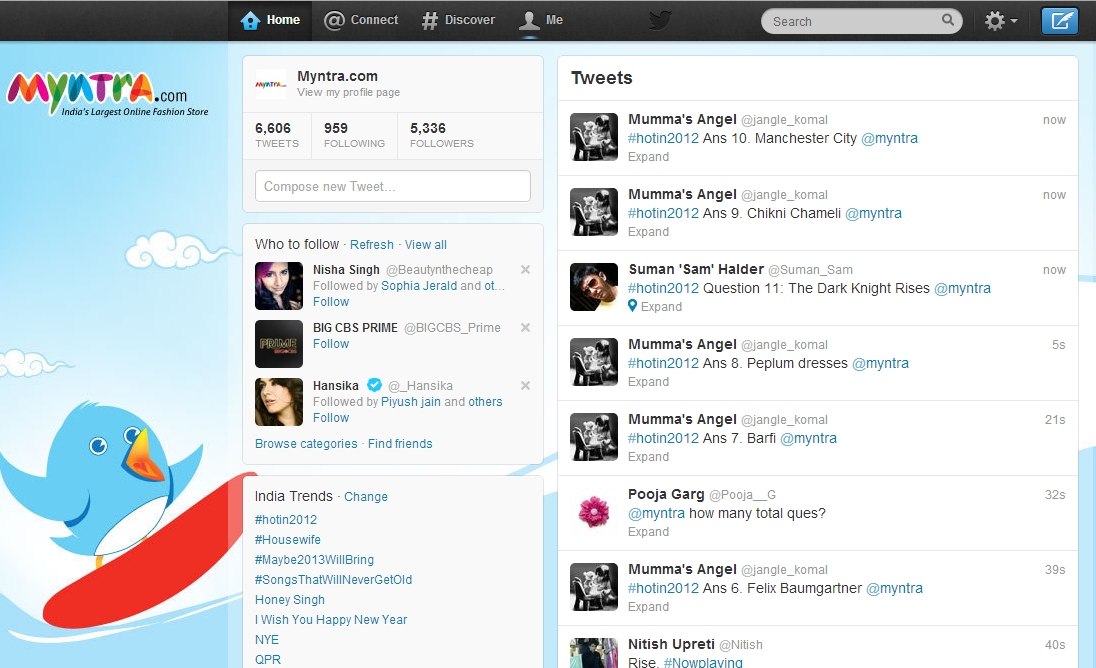
    It is, for better or worse, an item in the social marketer’s checklist. So unless it’s a day on which we’re outraging on multiple issues, you can easily see ‘branded’ trending topics. At Myntra.com, we’ve been playing with hashtags for quite a while now – #bachpanstyle was one such experiment. As we practiced more, the patterns started becoming more evident. Late last month, we started the #hotindecember hashtag in response to a business objective – creating more awareness about the similarly titled promotion at Myntra.com – and had constructed it around the promo TVC. It resulted in the hashtag trending on twitter. Just to check the lessons learned, we ran a #hotin2012 hashtag on 31st Dec, and ended the year as the #1 trending topic in India.

    Considering that there was a much more serious issue taking up everyone’s attention, this should be surprising, but it’s not, and that’s what we have learned of Twitter’s trending algorithm.

    That was about a brand using social as media. Like I mentioned earlier, the first hashtag was based on the TVC, something that had gotten us positive feedback on Twitter. After the Delhi incident however, the ad was considered by a few as ‘projecting women in poor light’. (worthwhile mentioning that Lisa Haydon, who starred in the TVC, had tweeted about the TVC being a lot of fun) Users, who also utilise social as media, are bound to have their opinions and will air them. The interesting part was that all this (hashtags and criticism) was happening in the same timeframe – 27-31st December.

    Why do I find it interesting? Let’s take a step back. It was only when TV stations started competing with the rabbit population that we started contemplating the fragmentation of media as we then knew it. Add to that the increasing web (+mobile) penetration and things became more complicated as time progressed. Brands (in general) still haven’t figured how to handle this, so fragmentation within a social media channel and its impact is small fry, except this is probably an indication of the future.

    This time, we chose not to react to the criticism – given the circumstances, it would have probably led to a nasty debate. Thankfully it died down. But what if a few twitter heavyweights had gotten into the act and made it trend for all the wrong reasons? We’d not have had the luxury. We’d have to refer to Crisis Management 101. In a worst-case scenario, we’d probably have to consider taking the TVC off air.

    In essence, when an interactive medium is added to the mix, fragmentation takes on a completely different meaning. It no longer means isolated compartments which don’t talk to each other, the events on one affect another. As a media buyer, a brand can choose not to be present on some media, but when a channel talks back, the brand’s choices suddenly dwindle. I think this will manifest itself much more in 2013, the learning curve is going to be very steep!

    until next time, user generated brand virals!

    Disclaimer: The perspectives above are personal, and does not reflect the thoughts or actions of the organisation mentioned. 

  • The year that will be…

    Crystal gazing began in right earnest in Dec 2012, and across the web, there were many top x predictions for 2013.

    Trendwatching made a list, and my favourites in it were #9 and #10 – “Full Frontal” and “Demanding Brands” respectively. The first was about brands moving further on the transparency curve and proactively showing they have nothing to hide as opposed to merely reacting. The second was about brands getting their consumers to contribute to their sustainability and socially-responsible endeavours.

    Branding Strategy Insider made 2 lists – Brand and Digital & Media. In the first, I found #5 – ‘The Known and the Branded’ – a very intriguing thought. Brands being thought of as category placeholders, stuff that doesn’t really stand for anything. Understandably, brands will find it harder to differentiate themselves. In the second list, again #5 – omni-channel marketing is something I have written about earlier while on the subject of cohesive experiences.

    JWT has their annual 10 trends list as well, and I thought #1 “Play as a competitive advantage” and #9 – “Going Private in Public” were particularly insightful. The reason I look forward to the JWT list is because while they deal with the immediate, they also come up with a couple of nuggets which are really far out. But the thing is, I can instinctively connect with them and am sure that even if not this year, these are inevitable somewhere down the line.

    This year, I also found Next Generation Media’s list quite interesting, especially because of their ‘implications for brands’ after each trend. My favourites in this list were #9 and #10 – “New Currencies” and “The WOW factor” respectively. I like the direction of the former, but would have liked it to be pushed further, but that’s mostly because of a more (personal) philosophical perspective on us having no alternatives to money as a currency. “The WOW factor” – related to ‘The Known and the Branded’ I mentioned earlier in the post, and the writing is pretty much on the wall for brands!

    Update: Came in late, but Simply Zesty’s list is a must-read as well!

    until next time, hope y’all have an awesome 2013. 🙂

  • Broadcast 2.0 then?

    Facebook is planning a new video-ad product that will offer video advertisers the chance to target video ads to large numbers of Facebook users in their news feeds across devices. It is also becoming more public about its Publishing Garage, that aims to put into place a set of measurements to demonstrate how well campaigns are working. Twitter has partnered with Nielsen for the the “Nielsen Twitter TV Rating” – an industry standard metric for measuring the conversation that TV shows spur on Twitter.

    The commonality I see is the shift from social to media, though to be fair, the Twitter-Nielsen partnership also talks of sentiment being measured in the future, in addition to tracking the volumes generated. I am using the term ‘social’ for two of the biggest platforms around now – FB and Twitter, but considering they have been the trendsetters, it is likely that the others will follow suit. Yes, there would be exceptions, I’m sure, but let me generalise a bit. While time will dictate whether this shift is smart or not, I’d think this shift is massively underplaying the true potential that social has thus displayed as a disruptive force. Social is now walking the measurement rules laid for a thoroughly different kind of media. (I liked this post at GigaOm because it throws light on, and questions why every social network is trying to turn into a broadcast platform) Doesn’t this put them on the same path of vulnerability that traditional media is facing now? Is this inevitable or is this sheer laziness and/or conforming? Also, from a user perspective, isn’t this a fundamentally different direction from the original premise/reason for existence of these platforms?

    Meanwhile, it is interesting to note that this is happening at the same time as users (increasingly) are treating social as broadcast – from the shoot-from-the-hip opinions on everything to the careful posturing. Not so suddenly, it’s more about numbers than actual conversations. Now what does that remind me of? 🙂 I don’t know how much of it is unconscious and how much of it is subtle nudging (read) by the networks and their features. But whatever the reasons, imagine a future where everyone behaves the way media behaves today – loud, pompous, full of themselves, ignorant to their own faults, violent towards any criticism, and generally abhorred. What happens then?

    So in the current direction I see the networks (and users) taking, the future media mashup will show more characteristics of traditional broadcast platforms than the social traits displayed by the social networks in the early days. My concern in such a scenario is because of what Godin has stated in another context – “Media doesn’t just change what we focus on, it changes the culture it is part of.” That’s when I wish social/we would be more ridiculous.

    until next time, growing pains

  • Interviewed on Lighthouse Insights

    It’s a bit scratchy, courtesy a really bad broadband connection, but poor Prasant has done the best with the material he had been given. 🙂 The chat was on Myntra’s social media strategy and how it manifests on various platforms. In addition to the more visible Facebook, and Twitter , it also covers our experiments on Pinterest, YouTube and even Foursquare. Most importantly, it covers one of the pillars of our social media strategy – customer care using Get Satisfaction. And finally, I gave a few thoughts on social commerce as well. Yes, I was asked for it. :p

    Read more at Lighthouse Insights.