Category: Social Media

  • The times, they gotta be changin…

    The last few days saw a frenzy of activity in the Indiatimes space. But before we go there, I read a few interesting things that I thought would make good starters. One site I chanced upon was Local Signal, which allows you to choose a city (its a limited list, for now) and once you have, gives you news, events, Q&A, and even blogs from that area. A pretty neat utility site, from what I saw. And now for some news. Hi5, which is really irritating me with invites from people I really haven’t even heard of, has gone mobile. And lastly, AlooTechie tells me that MIH (of the Ibibo ‘fame’) has invested in ‘Singapore-based BuzzCity, which owns a mobile social network myGamma that has more than six lakh members from India’.

    But the action has been happening very much at home!! Indiatimes has been rolling out services, like there’s no tomorrow. I first read about Indiatimes’ tie up with Onyomo, for a local search service. With Sulekha having announced some major plans just a few days back, this space has become very interesting indeed. Then it was the launch of AdRingles, an Ad Ringback Tone service (the link explains it well) and MocoLife, a group SMS service which also offers content on subscription. I remember reading that OnMobile, a VAS company had launched its ARBT a couple of months earlier. Since we are mentioning Indiatimes, I just read that they have also launched QnA.

    All this made me wonder (as I always do) on what exactly Indiatimes (both web and mobile) is upto. There’s clearly nothing profoundly innovative happening since all the services mentioned above are things that have been done by others, even Mocolife. Incidentally, Medianama has a good analysis of the last one.

    Now, I don’t see any decrease in the dominance of the Google, MSN, Yahoo, Rediff in the Indian webspace, unless Indiatimes manages to pull some rabbit out of their hat. With their track record, I wouldn’t bet on that. Which means, they would have to use the mobile platform to gain a foothold in the digital space. One way to do it is to launch cloned services and use their offline media might to build traction. But that wouldn’t be a great strategy since users would slowly shift to better services, once they get comfortable with the medium. I’d still say that the best bet for them is to create synergy with offline products right from a product level (right now its just using them as a communication tool).

    For example, look at the multiple editions that TOI has. How difficult would it be to use the TOI backend to provide news/business/events and even the listings (local search) part (Times Classifieds would have tonnes of data), build in the newly launched Flubber, sorry QnA into it, and make city specific sites that would add on to Indiatimes. Now, how difficult would it be to experiment with the iTimes platform of theirs, which anyways is idle (i don’t have stats, but i don’t know anyone who uses it, maybe I’m just not social enough) to build communities around this structure, make a mobile version, and then top it up with services like MocoLife? Digital communities which have a one stop shop for all requirements in their cities – local search, QnA, events……  and even have a group sms service to communicate all this!! Maybe its worth an effort..

    Indiatimes better move fast, since Big Adda is pushing the mobile version very hard, judging by the TVCs, and knowing Reliance, they won’t be satisfied by anything less than the premium position in any vertical they operate in. It perhaps is a calculated strategy from them, after seeing the dizzying pace of mobile growth in India. After all, even the great Google sometimes chases mobile more than they do the internet.

    until next time, the changing times
  • Communities and Brandstreams

    Last week, I’d written about transparency in organisations, and touched upon something that’d force transparency on them – conversations about them. While conversations can happen on the organisation itself, I believe the brand will also act as a starting point in many conversations. A transparent organisation will transfer some positive equity to the brand and vice versa. What comes first is a good chicken-and-egg question. Whether they can exist independent of each other is also a good thought.

    Since I have written on organisations, I’ll veer towards the brand this time. There is a good article here on what brands should consider before jumping into the ‘create communities’ game. But then, brand associations should never be restricted to communities, it can be as basic as listening in on conversations that happen not just on the brand itself, but the specific and generic categories it belongs to.  Moreover, communities don’t need to be very rigid in the way they operate. Check out Dell’s efforts here. The second half of this article also succeeds in conveying this fabulously. In a convenience driven, information overloaded consumer’s mind, it is difficult for the ‘four times a year’, ‘when we feel we have to communicate something’ TVC-print-outdoor campaign that many brands follow, to find a place.

    So, what are brands doing? From small businesses that give ‘prewards‘, to FMCG giants that attempt buzz marketing, everything is being tried. Some succeed, and some are questioned. What the last link, Nike shows is that brands cannot escape now with lip service. They have to be true.

    Which brings me to possibilities. Quite sometime back, I’d read this post about user generated advertising and product wikis, a sort of the brand’s lifestream, if you will. I found it a very refreshing thought, even thought Heekya (via Mashable) might be a good tool to start the journey, and was happy to read a tangential post  here. Please note that, though the second article uses ‘brandstreaming’ it is more to do with engaging the community through social media. Its still interesting though.

    But the best read I saw on this subject would be this post by Chris Brogan. I think it offers a great way for brands to balance their ‘official’ presence online with all the user generated stuff that’s bound to exist. But I’d still say community building has to start at home, i.e. organisation.

    until next time, start your brandstream..

  • Face it

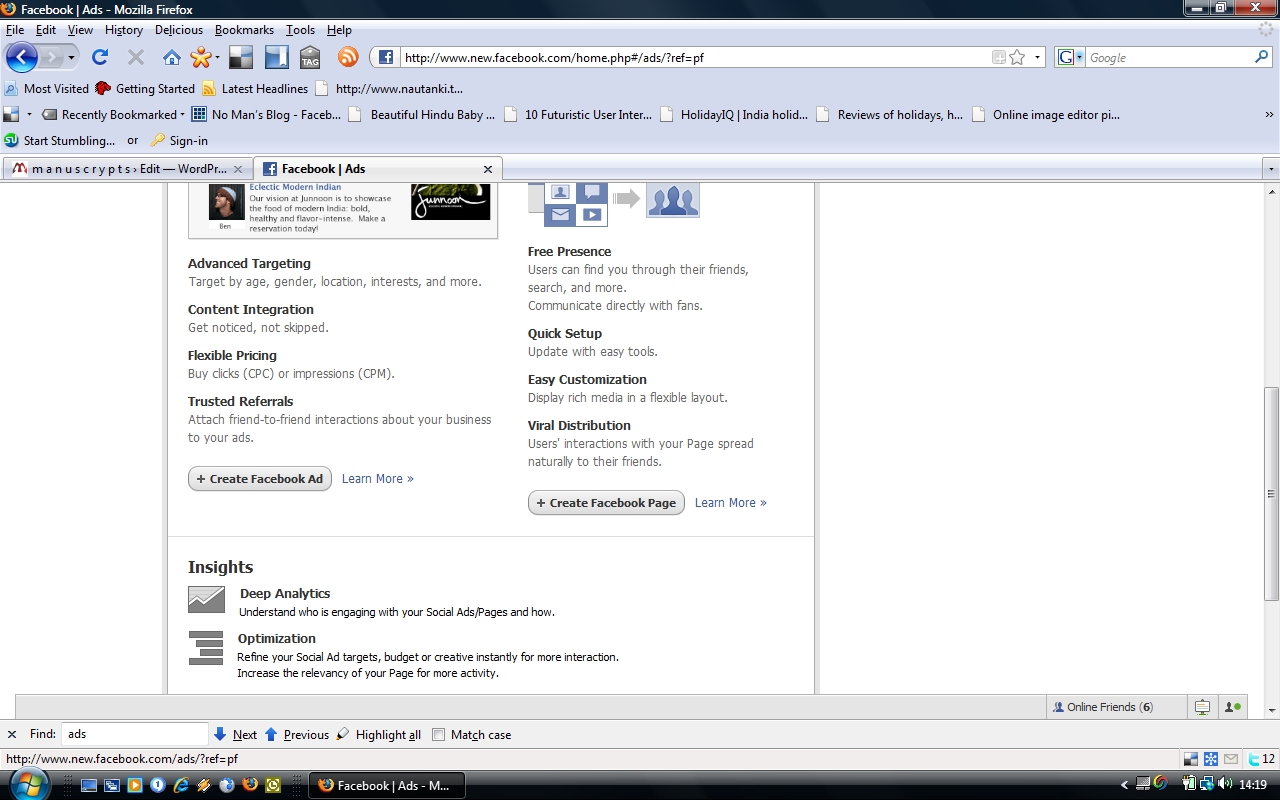
    After the not-so-great response to Facebook’s Beacon ads, it was interesting to watch how Facebook would deal with the advertising and the issue of privacy. In an Indian context, according to the latest Comscore figures, Facebook ranks sixth in terms of the online search market in India. So, in an increasingly contextual world, where there are also fears of user data misuse, advertising has to play a balancing act.

    I’ve come across quite a few attempts at this. To start with, as part of the new design, you might have noticed the thumbs up/down on many ads. On clicking it, it asks you to choose from options as to why you like/don’t like the ad. It gives Facebook some great data that would help it target its ads much better. It makes sense – if I like the ads that appear on the pages I visit, and find it interesting, there are better chances of me clicking on them. As a user, I’m happy to get information/offers that are of use to me. So, positive user experience with ads. Facebook’s advertising options seem to be working well for them, if we go by Mashable’s poll, done last month.

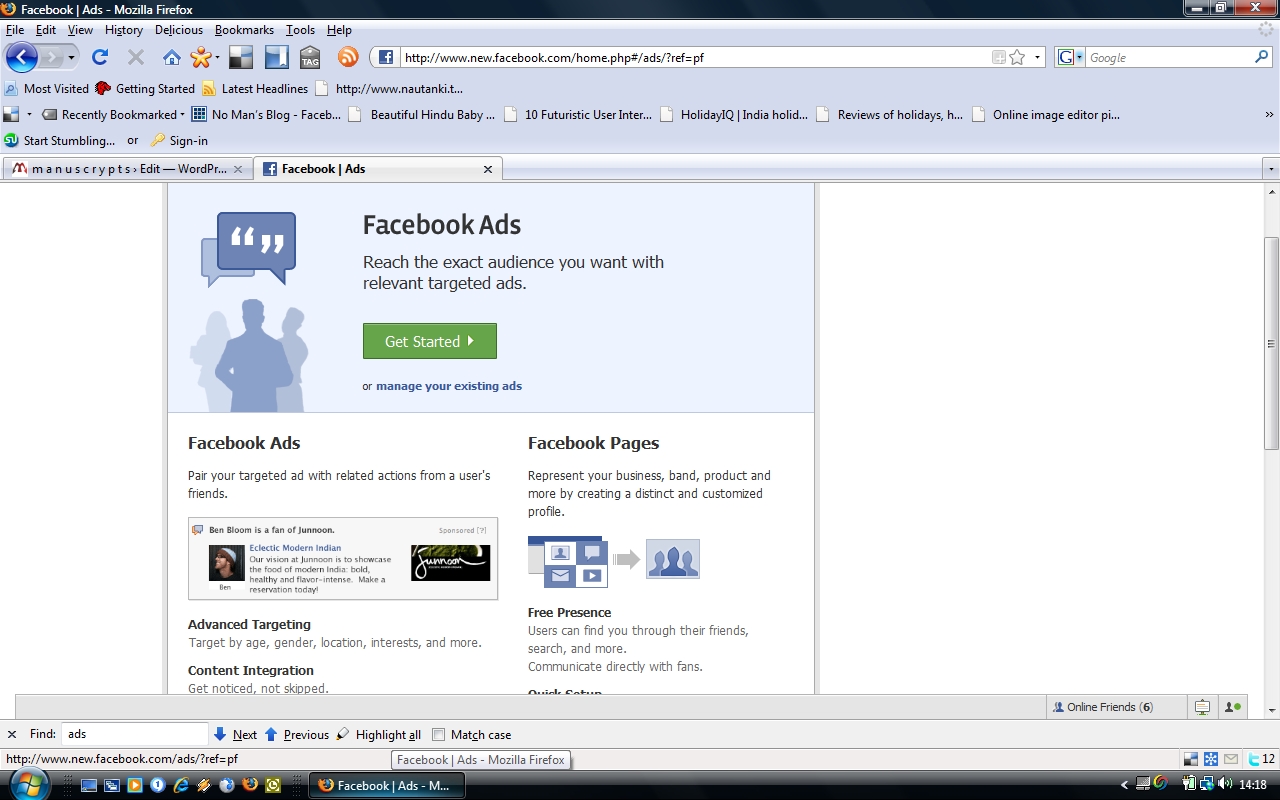
    You might have also noticed the welcome screen below, which help advertisers create ads on Facebook. (click to enlarge)

    Minekey uses the ‘targeted ad with related actions of a friend’ a lot. You might have seen the ‘XYZ has added the Minekey application’. But those won’t have the thumbs option. Also, check out some work done earlier by Career Builder. Its very interesting.

    Another communication I saw was the usage of a user’s action by brands to communicate their offering. So, (to use the example given in the article) if you see me saying ‘I loved The Dark Knight’, Warner Bros might have had a hand in it being shown to you. I hope brands will use this in moderation.

    But the really interesting piece of news I saw was Facebook’ way of social ads – Engagement Advertising. This allows users to leave comments on the ads they see. I wonder how brands will react to this, since it allows users to just diss their communication. It also forces brands to treat their message as secondary, relevance and fit to the community being the primary criterion. But its a great opportunity for brands to truly embrace transparency and a new way of communicating. More about it here.

    In essence, brands are getting newer ways to use social media, and even thread it with their offline activities. There’s more activity happening, check out the application that Microsoft has released on Facebook –Collabio. With users increasingly deciding what happens to brands in social media, it is imperative that brands understand how to present and represent themselves. Meanwhile, here’s some good data on fan trends in Facebook.

    until next time, add socialising to your ads

    PS. Am I the only guy feeling the eeriness of Obama Bi den… Osama Bin Laden ? 😉

  • e-Tales

    An India e-commerce study done late last year by IAMAI-IMRB pegged the industry to reach Rs.9210 crores by the end of 2007-08. In this, the etailing market is expected to have a share of Rs.1105 crores. The study also gives the things going for and against etailing. More recently, the JuxtConsult India Online report states that 80% of all regular online Indians ‘shop’ online  they either search or buy online, though I dare say that this would be driven a lot by online travel bookings than by etailing.

    So, perhaps, the timing could be just right for Storrz. I first came across the site when i read the coverage of Proto last month, and have been wanting to check it out ever since. But the immediate stimulus were recent articles in Headstart, and Mashable. I signed in, and was given an option to invite my friends too from the different email services, with a reward possibility too. A small query here, why not friends from my social profiles too, the reason being, my conversations there are so much more contextual. It would work great, for say the tees brands like Xtees, Youthcode, Nitrotribe etc. In general, aren’t those networks better places to find existing social crowds who can add quite some value to a social shopping network? (more…)

  • Tweetorial

    I’ve been seeing several sites recently trying to take the online offline – ActiveCiti, MeetUp, to a certain extent AroundMe, but I wonder if any of them would ever get the kind of enthusiasm that the recent tweet up in Mumbai received. That got me thinking of Twitter….again. Though I feel its a bit too late to answer the question “Par, Bhaiya, hum twitter kyun karte hain”, I’ve never actually dedicated an entire post to twitter, so here goes. (more…)