
Category: Social Media

  • More delicious stuff on the horizon?

    Social Median has been a pending site in my things-to-do list for such a long time that guilt no longer describes the feeling enough ๐Ÿ™

    I’ve liked the concept of the site a lot, and while I’ve been following developments there, and have added the bookmarklet to the browser, and though I’ve started several groups (example) I’ve just not managed to become a regular user. The SM bookmarklet has been idle. But more importantly, while the site sends me updates every single day, I rarely manage more than a cursory look at the shared items.

    Why am I so bothered about my non usage? To put it as simply as possibly – it brings together the link sharing capabilities of Delicious, the voting of Digg, topic based groups in which you can add sources and stories get pulled automatically, commenting on shared stories, ranking keywords and topics, and most importantly uses collaborative filtering through people with similar interests to serve you content you should read. A compelling proposition and I don’t have a logical explanation for my non usage.

    So, what’s the context? A few days back, I got a mail stating that Social Median has implemented Facebook Connect, and I feel that’s really big news. It essentially means that you can sign up for Social Median with your Facebook account and share the stuff with your Facebook contacts!! While I do admit that the newsfeed is a complete mess after the redesign, I’m also looking at the enormous data of user preferences that Facebook will now gain, and how Facebook can leverage itself as a news sharing source much more now. In future, this could reveal tons of data on news consumption patterns and interests. Facebook Connect’s importance is something I’ve been stressing on for quite sometime now, and this strengthens that thought. I wonder what this does to Digg’s Facebook Connect plans though.

    Another ‘link’ based service – Google Reader (okay, feed based), one which I use a lot,ย  has also done a small tweaking and added a commenting feature, though its utility The debate on that is still on. There is a feeling that it will become the place of conversation and take comments away from the source (blog/site). Also, as The Inquisitr mentions rightly, the implementation is quite clunky, and if a full feed is published it takes away most of the reasons for the reader to visit the site. I hope that at least a plugin similar to the Friendfeed one (where the conversation is synicated back to the original source) will be developed soon, but since there’s been no API release, they’d have to do it themselves. Doubtful.

    Friendfeed has been around for sometime now, and though its a perfect place to have threaded conversations based on links shared from practically anywhere on the social web, it is still deemed to be a geek service. I wonder if a tags feature to categorise all imported data makes sense. Speaking of Friendfeed, I also read about a new service launched recently called Streamy. According to TechCrunch, “Streamy is a personalized news service and social network that combines elements of Google Reader with FriendFeed.” Streamy does boast of an extremely good interface and suggests interesting stories to you, which you can then share with friends on supporting networks from Streamy itself. And its implementing Facebook Connect. So, a package with potential. (RWW has a comprehensive post on the service)

    Now the social bookmarking service I use regularly is Delicious, though its via the browser add on, and its been ages since I visited the site. But while they were one of the pioneers of social bookmarking, they really haven’t developed further. They could easily build conversations around the links shared by different people, make it easier to create communities around topics of interest – all the stuff that Social Median is doing, and definitely make it easier to share the links on say, Twitter – the reverse traffic of Twitticious, like what Krumlr is doing. I think enabling BOSS to pull stuff (history and top tags) from Delicious is a good step in the right direction. I have just started using a Firefox plugin called tweecious. What it does is go through your tweets, find those with links and post them to your delicious account. Pretty neat, though it would help if it gave me more control over what data needs to be transferred to delicious. (eg: I tweet a lot of posts from my blog,ย  and perhaps some topical news from news sites, I wouldn’t want that on delicious, so a feature to ignore links from a particular domain?)

    Reports indicate that Twine, another service which i have not used much, (despite L Bhat sending me an invite and taking pains to explain it ๐Ÿ™ ) could soon challenge Delicious, in terms of unique visitors, and with the kind of work it seems to be doing in the semantic web space, would easily become a more useful tool. I also got a mail a few days back announcing a Twine bookmarklet, with which you add content to Twine as well as tweet it to Twitter!!

    until next time, linking in

    PS. While on links, check out the following too

    BackTweets, a very useful resource to see who’s tweeted links to a site

    OneRiot, a new Twitter search engine which shows the links shared on a particular keyword (instead of tweets)

    Twazzup – another Twitter search engine which shows the regular search results as well as trends , popular tweets and links, with more visual appeal

    Fleck, a social bookmarking service, which has a bookmarklet for FF and IE, it also allows you to import bookmarks from browsers and delicious, and gives you the option to share links on twitter

    ambiently, which calls itself the web’s first discovery engine.ย  – it’s a search mechanism with a bookmarklet, which you can add to your browser. Now, when you’re on a particular page, and you click the bookmarklet, it opens up an ambient page that lists web links related to the page you’re currently in.

    PPS. The post feels a bit incomplete without Digg. Since I’m not a regular user of the service, I have not attempted to draw comparisons. However I do know that the latest on that front is the Diggbar. You can catch the action here.
  • The Facebook age

    Facebook’s redesign continues to make news on a regular basis. With a whole lot of vociferous users making the 237 Ways To Get Free Publicity ir dislike quite clear, with the help of a layout poll, it was interesting to see that a lot of advice was given to Facebook to not just blindly give in to the crowd –Rex Hammock, Michael Arrington, to name a few. While I’m still not a fan of the new design, I agree with that advice, in fact this is exactly what I’d thought brands in social media should do, so no reason why Facebook shouldn’t apply the logic to itself.

    But Facebook did address the concerns of the users, and made modifications without changing the core thoughts of the new design. Meanwhile it was interesting to note that a fair amount of users found their own Greasemonkey way of getting rid of those annoying quizzes. ๐Ÿ™‚ (Check this out for more interesting scripts)

    In spite of this excellent thought provoking post on Facebook’sย  strategy and execution, and not discounting Twitter-envy, I reckon that Facebook sees at least a few elements of the new design as the fundamental way forward, the one that can contribute to revenue. Real time features, fan pages redesign all seem to be steps towards dollars. This is perhaps why Facebook has played a balancing act and ‘conceded a battle’, since it wants to pacify users as well as be on track for monetisation. (Facebook is also working on a virtual currency system) I actually wonder if this was just a testing of waters before they attempt some massive changes.

    When I’d written about the Facebook redesign earlier, I’d mentioned that the ‘always on’ usage of Twitter was helped by the horde of applications that can be used from the desktop/browser to connect to Twitter. Well, there have been two developments. Seesmic released a dedicated Facebook application a few weeks back, and Tweetdeck, a popular Twitter app, released a new beta version which also integrates Facebook updates, and has already raised questions on the privacy of the Facebook network. You can check out a few more apps here.

    Another interesting thing to note is Facebook pushing private groups for families. You can share things without it going to your public stream (except Events). This is bound to increase the base – a teen audience as well as the over 50 audience. While Facebook’s largest set of users is in the 18-25 age bracket, the maximum growth these days is coming from the >35 crowd. This age skew would have quite some influence in all the changes that Facebook plans to bring about in the future, and it makes me wonder whether there’ll be a much larger balancing act required between the largest segment of the user base and the monetisable user base. Will they be the same? Will the usage patterns on Facebook change a lot because of the influx of a different audience segment? How will that affect monetisation? What would be the levels of accuracy that advertisers would be able to get in such a diverse system? Will changes in design polarise the users? Will this then result in the rise of new networks? What do you think? Maybe the Masters in Social Media can answer that in some time. ๐Ÿ˜€

    Meanwhile, with shrinking ad revenues and huge growth adding to costs, Facebook is attempting to raise capital this year. Going by this, Google should be interested. Interestingly Google values FB at $2 billion, and thats a far cry from its self worth of $15 billion.ย  ๐Ÿ™‚

    until next time, ‘Like’ ? ๐Ÿ˜‰

    237 Ways To Get Free Publicity

  • “Bridging the Social Media Divide”

    There’s this hashtag on Twitter – #bsmd, which stands for “Bridging the Social Media Divide”. The first meeting was hosted by Pinstorm, and discussed (according to the Pinstorm blog) “how marketers and social media enthusiasts can work together and forge ways of advertising via Social Media that are not intrusive while being RoI driven”. Again, quoting from the post

    While the social media enthusiasts believed that the medium required a change of mindset on the part of the marketers, the latter believed the medium needed more metrics and case studies to highlight that it was RoI driven.

    Here’s another post that captured the entire discussion. My earlier post on Maggi and the social media opportunity compelled me to write this.ย  Let’s start with the disclaimers – the following are IMHO, as a brand manager and a reasonably zealous social media user. I have linked to a few earlier posts because these points have been made before,ย  no sense detailing them again. ๐Ÿ™‚

    • The concept of internet itself wasn’t sold to marketers in a day, how old is social media? Just because social media is real-time now, does not mean the buy in has to be.
    • With the single digit penetration that India has, at a basic internet connectivity level, there’s bound to be skepticism, especially when the concept does not adhere to the principles of RoI which have been followed religiously so far
    • Its only with the kind of penetration that the US has, that it’s been able to provide the kind of social media examples it has – and that’s across multiple services – YouTube, Facebook, Twitter
    • As the cliche goes, India is a very different market. Case studies from the US can at best, offer us perspective. What works in that market quite likely will not find acceptance here, unless there is some basic commonality
    • Perhaps the sellers should attempt to show Indian examples of how brands are being talked about in social media, with a context that the marketer can relate to – it may be the same category, same audience demographic, or if its possible, his own brand.
    • The sellers should also realise that the internet is still being sold as a commodity with measurement criteria that the industry has agreed upon. Unfortunately, its difficult to separate social media and internet.
    • Perhaps 0.0/1.0 to 2.0 cannot be a single leap, and has to have at least a 1.5 in the middle, since it might even shifts in organisational culture. (earlier post)
    • Even social media enthusiasts are still grappling with the media. Besides, increasingly, all of social media is becoming a one-to-one, real time conversation mechanism. The contexts differ, and each conversation is unique. So, shouldn’t each marketer should have different metrics, basis his requirements rather than hope forย  generic spoon fed criteria.
    • The seller should monitor not just talks about the brand in social media, but what the brand is (and has been) doing across media, and figure out how social media can fit into these plans, then the measurement criteria might emerge more easily.
    • Social media might be a revolution, but the ‘mindset’ that the enthusiasts speak of is an ‘evolution’. How many times has a marketer been encouraged to use/increase his usage of Twitter, Facebook, YouTube etc by the agency? For a ‘full contact sport’ medium whose understanding is usage based, isn’t that a must before a social media sales pitch happens?
    • The social media sellers could try to work with not just the marketer but also the ad agencies, MR firms, PR firms, and any other entity associated with the brand
      • How about ad agencies being able to use social media and the precise demographics it offers to do preย  testing of campaigns, and have consumer feedback while presenting to the client – helps them make a better case
      • How about PR firms adding ‘conversations in social media’ as part of their targets?
      • How about brand tracks having an internet component? Online brand salience and equity? Or separate brand tracks online if the brand’s target demographics warrant it? After all, isn’t everyone claiming to be a youth brand now?
      • This also comes from my view that social media is a strategy, and not a campaign or one that fits into Brand/PR slots. It can fit into all parts of the product life cycle, and be used for various , if not all sub domains of marketing. Where, and to what degree is useful depends on the brand and its internal and external dynamics.
    • Marketers, look closely at the metrics you follow in other media, and you can barely count those where you’re not just basing the entire spend on reach.ย  (my earlier rant on the subject)
    • Social media might be a good way to test out the long tail of brand communication. (my post, and theย  link to the original paper here)
    • Social media works if it is an investment, not a spend. There is a difference, think about it. (an earlier related post) Once the difference is established, the perspective on returns might change
    • While on the subject of spend, we all know how much it ‘costs” to make a FB/Twitter/YouTube account, a WP blog etc, the actual costs are for maintaining a lively interaction. So sellers, please bill accordingly. ๐Ÿ™‚
    • Finally, what is the value that a seller brings to the brand manager who handles these accounts perhaps with the help of other evangelists in the organisation?

    until next time, keep the faith

    PS. A good read – Social Media ROI.

  • @having Maggi

    A couple of days back, I happened to see the TVC made as part of Maggi’s 25 years in India celebrations, and the association with the brand was so strong that I had to check it out and write a post on it.

    Right from school, when I used to exchange part of my lunch gladly for a classmate’s Maggi, until a little more than a year back, when Sunfeast Pasta replaced it, Maggi noodles used to rule the category. And even now, it makes its presence felt in the household, in the form of sauces and soups.

    The TVC has been well made and features the Maggi moments in the lives of different consumers – “camping wali maggi”, “first impression maggi”, “hostel ki maggi” etc, and even a “mumbai flood maggi”. I hunted for the TVC on YouTube, couldn’t find it, but thankfully remembered the site url from the ad. So you can take a look at it here – meandmeri.in – unfortunately no permalink, so click on the watch, and then ‘Currently on air’.

    From a consumer’s perspective, Maggi has built its entire equity based on a great product (they actually lost market share when they tried to change the product taste) . From a marketer’s perspective, the positioning has been awesome, they’ve created some memorable campaigns (most of us would still remember the Maggi jingle), and all of this has led to much emotional connect.ย  There are a million Maggi stories waiting to be told. So, to me, the web provided some great opportunity for the brand to connect with its consumers.

    I wanted to start with this urban legend(?) of a research which I have heard in B school, about how market research had predicted that Maggi would bomb as a product in India. It was often cited as THE example to ridicule the MR loyalists. I couldn’t find it online, but what I did find were some very cool notes. For those interested in Nestle’s brand strategy, positioning etc, here are a few links – Growth Strategy, an interview with the Nestle India MD (2007), and a case analysis.

    So, what are they doing online? I checked out the Nestle India corporate site and couldn’t see any mention there on the campaign or the microsite. Thankfully I remembered the microsite url, though I wonder why Maggi does not figure in it. The microsite is built on the concept of consumers sharing their Maggi stories, pictures, videos, and even recipes. The interface for that is decent. But what I liked best was the Maggi time machine, which shows ads from years back!! I wonder what prevented them from enabling comments on them!! So, in essence, except for a few ‘stories’, I couldn’t find a lot of conversations there.

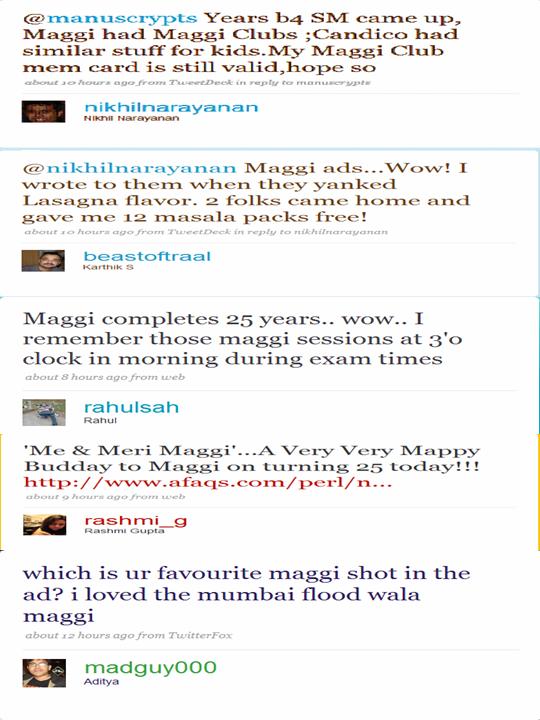
    Later in the day, I was on Twitter, and lo and behold – Maggi conversations.

    maggi

    (click to enlarge)

    I also got to know from @additiyom that there was a Facebook fan page too. While I did get a couple of Maggi pages with 5 figure fan followings, they were the international versions, and I thought this one (found on page 3 of search) with close to 300 fans was the desi version. There are many Maggi groups on Orkut, one with almost 40000 members, and 4 others with more than 5000 members. In the first group, there are about 160 responses for ‘which maggi flavor do you like most?’

    It made me think once again, of how brands make a website andย  forget about the internet strategy. I’d have loved to see a more well thought out web campaign – with the microsite also serving as an aggregator of content from places where the conversation is happening, for starters. By all means use mass media and promote the site, but if the idea is about getting in touch with consumers, it definitely helps to seed and maintain conversations over at the usual suspects – Facebook, Orkut, YouTube and even Twitter. The audience is already there.

    until next time, 2 minutes definitely makes sense in real time ๐Ÿ˜‰

    PS: Remember the old Maggi joke when Sourav Ganguly was out of form? ๐Ÿ™‚

  • “What will you do when the money goes?”

    Even as stories abound about a Google acquisition of Twitter, Adage had a story on how Google is already making money out of tweets. According to the article, Google is offering ad units that display the client’s five most recent tweets across the AdSense network. The link leads straight to the client’s twitter account, and the campaign is measurable by the increase in follower count. One could say that Twitter gets some publicity out of this, but its obviously not getting any money.

    The ad network Federated Media recently launched ExecTweets, a site that aggregates tweets from business executives. The site is sponsored by Microsoft. With a twitter account, you can join the conversation, receive tweets from the community and vote for tweets and execs. At least on this one, Twitter will make some money.

    Since we have mentioned two biggies, might as well mention the third too, though what they’re doing is different from the above. Sideline is the desktop app from Yahoo, that runs via the AdobeAIR platform. It can do custom search groups, advanced queries and auto refreshes by pulling in data from tweets. There are other services that offer similar features, but maybe there’s more coming. And it does promise 20% more awesomeness. ๐Ÿ™‚ On a tangent, a service called Say Tweet, which I have used in my personal blog to display my Twitter status, does give a sense of what Yahoo could do with Flickr and Twitter.

    In addition to the biggies above who’re using Twitter, there are numerous applications and services being built based on Twitter, and several others inspired by Twitter. A few examples. Tinker, from advertising and publishing network Glam Media, allows users to track real time conversations (from facebook and Twitter) happening around TV shows, entertainment events, conferences, and so on. It gives information on events by showing most followed and most discussed streams, popular events, and on trends with charts and historical data.ย  It also has embeddable widgets, which can be used to view a feed as well as update. They already have advertising and featured events and have further monetisation plans. iList Micro, from the iList service that alllows you to broadcast your listing to friends across networks, is the Twitter version and uses the hashtags #ihave and #iwant to create a simple process of classifieds. I have already mentoned Yammer (which now offers integration with Twitter), and Blellow in earlier posts, which are renditions of Twitter for more niche/enterprise uses, there’s also status.net arriving in a couple of months time.

    In spite of the several ways in which business are using Twitter, and the potential, I actually get worried when such services pop up on a regular basis, because I fear that when each service figures out a revenue model, one door could possibly be closing for Twitter itself. For instance, recently Jeremiah Owyang had a good post on social CRM being the future of Twitter, and within a few days, I read about Salesforce adding Twitter analytics to its CRM offering, and about CoTweet, a part marketing-part CRM tool.

    Twitter hasn’t been idle. From experimenting with advertising on profile pages (for third party and own apps, free for now) to tweaking title tags for better Google results, to hiring a concierge for celebrities (yes, really!) a lot is being done. And there’s also a new homepage design (limited roll out) which gives more prominence for the search function and increases homepage stickiness. It will also display popular trending topics (like in the current search homepage). (Hmm, perhaps one ad every 5 items, I wouldn’t mind that when i search)

    With the new funding, perhaps they have enough money in the bank to wait, watch new services, and incorporate the popular ones into their own functionality, in order to provide a diverse and robust service to all kinds of users.ย  Twitter is so open ended that it is different things to different people, but I wonder if identifying a few areas that they’d want to develop for revenues is of prime importance now. What I’m worried about is other services staking out potential revenue models, and whether addition of features towards no particular intent might result in everyone else but them making money out of these very features. But hey, maybe they have a plan. ๐Ÿ™‚

    until next time, tweet dreams

    PS. the lyrics of the song mentioned in the title ๐Ÿ™‚