
Category: Social Media

  • The evolution of Content Marketing

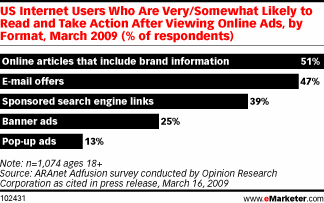
    A few weeks back, the eMarketer released some statistics about the kind of web advertisements that elicit reactions from readers.
    emarketer

    Clearly, the crowd likes to see ‘advertisements’ within content – I think advertorials would be a subset of that. This trend is all the more prominent in the younger audience, when the demographic profiles of the respondents are considered. (check out the statistics here)

    The graph shows that advertising in content is also ahead of sponsored search links, perhaps because the human writer would obviously have a larger sense of context than the ad serving Google. More importantly, there is a trust factor involved when the ‘advertising’ comes from a ‘known’ blogger/writer. There have always been debates about bloggers ‘selling out’ and plugging products/services, but sponsored posts are a reality, and so long as the disclaimers and the disclosures are in place, I am quite okay with that. I’m quite sure that if the concerned blogger gets greedy, the crowd will straighten him out in time.

    Content marketing is definitely different from traditional marketing/PR and raises interesting scenarios for all three parties involved – advertisers, publishers and consumers. Before you go further, I’d suggest reading up Chris Brogan’s (slightly old but) informative post about content marketing.

    The advertisers could range from large brands – products or services, to those serving niche sections. Trendwatching had written recently about sellsumers

    SELLSUMERS: Whether it’s selling their insights to corporations, hawking their creative output to fellow consumers, or renting out unused assets, consumers will increasingly become SELLSUMERS, too. Made possible by the online revolution’s great democratization of demand and supply, and further fueled by a global recession that leaves consumers strapped for cash, the SELLSUMERS phenomenon is yet another manifestation of the mega-trend that is ‘consumer participation’.

    Advertisers would have to figure out if they want to establish and maintain their own content marketing platform, or rely on on a network of entities like sellsumers – that could be individuals or a content marketing service that aggregates independent websites/bloggers, or encourage their regular consumers (/prosumers) to speak about a brand they use, or just support activities/communities and hope for good word of mouth. Perhaps it could be a combination of any or all of the above, with a different objective (a brand goal or a sales goal),  and different measurement criteria for each. In any case, this could prove a great way for brands to explore their long tails of products/services and communication too. It would also mean that brands would have to work harder to ensure that they reach the desired audience in the desired way, in an increasingly fragmented media landscape.

    Publishers, as mentioned above, could be the brands themselves or sellsumers  – individuals or a network. Perhaps newspapers could explore this as a revenue stream, since they’ve always been content aggregators with specialist columnists. The existing social networks are trying to evolve a revenue model out of this. Celebrities could build up an audience across social networks and create an endorsement 2.0 version. For any of the above, the key would be to establish and maintain a set of users, with whom they have an equity- a social capital, to whom they can provide a value, even when they’re doing content marketing. In essence, while the old publishers used their reach for any advertiser who could pay the required price, the new publishers would have to be focused and would have to live with the involvement of consumers in who they sell the reach to, and how.

    The end consumers will seek out networks they can trust, ones which can provides non intrusive ways of connecting them to the product/service they might have an interest in. They would play an active role in creating and maintaining relevant publishers and networks, by ensuring that they are trustworthy sources of information.

    Going forward, it is possible that all the entities we see on the web now, including us, will play all these roles at various times. Unlike the clearly demarcated advertiser-publisher-consumer system we have now, the new systems would be more fluid, with flexible options for all parties. The standards and norms of content marketing need to evolve. Perhaps the disruption we are seeing now, with the decline of traditional media and rise of social web is a prelude to this flexible system.

    until next time, role play
  • Social Connectivity

    Just yesterday, I read about AOL launching Social Thing for websites. Adding the service to your website gives you a navigation bar at the bottom of the page, users can sign in with their AIM/AOL/Bebo/ICQ ids and comment. They can also chat/IM, check out what their buddies are doing, and share stuff with them. According to Mashable, “Authentication goes through AOL’s Open Authentication API, which is being extended to include support for a single sign-on from Facebook, Google, Yahoo, OpenID and other services.”

    As TechCrunch mentions in its article which talks about Facebook opening its stream API to developers, the conversation wars are heating up. Facebook Connect and its potential is something I’ve written about several times before. Broadly, as a site owner, the implementation of FB Connect allows me to broadcast my content to my Facebook audience, and if they comment using FB Connect, it gets added to their stream thus multiplying the reach. As a commenter, I can share my activities on other sites on my FB stream. The opening of the API enhances the potential for FB stream conversations to happen outside FB.

    Meanwhile, a few days back, there was also a news about Twitter Connect. Obviously, since Twitter has very less profile data as compared to FB, it need not be seen as a competitor to FB Connect, but seen from a “conversation  platform choice” perspective, i’d say it still is. For those interested in how each of these Connect services work, this is an excellent detailed read.

    And what Connect conversation can be complete without the omnipresent Google. Before we get to Friend Connect, a detour. Google recently decided to give us more control of how we would be seen in a search result page – Google Profiles will now be part of search results and we can edit it. In addition to regular data, you can showcase links to your profiles on services like Facebook, LinkedIn, MySpace and so on. While Google claims its just responding to users’ needs, its obviously aimed at getting more user data. However, the profiles will only be shown at the bottom of the search pages, and will not ‘save’ you if you’ve been making news otherwise. 🙂 I assumed that the Profiles so created would be in sync with what gets displayed on Google Friend Connect, but apparently its not so. But you can have a vanity url (google.com/profiles/your name) so long as its connected to your gmail id. You can get a detailed report on the new Profiles here.

    Back to Google Friend Connect, once implemented on your site, it allows users to log in using GMail/Open ID/Yahoo/AIM . Users can comment, rate etc (depending on the gadgets you’ve added), engage with other users, and invite their friends from other networks to check out the site. There are many related things I am thinking of – will Profile and Friend Connect be made to work in sync, and is Google doing the opposite of what FB has done? FB created a social network first and then decided to connect other sites with it and thus enhance its own lifestream. With Google’s many services, it has a ‘disaggregated’ social network in place – YouTube/Picasa/Blogger/(even) Reader. At some point will Profile be just the equivalent of the ‘Info’ tab on Facebook and something like iGoogle (or God forbid Orkut) serve as the aggregator of one’s conversations across the web, not just across Google services, but the sites in which one logs in using Friend Connect. Google is always hungry for more data on users, so it can build more (and truth be told, sometimes better – like the proposed new Google News) products and get more data and obviously find more ways of making money.

    Of the four, Facebook is now using its Connect on popular sites to add more layers to its existing user data  and increase the conversations on Facebook. The opening of the stream API should get us some interesting apps. We’ll have to see what AOL does with its new service, how it ties it with Bebo etc. Twitter Connect is in many ways a different animal altogether, its simplicity and existing third party applications throw open many possibilities (as always) The data just goes back to Twitter, and it can be argued both ways whether Twitter Connect can be used effectively to increase a site’s visibility in the open yet ‘noisy’ stream, but the commenting using Twitter login would be useful to quite a few people  (a wild thought – maybe Twitter should just buy Friendfeed and make that its base social network). Google Connect is easy to implement and interesting gadgets are sure to happen. The possibilities of aggregating  it into a network remain. Now I wonder if Microsoft will find new ways to connect, or will they just Vine? As for Yahoo, maybe they’ll connect with Microsoft finally!! What will be interesting is what handle you would use to connect.

    until next time, connecting people ain’t just Nokia’s job no more

    PS.  6 years of blogging. A week’s break. 🙂

  • Social Media – beyond strategy

    Unilever CMO Simon Clift, at Ad Age’s Digital Conference, spoke about the increasing role of social media in brand management, and said that the internet allows consumers to hijack conversations inspite of the huge money spent on advertising. From Unilever’s experience with Dove also comes the understanding that its not just the communicated parts of a brand that comes under scrutiny, but also the corporate’s entire set of credos – sweatshops, impact on environment are a few things he mentioned. Unilever has prominent corporate signatures in its advertising in UK. He also spoke about the increasing penetration of mobiles, of “marketing program with social benefits”, and a product centric approach.

    In essence, it reiterates the decline of one way communication, consumer participation, of brands being ‘deeper’ than the marketing that is done for them. But it was good to hear it from a leading FMCG corporate. The most interesting part of the article for me, however, was this, from the author of the post

    Social media is not a strategy. You need to understand it, and you’ll need to deploy it as a tactic. But remember that the social graph just makes it even more important that you have a good product. Put another way: The volume and quality of your earned media will be directly proportional to the impact and quality of your product and ideas.

    I think that nails it. All this while I was considering social media as strategy. Now I think its more than that – its something that will make the organisation really focus on what they’re delivering to their consumers, how they are doing it – not just from a delivery platform/operations pov, but also from how socially and environmentally conscious and responsible they have been. In Mr.Clift’s words “enlightened self interest”. The ways and means of communication – brand advertising, promotions, PR etc, will follow much later.

    Meanwhile, the Marketing Pilgrim asks an interesting question – does social media really have the pulse of the people? It cites the Johnson & Johnson Motrin ads that had raised the hackles of mom bloggers a while ago, and caused them to remove the ad. Apparently a research was done later that threw up some interesting stats – 90% of women had never seen the ad, and when they did see it, 45% liked it. It also speaks of the Skittles – Twitter experiment, and a research in which only 6% of 300 people sampled had heard about it. Those on Twitter would’ve heard about both these, but the Pilgrim asks whether these voices resemble those outside at all, and how much of influence do they have outside.

    I, for one, still think social media is a good microcosm of the real world. It does give varied perspectives, and the key is in evaluating the perspectives, digging further where required, and deciding on a course of action that fits larger objectives, and not knee jerk reactions. Wonder if there would have been different results if J&J and Skittles had attempted to carry the community along in their efforts.

    But the bigger opportunity, I have always felt is that it allows brands to experiment with segmentation. On one hand, the net allows extremely targeted communication to a core segment, and on the other hand, cheaper distribution allows the brand to also communicate with different segments of the long tail of consumers. It means that brands can play different roles according to the consumer’s interests, and varying with the context, by tweaking its communication, even while sticking to its core objectives. There are new monitoring tools being developed that will aid of this.

    Most importantly, it allows brands to find evangelists in each segment and work with them to improve and communicate. Consumers who find a product interesting and appealing will communicate it on their own, adding their perspective and giving a human touch of ‘interestingness’. I’m increasingly seeing posts about marketing ideas that have differed from the norm – Penguin India’s ‘Blog a Penguin India Classic’, which I wouldn’t know about if Karthik didn’t mention it on Twitter or his blog (though I do think they could’ve done it better by using social reading lists like Visual Bookshelf – on Facebook as an app too, Shelfari etc to reach Penguin readers – can easily find that through book titles), product placement ideas for Nestle evolving from the “Mad Men” on Twitter. Cisco’s comic book experiments via Chris Brogan’s post (Webex in Marvel Comics), and Kara Swisher on All Things Digital ( The Realm, an entire comic series). All appealed to me as a marketer, and one as a bibliophile too. Social media is not one thing – the channels vary in audience, kinds of interaction etc – Facebook, Twitter, You Tube all allow new ideas ( I thought Volvo’s Twitter stream inside a YouTube banner ad was very interesting) and fresh engagement rules, and ways to break advertising and brand communication stereotypes.

    I wonder about the role of strategy in a social media landscape where many things are still unfamiliar. The standards, processes and even objectives are in most cases, hazy, and evolution is happening on a regular basis. In such a scenario, perhaps organisations should first take a long look at themselves and their customers – current and potential, and start by setting goals that go beyond social media.

    until next time, lab time

    Bonus Reads: Social Media tools popular among marketers (via Digital Inspiration)

  • A plus cases on Twitter

    Last week, @aplusk beat @CNNbrk in the race for one million followers. In plain English, Ashton Kutcher, an actor, challenged CNN on Larry King Live – who would get to a million followers first – to prove a point that an individual could have a reach equal to a large network on Twitter. Twitter joined in the fun, because unlike the norm, users couldn’t unfollow either of the parties, of course smart tweeps found a way out anyway.  Point taken, AsKu, though the irony was that until a  week back, the CNN account was not run by them, though for sometime they’ve been managing the account through the person who created it.

    For more than two years, the CNNBrk account (for breaking news) had been created, maintained and run by a 25-year-old British Web developer who just wanted a way to beam short news alerts to his cellphone.

    And that’s the beauty of this user driven service. Something that I fear might change with the ‘mainstream’ spotlight and the rush of real celebrities. Its only a matter of time before a new celebrity thinks of a new stunt. But it is to be noted that  Kutcher is donating 10000 mosquito nets worth $100000 to a charity. In fact, one week before that, I’d read about Hugh Jackman’s donating AUS $100,000 to charity via Twitter, the charity to be selected via Twitter pitches.

    Now, I’ve always maintained that users should figure their own comfort levels and use the service accordingly. But I also feel that a sudden influx of people with no intent other than rooting for a celebrity might be the kind of inorganic growth that will work against the service and its more regular users. This could range from a disruption of the service due to the load to a change in the ‘culture’ of the service.

    Kutcher’s point was about getting a reach higher than a media giant. I’ve always had a problem with numbers – followers, updates etc as a means of measurement on Twitter. I find it a paradox for a place which became popular because of a qualitative measure – conversations. CNN will deliver breaking news regularly, and (as someone suggested on Twitter) Kutcher followers will just have to wait for those occasional Demi photos. Reach has been an index to sell traditional media space, is that the benchmark Twitter wants to take forward?

    There was a very interesting post on Tech Crunch on whether Twitter should remove its follower count. Like I tweeted, I’d agree. Once upon a time, it was a medium to share an instant – something you thought/read/saw/felt to make others smile/think/share their own expressions. With growth came the ‘how a tweet might cost you a job’ and ‘5 ways to increase sales with Twitter’ theses, and the instant was lost. Perhaps you will ignore that as a subjective grumble. But think of the times you see the ‘need 5 more followers to get 500. please RT’ and what you feel then. What happens when that’s the norm and the service changes to accommodate and encourage that culture because that’s what helps them make money. [Note: I’d love for Twitter to make money, but I’m sure they’ll find better ways]

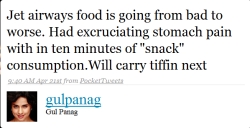
    While on celebrities and Twitter, closer home Gul Panag has been quite active on Twitter the last few days. The Twitterverse has had its share of imposters and has been trying to ensure there’s no ‘identity crisis’ this time, so much that poor GulP might have one soon. This tweet of hers caught my attention. (Oh, okay the dimples too!!)

    gulp1

    Spicy Jet news. Poor them. It reminded me of a post I’d written sometime back on ‘Social Ambassadors‘ – what would happen when the transparency of social media met celebrity bloggers? In this case, micro bloggers. In fact, micro blogging is even more ‘dangerous’ since the interaction is real time, and not like a PR draft that can be posted on ths site, and replies given in a few hours or even days. This becomes all the more important if celebrities use social media as a personal broadcast medium to their fans. Of course, brands can use the media to their benefit too – for example, create conversations between celebrities (a Twitter conversation between Aamir and Gul basis their Tata Sky TVC would be fun), use celebrities to communicate beyond the obvious advertisement etc.

    The challenge is for celebrities too. Perhaps it will also make celebrities more responsible when making endorsement choices. (It would be fun to ask SRK/Aamir why they switched soft drink brands in between.) Also, can celebrities retain their ‘interestingness’ when they are in touch with the fans all the time, unlike a traditional system when news about them was less abundant?

    On an aside, when celebrities move to direct-to-crowd platforms, what happens to the go-between media for whom they were the news makers, and we were the news consumers? And what happens to the micro celebrities on Twitter? 🙂

    until next time, when twitter streams meet mainstream