Category: Social Media

  • Revenge of the corporate website?

    A few weeks back, there was a discussion on one of the LinkedIn groups I’m part of, on whether the corporate website is becoming irrelevant, and whether there was a tendency to make it more social. It was based on a post by Jeremiah Owyang a couple of years back, on how to evolve the corporate website. Coincidentally, I also caught a post by the Jeremiah on the same topic, a couple of weeks back, which talked about brand websites becoming aggregators of conversations happening around the web.

    This is a topic I have written about earlier, but with the rapid progression of tools that have been happening in the last few months, this would be a good time to update.  The tools have been evolving – Facebook, Twitter, Flickr, You Tube, and on each of them are built communities, which are finding newer ways and more mechanisms to express themselves on topics, and that includes brands. The aggregation is happening within the networks themselves, and there are ways to take the conversation outside the networks. I’d written last week about Facebook’s Live Stream Box last week, which allows updates to be streamed on external sites. Center Networks has an interesting post that talks about how Friendfeed can take over the forum/ bulletin board world. I also read about one of the pioneers in the user generated content space – MouthShut, planning to tap into the social media marketing to reach out to customers and giving free accounts to brands. On an aside, they are also planning to hire a couple of folks to handle this, so SMEs (Social Media Experts now 😉 ) might want to check it out.

    Meanwhile, AdAge has a very interesting post on how, even though Twitter and Facebook have grown as feedback and customer-service channels, the product review has also been growing in importance thanks to its more structured nature. The post also rightly points out that in addition to the listening skill, it is also important for brands to develop a culture that can respond to the feedback that’s now perhaps coming in torrents.

    In my earlier post, I had wondered if the reason behind brands’ reluctance to join conversations on networks, and sticking to their own, often static websites, was because of their liking for control. The other reason I had thought of was the ability to ‘measure’. Things have moved on, and we now see many brands making Twitter accounts and Facebook pages. While many of us bemoan the lack of a concrete plan behind such efforts, it is still a step forward. Even the Skittles episode, which many people ridicule, was a significant experiment to me. They tried something, they learned, they moved on. Measurement is still a much debated subject in the social media space. There’s nothing stopping brands from utilising traditional measurable methods of web marketing and also having ‘unmeasurable’ conversations on the side.

    If brand websites are guilty of missing the bus on involving existing/ potential consumers on their website when the conversations on social media platforms were still in a nascent stage, this perhaps is the time they can redeem themselves. Indeed, brands have started listening to, and acting on the basis of consumer feedback. As newer and better monitoring tools crop up on a regular basis, this is becoming easier. But for now, all these communities perhaps prefer the conversations to happen on the ‘unofficial networks’, as opposed to the corporate website.

    Perhaps brands could try to figure out why that is so, this would help them evolve objectives and a strategy for the website. Going further, it would also give them an understanding of how they could tweak their internal structures to create sustainable processes that can tackle the challenges that an evolving web throws at them.  This is perhaps even an imperative if the mob justice I’d written about last week becomes a trend. But that would be a negative way of looking at it. An interactive website that (without bias) pulls in ‘relevant’ conversations from around the web and gives more perspective to their customers would be definitely appreciated. By treating consumer feedback with the respect it deserves, brands would not only be giving more credibility to their website, and increasing the number of conversations that happen there, but perhaps even creating evangelists who would help the brand by proactively giving it relevant feedback and even taking up for the brand in case of bad PR, or at the very least, considering issues objectively. But then this is as much a culture and process change as it is a web design change.

    until next time, homepage with branch offices..

  • Mob bile

    Facebook recently launched Live Stream Box, which allows webmasters to stream relevant real time status updates on their site. Users can log in with Facebook Connect and post updates that will appear on facebook (their own profile as well as friends depending on their settings) as well as the site. It means that if say, I’m watching a live stream of any event on a particular site, which has this installed, I can use this to get my friends on FB to join the conversation. Two things struck me- one, it makes a whole new way of connecting friends around their topic of interest (context), and two, (a question), is this a step aimed at bettering twitter’s common lifestream and hashtag based way of aggregating conversations? (something that Facebook lacked so far)

    As all the services increase their focus on real time, I couldn’t help but think of the impact it has had on usage. Are the users on these services becoming increasingly trigger happy? TC had an article recently titled “Friendfeed, syphilis and the perfection of online mobs“, which talked about the service being the hotbed of mob justice enthusiasts.  (because of its ability to aggregate conversations in one place) Its a subject that I have discussed here earlier – once in the Hasbro-Scrabulous context, and then collating 3 separate incidents. I must say that we have moved on since then- to places closer to home – the latest being The Kiruba Incident involving Cleartrip (The Kiruba version) In many cases, the mob doesn’t even pause to check the facts or look at the issue objectively/rationally, before they react. With all kinds of people out there, I wonder how long it will be before someone decides to use more than just the keyboard, and look at real justice options. (Actually it has happened before)

    So, what would the effect of all this be on brands? Would they be able to keep up? Would they be able to deal with an angry mob? Real time is a reality, and it is would be more of a loss if brands decided not to use twitter. Its a different matter whether they choose to engage or are content with listening. There are quite a few tools out there which can help monitor the conversations, but what if the brands are not wired enough to respond effectively to the fires that happen? In this context, I read an interesting article on Adage, that talks about Slow Marketing. It talks about going back to the basics, and a need to focus on human, one-to-one connections.

    The responsibility is on both sides. In their eagerness to cash in on the new big thing and create buzz, brands (and agencies that advise brands) set expectations that may be way beyond what the organisation behind the brand can actually meet – in this context, perhaps turn around speed, and response to all communication directed at it. From the article, 

    Pick your battles: The social-media feeding frenzy puts a premium on responding to all conversation. You don’t need to respond to everything. Take a step back before diving in. In some cases, not engaging is the best form of engagement.

    The responsibility lies with users too. Long before there were brands on the real time platforms, there were people. And people used to help newbies learn the protocols of communicating in the network. If you were a user, you wouldn’t want to be in a place where people were only out to make fun or do harm to you. Maybe we should extend that courtesy to brands too, and allow some leeway, at least in terms of reaction time. In many cases, the person behind the handle will be just another enthusiast like you, with hardly any support from the organisation, and he would be trying to show to his bosses the value that these services can provide. All of us have favourite brands, which, if they use social media effectively, will end up being more useful to us. By making witchhunts a standard operating procedure, we might be doing more harm than we realise.

    There is an interesting discussion online, that talks about company websites and their return to favour, but more on that next week 😉

    until next time, see you later

  • Broken News models

    The Iran crisis once again brought the present day tools of news gathering into the limelight, even while highlighting the inadequacies of traditional media. From real time tools like PicBrk to spoof ads and stories, the tools became the focal point of the protests. It was as much about changes in news gathering as it was about the ability to share, both in real time, a skill that traditional is yet to pick up, in spite of ‘breaking news’ on television. The significance of Twitter’s contribution can be gauged from the fact that the US government asked Twitter to postpone its scheduled maintenance so as not to disrupt the flow of news from Iran. The inability of traditional news gathering and distribution systems to come to terms with real time media consumption, and their usage of social media as yet another broadcast medium was highlighted at the 140 Characters Conference (#140conf). All this makes me consider, yet again, the future of traditional media systems and conglomerates, especially newspapers.

    A few days back, I read about the Associated Press issuing social media guidelines to its staff – not to show political affiliations, or post views on contentious issues among other things. The ‘best’ part is that they also have to monitor their profile to ensure that comments by others do not violate AP standards!! Ahmadinejad Press? Here’s the policy in its awesome entirety.

    It’s been quite a fun week, with a speech by Dow Jones Chief Executive Les Hinton – also the publisher of the WSJ, adding to the amazing show of perspective. He described Google as a giant vampire that was sucking the blood of the newspaper industry. Now, I have reasons enough of my own to be cross with the omnipotent Google, but  even assuming that it is a vampire, who showed them the “X – blood here” sign in the first place? While Google states that its mission is to give readers more perspective by aggregating news from different sources, and even directs clicks to the newspaper sites. Newspapers argue that these clicks are nowhere near to the visits (and revenue) that they’d have gained if people came directly to their websites. They also have a problem with ads appearing on the side when people search for news. (Source) I have actually not come across those, and Google News definitely doesnt have them anyway.

    That is context enough for an interesting article I saw on Adage – ” Why ‘Going Galt’ isn’t the solution for newspapers”. The article is in light of the digital startegy of The Newport Daily News in Rhode Island, that’s closing its ad supported site and selling digital subscription only. John Galt, meanwhile, doesn’t need introduction for Ayn Rand readers, but if you are asking “Who is John Galt”, catch up here. In this context, it means that newspapers stop creating content for aggregators to pick up and make money. As the article points out, its chances of success is only when it deals with news that’s not commodity – could be specific locality/genre where there aren’t competitors. Its quite easy for newspapers to stop Google from taking its content – a 2 line code, as has been pointed out regularly.

    Cody Brown has an excellent article which shows the inherent differences between print and online, in terms of how news is processed. To summarise, print uses batch processing, where news and rumours are sifted through, verified and reverified and the crux is the final output and the credibility of the publication. The web, uses real time processing, it works like a gigantic wiki, everyone contributes, the crowd corrects, and the final output is of relatively less importance. The flaws of one become the benefits of the other. Batch processing finds few takers in the age of real time, and as this article points out so correctly, Twitter is the fastest way to get informed, or misinformed. This explains why I see stuff on my networks, and immediately move to a rediff/Google News to immediately verify from a trusted source.

    So newspapers face a double whammy. On one hand, its news creation is facing obsolescence in the face of changing media consumption habits, and on the other hand, it cannot find ways to make enough revenue out of the content that it ‘painstakingly’ produces. There are of course, traditional players who are bucking this, but as this article makes a case for, there can only be one Apple, who is an un-Google. I am still trying to fit in this understanding with the David – Goliath model. Apple operates so differently from Google, that it would be easy to summarily dismiss them as non-competitors, but there’s more to it. That’s for later, but the idea seems to be not to be a better Goliath, but to be the best David and play by rules that would take Goliath enough time to figure out, for David to finish the game.

    A small note on the Indian scene.  We are perhaps a few years away from the mess that US newspapers are in,   But consider, a Galt stance would’ve been possible a few years back, but with players as diverse as Rediff and Instablogs having a mechanism of reporting, it would be a folly to even try now. Rediff has built services and business models that doesn’t leave them to the mercy of making money out of news. Instablogs is also figuring out revenue models, at obviously lesser costs. Technology and faster news delivery platforms will appear, its inevitable. Newspapers in india  need to replicate their real world credibility online very fast, understand ‘real time’ game rules, and evolve radically new business models if they don’t want to repeat the US scenario. For ““News doesn’t break, it tweets”, the TC article credits Paul Saffo as saying.

    until next time, notice how many newspapers have ‘Times’ in their name? Real time? 😉

  • Beyond run-of-the-mill

    ..and I took a look at the last few posts and realised, that the excitement of the Facebook -Google- Twitter three way fight was making me obsessed, and I figured you guys would like a break from that too. Thankfully, I came across two activities, that I thought showed a fundamental way of approaching the internet as a medium.

    At a basic level, the internet (and mobile) differ from say, print, OOH, television and even radio (in spite of call ins) simply because it allows two way expression. And if we go meta on that, even the internet, like other media, is after all a tool, as far as brands go. Its just that in many cases, its a much better enabler than the others because of its features. So, Facebook, Twitter etc are only tools – I have to keep reminding myself of that. The two examples below have shown how to use the web to increase the utility and value they are offering consumers. I liked these two all the more, because while they have presence on the usual suspects, these activities do not use the services.

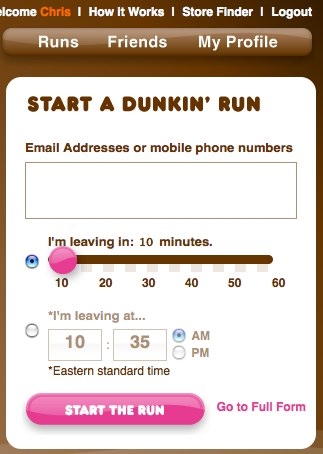
    Some of you would’ve read about the Dunkin’ Run iPhone app and website by now. For those who haven’t here’s the gist. Going out for coffee? Want to get your friends something too, but can’t be bothered to remember their order? You become the ‘Runner’, and use the app/website to initiate a group order. Your friends/colleagues ( a list you’ve made, and you can make different ones) get an interactive alert, and they can place the order online/app. If they’re registered users, they can even pick from their favourites/ previous orders. Once the list is made, take a print out/show it on the phone. Oh, okay, you can display the run status on facebook too. This is how the app looks on the phone

    dunkin dunkin1

    (Thank you, Chris Brogan, Mashable)

    ‘Run’ seems to be the operative word since the second example is to do with a product and activity right in that space. Nike. On Wired, I read about this excellent service called Nike+, which is now helping users track personal metrics and thus adding value. By using a sensor, and syncing an iPod to the website, (after the run) users can now track distance run, time taken, calories burned, weight lost etc and over a time period. These are displayed visually, on their profile, and it can be shared, and for extra motivation, users can even take up a challenge or set individual goals, and if that’s not enough, you can even create a list of people who could motivate you for completing it. They are updated about your progress. When i visited the India site, I could see a ticker that showed updates about various runners.

    According to Wired, “Nike has attracted the largest community of runners ever assembled—more than 1.2 million runners who have collectively tracked more than 130 million miles and burned more than 13 billion calories.” It has not only helped the users, but think about all that data Nike has, which it can use to provide even more value for customers and build better products. Amazing, I think I just might end up doing this stuff!!  Oh, okay, there’s a twitter app too – Twiike.

    Two ideas, which use the concept of sharing without needing the tools that I keep discussing here. A good reminder that while the tools race for users, and web domination, brands can quietly use the philosophy of web 2.0 and build communities around users through simple ideas and wonderful execution.

    until next time, Just Donut it 😉

  • It starts..again..

    Facebook is on the march, though I have no clue about the destination. A few days back, I read about the ‘Search Inbox’ feature getting added, that’s after the overall search was revamped and the rumours of the “Everyone Button“. With photo sharing, a revamped mail box, status updates, videos, games, I guess I’ll have to correct the earlier statement and say that the ‘walled garden’ has offered enough evidence that it is making itself *the* destination.

    I remembered an article I read a couple of weeks back on how its this merging of activities on facebook that has given it a growth of 8.54% growth in the last month, as compared to Twitter’s sudden fall to a relatively dismal 1.47% growth rate. As Shefaly pointed out the last time I’d compared the two services, there’d still be an audience that consider the Twitter protocol more useful in spite of Facebook’s ‘charms’. A general comparison of the user figures would show that Facebook has the mass. Whether the Twitter audience is a good enough number, time will tell.

    The other interesting article I read was about the social network identity crisis. For one, this is not about us, the users, but the networks themselves. I’d written sometime back about LinkedIn’s attempts to be like Facebook, which thankfully didn’t develop much. This article compares LinkedIn, Facebook and Twitter, and their overlap. Friendfeed is another unique character in the mix, and serves well as a great aggegator, though it does appear geeky as far as the average user of Facebook goes. Like I’ve said before, Friendfeed thinks up all the neat stuff, and Facebook makes them popular to the masses. As for LinkedIn, their ‘official’ networking positioning keeps them at a safe distance now.

    But yes, the battle, in different manifestations for several years now- as mailboxes, portals and so on, has been for the spot of destination site, or rather the starting point of the user experience on the web, the first site a user opens on his browser, the base. And that’s the reason i feel that the recent spate of Facebook’s initiatives, while they seem to be aimed at replicating the utility of Twitter, are actually targeted against Google, and specifically, Wave. The approach of both are actually from two opposite directions – Google, from Mail and Talk to the spectacular collaborating, sharing and weaving features of Wave, and Facebook from social networking to newsfeed, to chat and mailboxes. Wave is Open Source, Facebook is opening the stream to developers. It will be interesting to see whether there can only be one/couple/all survivor/s from Wave, Facebook and the simple appeal of Twitter.

    until next time, Wavebook 🙂

    Update: Excellent post on Facebook vs Google, (click it, dammit :p) and here too, and why Facebook has a chance.