
Category: Social Media

  • Brands – Interesting vs Popular

    These days, Reader is helping me find a balance that contains both ‘interesting’ and ‘popular’ content. I came upon a very interesting post on Reader via Mahendra Palsule, which was one exactly this topic – Would you rather be Interesting OR Popular by Justin Kownacki.

    For the purpose of this post,

    Interesting: Arousing or holding attention

    Popular: Regarded with favour/approval by general public

    To briefly summarise, Justin sees a clear dichotomy in ‘interesting’ and ‘popular’, and states that when something becomes popular, “it will simultaneously cease to be interesting.” The reason, and I would more or less agree to it basis my experiences, is that when it becomes popular, my relationship with the ‘interesting’ entity changes. Suddenly, it is an interest that has moved from a relatively private territory to a more public one. Like Justin notes, it creates dissonance with my self perception of being an interesting person. Meanwhile, money also has a role to play. “interesting sells, but popular sells a lot“, for various reasons.

    Meanwhile, like many many others, I subscribe to the uber popular (and interesting) Seth Godin, and on the same day, he wrote a post titled ” Driveby culture and the endless search for wow“. I felt that they were related, especially when Godin writes about the creation and consumption of culture.

    As the comments in Justin’s post indicate, there are entities which have successfully been both interesting and popular, but I’d say they are exceptions. I’ve always believed in ‘interesting’ (against ‘popular’) over a larger time frame, and if I go by Godin’s last paragraph in the post, I think he is on that side too. Which is why, I wonder with the massive changes that social platforms bring to creation and consumption of content, brands will have to choose between interesting and popular.

    To generalise, the era of mass media made ‘popular’ easy for brands. Like Godin says, money could buy an audience. And that’s exactly what happened when there was scarcity of content. The audience had, and paid, attention. A percentage consumed the brand, sales went up, more money bought more attention. The message  also often pandered to the lowest common denominator. Brands didn’t have to be interesting until they operated in the commodity space, and then it became a gimmick.

    When I started using the platforms of what is labeled as social media, I thought there was something that could change this cycle. I still do, in spite of this post (most of it justified, by the way) by Steve Hodson. I think what we’re seeing now is brands seeing social as just another media, and going the ‘popular’ way. The  majority of the audience too, is discovering popularity, and would like to have a share of that themselves. So their consumption and creation would be on that front. In a way, for now, one set of media is being replaced by personal brands.  But in spite of that, the basics of social platforms create opportunities for those brands with ‘interesting’ as their way to be, to have their say. While examples are few and far in between now, I think its just the learning curve taking its time. Maybe the examples are not so easily available precisely they are only interesting to a smaller audience set of users now. Maybe there never will be, because it IS difficult for popular and interesting to go hand in hand.  🙂

    I think ‘popular’ is going to be even more difficult to sustain, and not just in terms of communication, but organisational culture, scalability and so on. As content becomes even more abundant, and as technology permeates the lion’s share of our daily interactions, I think the audience will swing towards ‘interesting’, because in  it, I sense, is freedom, and opportunity. And that goes for brands too. However, it remains, as always, a matter of intent, and though I feel that it is indeed a question of ‘interesting’ vs ‘popular’, in the medium term, both kinds of brands will co exist.

    until next time, popularity chats in the comments then? 🙂

    P.S: Do you think Apple is interesting trying to be popular?
  • Whereabouts : The next social play

    Like I mentioned in the last post on the subject, ‘Location’ is back in a social avatar. A few days back, Foursquare celebrated its first year of existence, and now has more than 500000 users, 1.4 million venues, and $1.35 million in VC funding. I celebrated it with only my fourth mayorship. 😉 But there are a few more reasons why I decided to do a post. Both Foursquare and Gowalla had been launched at SXSW last year, and this year, location based services (LBS from now) are expected to be the talking point, much like Twitter 3 years back. 🙂

    In my last post, I had mentioned the specific competition in the space – Loopt, MyTown, Gowalla, Yelp, developments happening there, as well as the tie ups that Foursquare has managed with HBO, Warner, Zagat. Since Foursquare is arguably the poster child of LBS, and since there haven’t been any dramatic game changing developments from other players, I’ll focus on Foursquare and a couple of players you would know from earlier.

    Foursquare recently announced that it was launching a few business tools, which include basic statistics like total check ins, unique visitors, sharing to Twitter/ Facebook, gender split, time breakdown etc.  More importantly, it gives business establishments real time information that can help them plan promotions, take care of customer complaints, keep track of customer loyalty etc. There’s also a page where staff can interact with customers.  Though these might seem basic now, more detailing is bound to happen very soon, which will perhaps allow quick polls on menu items, service, allow optimisation that will cut things like waiting time etc. Indeed, Starbucks, which has been very active in the ‘social’ space, is now linking Foursquare to its rewards program, for instance, allowing users to earn a ‘Barista’ badge when they check in to 5 separate Starbucks outlets.

    According to Alexa, India contributes to 2.4% of Foursquare’s traffic, and is the 8th largest contributor. Maybe not the surest of sources, but its an indicator nevertheless. With rapidly increasing mobile penetration, net access costs are likely to come down, and this could mean good news for players like Foursquare. Imagine the implications on the CCD controversy if the Foursquare implementation had been done. 🙂

    (Interesting Read in context : Why “Where Are You Doing It?” Trumps “What Are You Doing?”)

    But wait, there have been other developments too. Twitter, still my favourite service out there, has turned on geo location. The API has been around for a while now, but it wasn’t really anything that anyone seemed to be taking an interest in. The first time I saw the implementation, was on a tweet from LBhat. Check out that tiny pin at the end, and you’ll see where he tweeted from. With the kind of development that happens with Twitter’s open API, there are bound to be some interesting apps very soon. Not to mention that Foursquare is already integrated with Twitter. (All this reminds me of an app called CitySense that I wrote about almost a couple of years back)

    Meanwhile, it has also been pretty clear that Facebook would make a play for local very soon. There was speculation recently that Facebook was showing an interest in Loopt, but nothing has been confirmed yet. What has been revealed is that it will unveil its location based features in April at its developer conference, f8. (location is shown on a Google Map 😉 ) Facebook has been pushing its mobile interface a lot recently, check out your logout page, or the ads on the right side of your home page telling you how many friends are using it. The article states that its more a play for local advertising (against Google) than against services like Foursquare. Business pages + location features for users + tools built from API will be interesting.  But it will also be interesting to see what they do about privacy. Something that remains a challenge for Google too, especially when Buzz and Latitude are integrated.

    Meanwhile, there are other interesting players emerging. Check out Miso, a Foursquare style app for TV and movies, RateItAll, that now wants to help businesses build their own Foursquare, Pelago’s Whrrl, which tries to connect social networking with real social activity – real places where ‘regulars’ meet up. Location based services are interesting because they integrate the real and virtual worlds. When I look at these and other  interesting developments like say, Google Street View (have you seen Hong Kong yet?!), and Augmented Reality experiments, the ‘Internet of Things‘ I think we haven’t even scratched the surface of the possibilities.

    until next time, now for vocation based services 😉

    Update: Just read that we now have a check in Aggregator – Rummble. Read about it here.

  • Wide Labels

    I ended last week’s post with the view that removal of labels and building in the intent and components of these labels into an organisation’s processes might result in structure better than one obtained by a piecemeal approach. I’m still thinking about Surekha’s last comment – on corporate governance, and wondering whether it does indeed encompass (enough) the social facet. Social, both in terms of implication on the larger society, as well as the social used in the context of say, social media.

    While I’m not expert enough to look at the first part comprehensively and offer the soundest of opinions, I think the latter is everyone’s playground 🙂 On that front, I don’t think corporate governance quite makes the cut. And that led me to keep searching for various models being discussed. I also brought into this search the perspective I’d shared earlier on a Dunbar’s number for brands/organisations, retaining the ‘soul of the brand’ (courtesy Chris Brogan) and scalability issues.

    And that’s how I came across the ‘Platform Organisation’ concept. The presentation below approaches the need for this from a communication perspective

    The larger organisational imperative can be read here. This worked for me because I thought it matched business and social needs.  The community would ensure the soul of the brand is intact and would also allow a ‘scaling up’ of the brand’s Dunbar number. But I did wonder whether this would work for large organisations that  have a legacy of systems and processes. Deciphering that would perhaps be the next logical step.

    As I’ve always maintained, the business structures we have built have a huge impact on how we live and consume as a society, and the lives we lead as individuals,(an old and favourite read discovered via Dina) and hence the extended interest on this topic stream. 🙂

    until next time, life’s work 🙂

    PS: While on the subject, a related good read via @vijaysankaran “The Definitive Guide to Scaling Social Enterprise

  • Effective Cause

    The Pepsi Refresh project is something I keep bumping into, inside this blog, as well as conversations outside. I admit to a bias towards it, because I somehow sense a sincerity in its approach. Some time back, Surekha shared with me a document on which we debated a bit. From what I’ve been reading, Pepsi hasn’t given (at least clearly) this project a CSR label, so the debate over whether CSR money has been spent well or not is a little pointless. Besides it was more on crowdsourcing CSR .

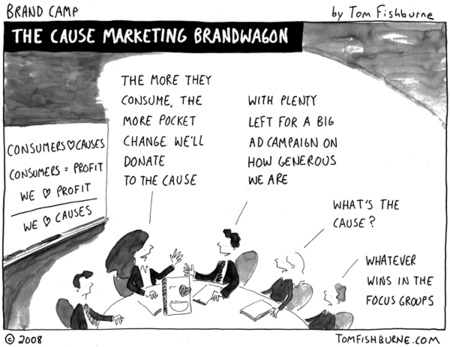
    But thankfully, the national animal ensured that we continued the debate. Aircel’s ‘Save the Tiger’ has also not been given a label, but it does give a good handle to convey my thoughts on CSR, especially since there are at least a couple of good posts on it already, by L.Bhat and Karthik. Harish’s ‘Branding with a cause‘ is a more general, but very relevant read in this context. Aircel’s high decibel campaign ensured that most of everyone knew there were only 1411 tigers left. If awareness was the objective, as stated, it’s been done, especially since the slacktivist generation has retweeted and facebook-fanned it so much that even the tigers must know now. They haven’t been asked whether they want to be saved in a planet full of us, but that’s a different debate. So is the debate whether Aircel should complete the loop, after all why can’t we? (and maybe there’s another phase anyway) But I digress, and generalise. Sorry.

    Clipboard02

    (Image Courtesy: Tom Fishburne)

    The questions I have are these. Should CSR be related to the business domain or not? Aircel’s was not, but as Surekha rightly pointed out, they chose a topic that would connect with their target audience. My problem with that, though it helps stand out from the clutter in a commodity category, is the lack of context. With Pepsi, though one could say the project has nothing to do with sugared water, there was always a ‘youth’ context, which was established long ago. Now, if it were connected with the business, and it is possible with say, the pepsi project (surekha gave me at least 2 excellent ideas) I would turn around and say, vested interests, and doubt the sincerity of their efforts. ‘The big corporate giving us eyewash’ view. It would also bring in ROI measures etc, which I find hard to associate with CSR. Roshni put it succinctly when she said ‘sort of like proclaiming, hey, we did charity’.

    In trying to find a solution, I remembered a post by Umair Haque on ‘Great to good, which, perhaps unwittingly, made me think of a similarity between social media and CSR. As mentioned in my last post, the piecemeal approach to social media is something I dislike. Its as though it exists stand alone inside a box, I think I have a similar problem with CSR as a label. So, (simplistically put), what if the label were to be taken of and every process was carried out with an inbuilt csr approach – from creating environmentally friendly, sustainable products/projects and choice of partners/vendors to eco friendly packaging and everything in between? Oh yes, practical business considerations. I forgot. 🙂

    until next time, with great responsibility comes great power?

    Relevant Read: Cause Effect

    PS: JK cement deserves appreciation for its support of an unrelated, but worthy cause – bikinis 😉

    PPS: While on tigers, this one, by my good friend Blues, is a killer read 😀

  • Social Scalability

    When I see brands and organisations take a piecemeal approach towards social media – either the token presence or the department focus-based approach, I sense that the need for a cultural shift is ignored by many. Cultural shifts are a difficult proposition (good post by David Armano) and need a buy in from all parts of the organisation before even starting out. I have really begun to wonder if the scale of global corporations have made this impossible, and whether splitting up the usage of social platforms as per functional areas is this is their way of keeping the scale under control.

    The scalability of social media has always been a topic of interest to me. The link that I had ended last week’ s post with mentions that ‘socialising cannot scale’, although that is in the context of individuals. But I read this line – “Once a group reaches a certain size, each participant starts to feel anonymous again, and the person they’re following — who once seemed proximal, like a friend — now seems larger than life and remote…..It becomes old-fashioned broadcasting.” and wondered if that would apply to brands too.

    I’d discussed this topic here earlier – whether smaller organisations are better suited to social media and more recently, the possibility of a Dunbar’s number for brands. Last week’s post  – on the preferential approach by brands towards customers with more social influence also creates a context. A smaller scale and lesser number of consumers would mean all the conversations could be treated the same, and the business/brand could remain true to its soul. (good post by Chris Brogan) Again, is it possible for a large organisation to go back to the basics outlined in the post and if necessary re-define itself? What about all the investments made and the processes sculpted over a period of time? Simplistically put, will a Starbucks, for example, ever consider doing this counter intuitive yet brilliant ‘Disloyalty Card‘? (for a moment, forget relative positions in the marketplace)

    So I still believe that unless large organisations go through fundamental cultural shifts, small brands have a better chance of using social platforms to their full potential. Is it possible that the spread and dominance of social interactions will force businesses to scale down? Unlikely, even I have to admit, and its more likely that small and big businesses will co-exist in social platforms as they have so far in the real world. Their treatment of consumers will differ because large brands most often appeal to a mass audience. They have to tread many middle paths and rely on solutions that are a compromise. Smaller brands can perhaps be truer to their soul and will attract audiences simply because of the customised tone and attitude. (a great product is taken as hygiene here) So how will consumers react to the different way they’re treated by these brands of different scale?  Will they have expectations according to categories too – product vs service, considered purchase vs commodity? I doubt that. So, shouldn’t brands develop their social media plans only after understanding the specific expectations of the crowd from their category, rather than generic category case studies?

    until next time, weighing scales 🙂