Category: Social Media

  • Jump with a crowd

    ‘Jumping the shark’ is a phrase that has been jumping on to my face regularly, but something that got lost in the rigours of speed reading and processing. Thanks to Tom Fishburne’s excellent post on the subject in the context of brands, products and organisations, I got to think about it a little more. The quick definition would be (from the post), “the moment of downturn for a previously successful enterprise.” The problem with it? “The risk of jumping the shark isn’t getting eaten by the shark. It’s leaving your loyalists behind.”

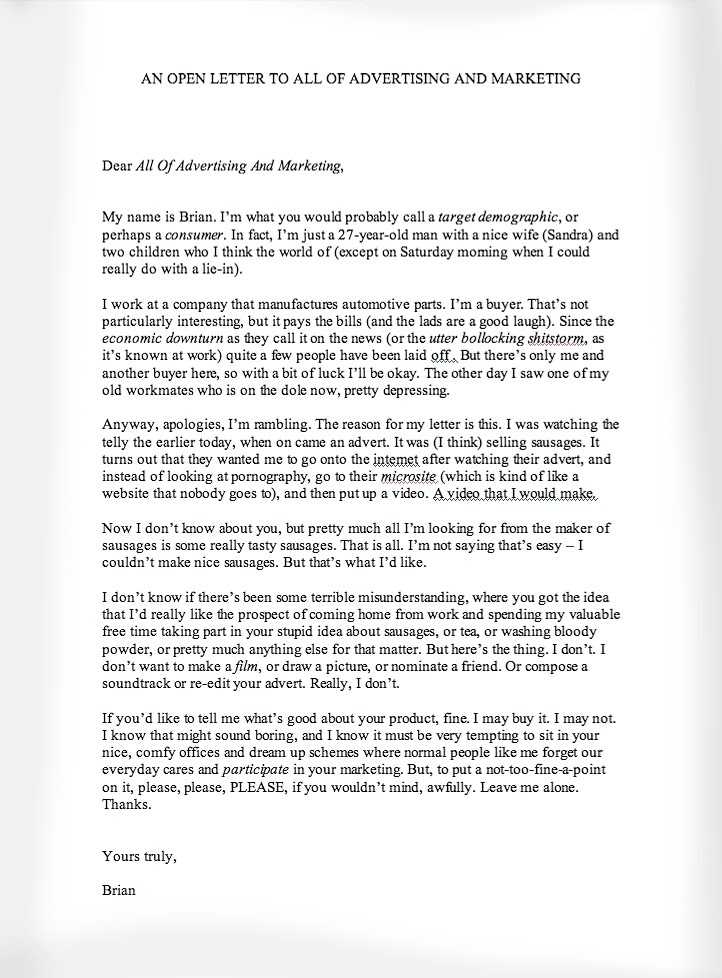
    I thought about it a bit, not in the context of brands or businesses, but more in terms of brand communication as a field, advertising specifically, and brands’ usage of the social web. Consumption patterns, media platforms available etc had pretty much created templates for creative agencies over a period of time. But the arrival of the web, social platforms and the democratization of media have managed to disrupt the ways of the one-way communication age. This post is a good one to read in that context, and talks about the change digital has made to campaigns, and the ‘role of the consumer’. But desperation, hype and the eagerness to get on board makes everyone concerned ‘jump the shark’. And unfortunately, the way I’ve seen many agencies and clients execute it (purely as a consumer), I’m quite inclined to agree with the author of this hilarious letter. (via PSFK)

    Clipboard01

    (click to enlarge)

    The job of the brand manager/creative agency is obviously a more difficult one now, and is made even more so thanks to the approach – of tool strategy. Like this (old but) excellent post states, ‘the technology that underpins social media is changing fast’, but its ephemerality ‘is a feature, not a bug’. It made me wonder whether brand communication/advertising, as a process (the way we see it now) had ‘jumped the shark’, mostly because the thinking process still sees  social platforms in the same light as traditional media and has not changed to be in tune with the former’s dynamics. In other words mistaking social media marketing for social media.

    Maybe they have to dig deeper, figure out the value that people are willing to pay for, and then find their ‘purpose idea + social object‘, and consistently. But that would mean a sea change in the way brands and creative agencies operate. Is adaption possible, or is complete disruption inevitable?

    I juxtaposed this thought with something that Seth Godin wrote recently, about the ‘red zone‘ – the joyless part of the learning curve. His graph also has a green dot, which represents ‘someone on the other side.. rooting us on, or telling us stories of how great it is on the other side’. Perhaps if brands can find from the existing consumer crowd a few who believe enough to play the ‘green dots’, they can adopt a more holistic approach to social platforms and carry the loyalists without it seeming like ‘jumping the shark’?

    until next time, safe jumping.

  • The path to transparency

    Google Me is already showing great results, even before its launch. Maybe its the fear of whatever-it-is-going-to-be that has made Facebook release a couple of tools a few days back. 😉

    Facebook Live (via), a live video streaming facility, with features like a live feed, and ‘ask a question’. More interesting is the app that will allow regular Fan Page administrators to add this to their page and the embedding on other platforms – Twitter, Google Buzz etc. But what I’d really like is for Facebook to get into proper video distribution- create an app that will replicate what the Justin.tv and Ustream apps for Facebook achieve. So brands/organisations can stream everything from say, earning calls to new store openings to special brand ambassador promos and so on. Think of the engagement possibilities.

    Notes. I have never found Notes very interesting at all – maybe because I blog a lot. So, except for the occasional note, or using it to get the blog feed into Facebook, my usage has been limited. For long, I’ve been asking why Facebook doesn’t allow me to tag Pages that I need not necessarily have ‘Like’d (in the Facebook way) , but would want to still tag in a status. So I couldn’t do say, “visited the @Wrangler store” as a status unless I ‘Like’ the Wrangler Page. I still can’t, but now I can do this in Notes, and I can add photos too. As ‘Location’ looms, it’ll be interesting to see how brands deal with this.

    Even as the opportunities for brands to engage increase, I can’t help but feel that its also moving them to some inevitable levels of transparency. The good part about all this for brands, though Facebook may not be the ideal way to do it, is a certain accountability that it creates for people who create content and comment on the brand, thanks to identity.

    A few weeks back, Surekha, Mahendra and I had a good commenting session over ‘The Age of Transparency‘ on Reader, an article that talks about the implications of transparency on individuals, society, government, companies. While we’re still far away from a stage when transparency is a default and ubiquitous feature for people, brands and organisations, it might well be a reality in a few years. Like Surekha mentioned in her comment, it wouldn’t do any good for a brand to engage only because it can’t afford not to, but then the question is, will brands/organisations see the trends in the evolution of these tools and more importantly society in general, and be objective enough to start rewiring themselves? Or maybe the ‘forced’ presence and the opportunities that new tools provide will act as a good catalyst for the required change.

    until next time, anonymous comments are fine too 🙂

    Bonus Read: Kapil Ohri’s well researched article on Indian brands on Facebook, (and my earlier post on social media and the scale of organisations) 🙂

  • ‘Like’ Minded People

    I read an interesting post by Dare Obasanjo titled “There will be many social graphs“. It took me back to the context of my post on Google’s social plans, where I’d mentioned the possibility of creating networks around different contexts – with not all connections being ‘friends’- a Twitter kind of asymmetric relationship, and how Facebook and Google both have an opportunity at that level. The form and kinds of data that we share – blog posts and thoughts, status updates, photos, videos, answers, people and the contexts we share them in, are many, and sometimes I wonder if one service can actually aggregate all this, while still providing user friendly privacy options.

    When i read (and saw) that Facebook is replacing ‘boxes’ with tabs, and also saw that my ‘Like’s (Interests and Likes seem to be undifferentiated now!) were now displayed prominently on my profile, I wondered if Facebook could really aggregate everything. Imagine, if those Likes+ interests were differentiated – i.e. Interest was ‘Music’ and ‘Greenday’ was a Like. Now, the way I’d like it is, if I had Interests displayed on my Profile page (or a tab, if you prefer) – there could be options of ‘how many’, ‘most active’, ‘most recent’ etc, with the existing ‘who can see’ privacy option, but more finely grained for each interest. For each interest, I should be able to build a page – with third party content included – subscription to blogs on the subject (either through FB Notes or say, Networked Blogs), Facebook Questions  and Quora, it could be Facebook groups, Pages that I have liked (so the interest ‘Music’ could have every artist/band/music media brand/ label I’ve liked), Friends who share the interest, people I ‘follow’ in that interest category (will explain in a minute) and when FB plays location, include that too, and sync Events. Goes without saying that I should have micro-level privacy setting options for sharing with others. I should be able to ‘Like+follow’ an interest of a person even if I’m not his friend (assuming he’s kept his interest public),  and even recommend to my friends.  A sort of ‘Twitter list’ for each interest. Yes, of course I need to be able to import Twitter lists too. There would also be a universal ‘Interest’ page that collates data from all the Interest Pages created by individual users, and also gives suggestions on ‘Whom to Follow’ for that interest – an algorithm based not just on mass ‘Like’s, but also basis contexts like Location, sub-genres, and my previous activity. To scale even further, use (mass and personal) data from services where I’ve used some form of Facebook Connect. Of course, Facebook would then have ginormous data on me, but they have it anyway, so I’ll be optimistic and hope that they use it to ‘personalise the internet – like Hunch, than for anything evil. Of course I’m assuming I get data portability too. Then maybe the different Facebook Search options can also really have fun. The entities who want to ‘engage’ users would also find this useful. I realise that I might be being simplistic about this, but what about the direction?

    And though most people are skeptical about Google’s social efforts, perhaps justifiably so (read this at GigaOm and Stowe Boyd’s “Can Google go Social“), and the Wave crash doesn’t really help perception, I don’t want to rule out  the possibility  (like I said in the earlier post) of Google getting over their privacy agony, and surprising us – imagine the ‘Interests’ as a separate service/ something around or integrated with iGoogle/Profiles/Buzz (brrr)/Chrome (browser or OS)/ Search itself.

    While on interests, suggestions and discovery, Twitter’s ‘Who To Follow’ hasn’t excited me much in terms of the people it has suggested. It says that the algorithm is based on people you follow and those they follow, but for now everyone’s busy trashing it, using its own acronym – WTF. So, how about using interests (Why To Follow – work harder on the existing Interests structure?) – either ask me when when i register, you can ask me now too, the lists that include me, keywords from tweets and bio, hashtags and hopefully ‘learn’ my preferences over a period of time. Popularity by itself is really not that great a parameter – if they’re popular, chances are I already know, and there’s a reason I don’t follow, even if its ego 😉

    Its not as though these are the only guys who can build a more nuanced social platforms – perhaps its possible for someone like Quora to start with questions and build more – eg. relevant posts from say Networked Blogs, and more people from Twitter Lists? Foursquare, or any of the LBS could scale too – from places to activities and consumption that happen at those places.

    Meanwhile, interests, context, relevance, building authority and influence, all of these are established on identities,  but there’s a debate on whether an old friend merits a return – anonymity. 🙂 More on that later. 🙂

    until next time, interesting?

  • Hairsay

    So, the Old Spice man  increased the sales of the product. Now we can renew the debate on the efficacy of social media on the bottom line. We obviously won’t ask for correlation data. 🙂 The other side effect is that every brand manager will now want to replicate it – especially the viral and the ROI. Quite like a poster child (in India) of an era gone by – Sunsilk’s GangofGirls, which at that point had made many a  brand manager experimenting with digital media tell their agency “I want one too”. Damn virals work at meta levels!!

    I recently read Kapil Ohri’s article on afaqs, on the site’s makeover – the shift from blogs and gangs to trends and forums and the ‘mandatory’ buttons – Facebook and Twitter. Its early days, so it’d be unfair to make a comment on the numbers, even if they were to be considered a parameter of success/ failure. But while, on buttons, I think YouTube videos would’ve been a help. More on that in a bit. A revamped GoG, and the Pantene vs Dove war for hairspace being fought offline and on blogs (Karthik, L Bhat) gives me enough food for thought.. and opinion.

    Sunsilk Gang of Girls: GoG could have (like an industry person commented on the afaqs post) integrated Facebook in a much better way. Check out what Levi’s has done at their online store. Instead of separate registrations and profile, Facebook’s plugins could make life easier for the user and automatically bring in the ‘gangs’. It could get them to pull their own photos from Facebook for the ‘Makeover Machine’, suggest it to friends, and so on. Or build a Twitter app that uses the display picture. It could have perhaps thought bigger and had their ambassador (Priyanka Chopra?) interact with the users through her own identities on these platforms. Or used a location based tool like Foursquare (or FB Pages or later Google Places) to start building a resource for salons and tips at each place (think of a Burrp! for salons), maybe in sync with a YouTube channel for tips.

    Pantene: Good Morning! They obviously missed a little thing when they didn’t pay attention to the pwnage of DNA at the hands of the Times Group during the former’s launch campaign in Mumbai back in 2005 (?), or the more recent Airtel- Reliance DTH fun. Not to mention the cliche that after a certain point, the only person who gets teased is the brand manager. Ok, I won’t overstate, but c’mon this is a real-time era AND they did walk into a Dovetailed ambush. Since the internet already has made them un-mysterious (thanks for that info, Karthik), maybe Pantene should have just added those FB page and Twitter links to their mass media communication, and solved the mystery immediately online. Mind you, thanks to our dismal internet penetration, they could still demystify it again on mass media, later, after perhaps, adding the content from their online and offline activities. (think non market research agency 80%) That way, there would’ve been at least some buffer against a Dove’s sneak attack. Arguable, but possible.

    Dove: All of us should take the time and remember the controversy over the ‘campaign for real beauty’. But hey, they saw an opportunity and used it. Effects on long term goals are again arguable.

    A little note on ‘low involvement’. I wrote about brands, content and new media platforms in the last post, in the context of the Old Spice campaign, and also mentioned the importance of ‘intent’ and setting objectives. Once the ‘why’ is done, the relevant crowd can be identified, along with the platforms and activation strategies – ‘(to) who’, where and what. (Read Rohit Awasthi’s comment on Karthik’s first post) When the ‘right’ content is pitched to the ‘right’ people at the ‘right’ time (and the ‘right’ platform too), very few categories are low involvement.  (read Naina’s comment on that post) And that’s the beauty of the web in general, and the tools that social media have provided marketers. Old Spice could be seen as low involvement too, until they did this campaign.

    But having mostly seen communication as advertising (except arguably PR), creating content for social platforms is in itself quite a challenge for brand managers. Even if they were to  view ‘social’ as ‘media’, it requires a complete realignment of how media and content strategy is done, mostly because the mechanics of distribution are completely different. At a fundamental level, brands are dependent on users of platforms to create a buzz, and money doesn’t always work. At this point, tools can help with the ‘time’ (including location and other contexts) and ‘people’ (interest), and the way it works, if the ‘content’ is done right, people will get other people.

    Therefore brand managers need to make a more diligent effort. The fragmentation of traditional media does not seem to have made much of an impact on the costs involved in using them as distribution channels. So when ‘social media’  presents ‘free’ channels, brand managers see a value proposition and jump right in with a TVC and or/other weapons of mass mediocrity. Brands, I believe, need to invest a bit more on who they’re trying to reach, and then invest some more on building content and designing networks and constructs (irrespective of platform) that will drive the crowd to interact with the content and share it more. Content and people that will drive more connections, and help meet everyone’s objectives.

    But yes, until Augmented Reality allows me to scan a shampoo and tell me how many of my friends liked it, and think I should use it, (though my hair won’t last that long 😐 ) lets keep playing all the shampoo games we can play. 🙂 And while on using social platforms purely with a sales objective, I’m reminded of how Grandma uses her laptop. (vid below) Can it be used for those purposes? Of course! But is that its best case use? We can argue 😉

    httpv://www.youtube.com/watch?v=Vg6emajJmEo

    until next time, sometimes brand strategies can be real poo!!

  • The brand your brand could be like

    The world seems to have loved the Old Spice guy horsing around. Even though the campaign had been around for a while, (via Surekha) the last couple of weeks took it to a completely different level, with the Old Spice guy (actor Isaiah Mustafa) sending unique video responses to people who had blogged/tweeted/written to him  – not just celebrities like Kevin Rose, Alyssa Milano, Mrs and Mr Demi More, Ellen DeGeneres etc but regular people too. He even made a marriage proposal on behalf of one @Jsbeals. You can see all his work at the channel here. Mashable has some statistics, which are quite amazing, and yet unsurprising – 180+ videos, 22500 comments, and more than 6 million views, when I last saw it. But more than the stats, it is the amount of interest that it has generated. The Google CFO mentioned it during an earnings call, and closer home, my eminent blogger friends – Bhat and Karthik have been gushing about it, understandably so. The Old Spice Guy even managed to charm 4chan, (this one is the 3rd most viewed in the series) and that I don’t think has a precedent! Meanwhile, after some really hard work (the making of), he has now wrapped up with one final video, thanking the internet.

    There are many lessons from what is quite obviously a case study – an idea, its amazing execution, the co ordination between creative, social media and tech to get near real time responses done, the confidence/bravery/trust of P&G to allow this team the liberty to make the responses with minimal supervision and as Karthik wrote, the importance of creating some really kick a$$ content. And thus the point of the post – an example of brands being media.

    When one way distribution platforms dominated, things were relatively simple – print ads, billboards, radio spots, TVCs, and even internet banners. But then came the tools of self publishing, the acknowledged game changer, with several possibilities.

    It meant that brands, not unlike us common people, could create their own channels using multiple tools and services available. Some brands used it just as they would use the channels of an earlier era, and pushed until no one was interested.

    When they were done with understanding that questioning the veracity of the content appearing online wouldn’t get them anywhere, some brands figured that the only difference that had been made was that a new breed of influencers and opinion makers/breakers/changers had been created. So, they formed alliances, sometimes transparent and sometimes not so. The thick line is now represented by multiple shades of grey. But that just seems to be the way the world in general works now, the Cisco-CNBC case, for example.

    And then there were brands that went deeper and figured out that creating things that would spawn positive content would be a better idea, even if it meant that they had to rework everything. It could mean that they came out with a great product/service which created or mobilised legions of fanboys/girls. They could involve their consumers by asking for ideas. Or they could take on a cause honestly and contributed to the larger society. Not every brand has a CEO who sets a gold standard (here’s an excellent example of Anand Mahindra’s Twitter magic), but it definitely can create an environment that will make ambassadors of employees. It could create such great content or offer so much reward that  others generated excellent content for them (users created an Old Spice voicemail message) , or at least link to them. And if these aren’t possible, a brand could at least ensure that you offered a little value to consumers on the platforms they preferred. And these are by no means the master set.

    When brands and their fan boys and girls become media in themselves, it raises many challenges too. What happens when a brand goofs up on a product and makes its vocal supporters seem like losers?  (you got that signal, I hope) How much of ownership can the brand take for the fans and how will their action or inaction affect those common consumers who are watching it all? What happens when there’s random malice that uses your brand name? (the recent Coke Facebook scam) Even for the star of the moment – Old Spice, what do they do, when a celebrity retorts in the same vein, and asks them to donate to a cause, that’s creating erm, waves all over the world. I, for one, am waiting for a response.

    But despite all that, I believe that the opportunities make the challenges worthwhile. The work is definitely different – doing an eyewash research, releasing an ad, and adopting vague measurement techniques like reach won’t really cut it. With technology that discovers newer and newer contexts for consumers to express themselves, and their intent, brands have to learn to react, if not be proactive, in real time. So, since the web has successfully bottomed the costs of distribution, it is perhaps time that brands started investing the savings into creating good content, finding their way on platforms and with the people using the platforms.

    until next time, content. is. marketing. too.

    PS. next post, in a fortnight 🙂