[scribd id=51588948 key=key-2gk001xwcnalhi3qkig mode=list]
Category: Social Media
-
Brand-streams
Last week, I got a beta invite from a new lifestreaming service called Memolane and I’ve added my blogs and quite a few services I use to it. You can check it out here. I’m quite a fan of lifestreaming – as a concept. Though I have seen quite a few web based services perish, I persist. In the meantime, I maintain my own twitterstream (though I started it 2 years after I began using Twitter) and even used Sweetcron to try out a self hosted stream sometime back. These function more as activity streams than anything else and only faintly show the connections to other people.
When I saw my stream, I was reminded of a thought from a couple of years back – a post I had titled ‘Communities and Brandstreams‘. Though I’d referred to quite a few posts then, in this context, the two significant ones are @misentropy‘s “The future of: user generated advertising” and RWW’s “Brandstreaming: What is it and who’s doing it?”. The former is about the concept of an open source product/brand wiki and the latter is about how a couple of brands used Friendfeed and other services to stream their content.
Now that I am revisiting this, and with last week’s thought on ‘the structure that would hold the identity of a brand together’, I’m wondering if a brand-stream might be a way to approach it. So if we mash the idea of a lifestream – connecting the individual nodes of interaction [in my case, it would be the web services like Twitter/Faceb0ok/Foursquare/Flickr/YouTube etc, but for a brand, it would not just be its web services but also apps and even ‘real world’ data collection via sensors or the Internet of Things or say a variation of barcodes/QR codes/ stickybits] with a brand wiki we could do at least a couple of things. One, if we open it out for users/consumers to share (with the brand-stream, as well as with their own community) how they interact with these nodes we could then capture and use data by time, kind of activity, user profiles, services used, ‘reach’ of individual users and so on. The entry to the stream could be across platforms. It would make it easier for a user to not only experience the brand through a medium he’s comfortable with, but also check out ways in which others are experiencing the brand and suggest new ways for the brand to interact with others like him. Two, on the other side, users on the enterprise side could also connect to this stream basis various contexts (brand, customer service, operations, even HR) and make the business truly ‘social’. Sounds interesting? (see this for a vague visual cue 🙂 )
until next time, streaming out loud 🙂
PS: On Lifestreaming, on the personal blog. Check related posts for more. 🙂
-
Weekly Top 5
[scribd id=51588941 key=key-19m03e2zvo6xcn09ckzo mode=list]
-
While on contextual reputation…
Though I don’t answer much on Quora, I am quite a gawker and vote up answers too. One feature of Quora that I found extremely interesting and useful (and tweeted about) is the way Quora gives contextual ‘reputation’ (while reading answers) using the person’s topic bio. The interesting coincidence (because he also RT ed this tweet) is that I noticed it thanks to Mahendra‘s answer to a ‘Google Reader’ based question, and right next to his name was “Daily, dedicated user. Subscribed to over 200 feeds, followed by over 700 people on Reader/Buzz”. I must admit, before I realised that it was a topic bio, my first thought was why Mahendra was ‘wasting’ his Quora bio on Reader when he had such a huge list of phenomenal things he could say about himself. 🙂
But yes, coming back to ‘contextual reputation’, I liked it because it gives a lot of relevance and credibility and adds a layer to an answer – you can better understand where this answerer and his response is coming from, for example. Another nuanced way of helping the reader weed out noise. I also thought this was a good way for brands/organisations to develop credibility in their domain, and involve their users, using function specific spokespersons, (brand, HR, operations etc) since “brands are currently not supported on Quora“.
And now we can go off on a tangent and check out a few brand experiences I had last week, all with oblique connections to contextual reputation, though lycra like they might seem 🙂
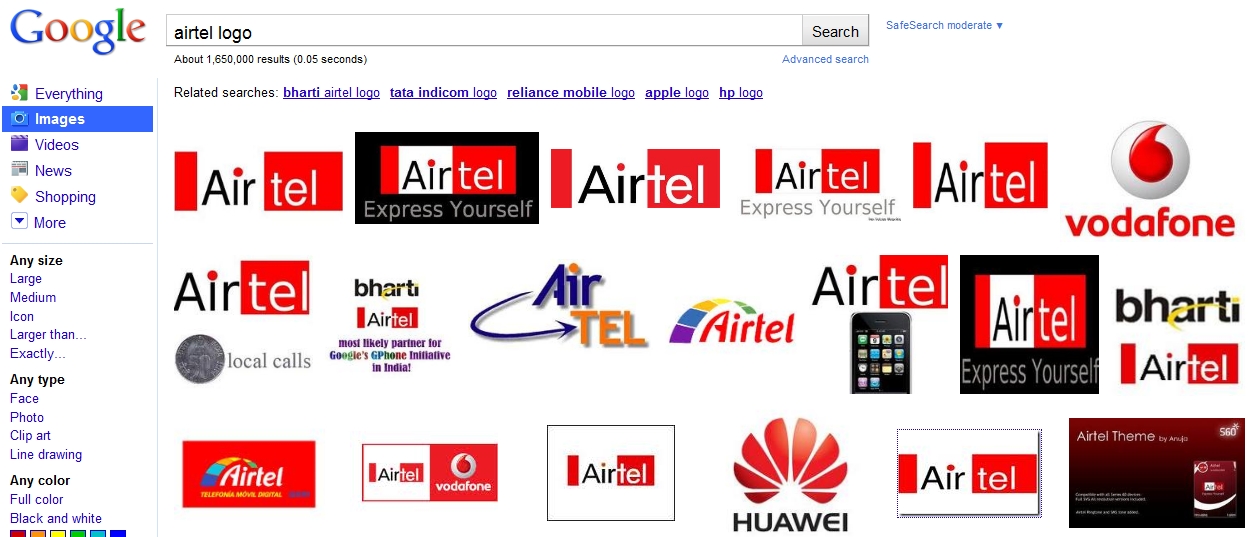
When Airtel changed its logo sometime back, though there were infinite debates on the need and quality of the new logo, their on ground management of the logo change was almost unequivocally appreciated. However,
To their credit, the ‘everything’ search, though has the old images, has the first link pointing to the new logo. But from an image perspective, ‘contextual reputation’ for logo change online gets a thumbs down.
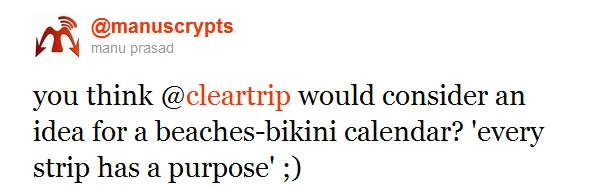
Cleartrip, quite a favourite brand for their ‘no nonsense. clear talk and action’ way of managing their product and online presence, has a new campaign ‘Every trip has a purpose‘. But favouritism unfortunately doesn’t stop me from wordplay and I tweeted
Just as i was chided for provoking a brand, and was replying that I trusted Cleartrip to have a sense of humour, they replied with a ‘laughing hard’. Contextual reputation thumbs up. Hopefully they weren’t being sarcastic.The last experience was from Tanishq, whose new Blush campaign I came across last week. Like I tweeted then, immediately after the Quora tweet, I found it quite interesting and worth an applause that a brand was experimenting with a Firefox/Chrome plugin. Instead of me explaining how it works, I will, in my new found enthusiasm for imagery, give you a screenshot.
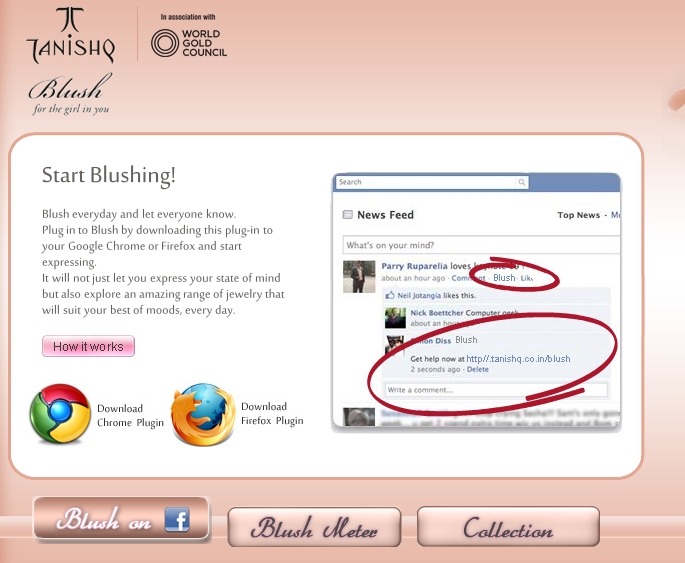
As you can see, the plugin gives you, in addition to the ‘Like’, ‘Comment’ options you see after a Facebook status, a ‘Blush’ option, which when clicked, adds a comment with a link to the ‘Blush’ page. Hmm. I won’t get into a ‘app within FB vs outside website’ debate (there must be some reason, I assume). But unfortunately, boring that I am, I’ve never seen a jewelery that has made me blush. I can’t even see it in the Tanishq collection, assuming that I have the ‘where to wear it’ right. Maybe girls/women see it differently. So, why didn’t Tanishq just have a ‘Gold’ button, which would actually add to their ‘contextual reputation’ more than blush, and tie it to some sort of action that would actually get something tangible for all involved.
For example, I install the plugin and start using it just because of the ‘show off’ value. What if they tied in an offer linked to the number of “Golds” I gave/received on statuses, and then communicated that in the comment that appears after I have ‘Gold’ed a comment. Or how about virtual gifts, a way to showcase the gallery, and then an easy app to add the virtual gift to a profile pic? I have an inkling that women are likely to have a “nice earrings/pendant. where did you get it from” conversation. They could even make this Like based contest i.e. if you virtually gift someone and get them to add it to their profile pic, and they get maximum likes (make a leaderboard) we’ll let you actually gift them for free. Do that on Valentine’s day, and it just might work.
Meanwhile, I have a ‘reputation’ for longish posts, so I’ll just stop here.
until next time, add to the context?
-
All hands on deck
Since tis still the season of predictions and ‘looking forward to in 2011’, and because I brought up the subject of brand agencies reshaping themselves for the future, I thought I’d share with you three of my favourite decks of insights from the many that I managed to scan in the last few weeks.
We’ll begin with JWT’s ‘100 Things to Watch in 2011’. (via Surekha on Reader) While there are many things in this that you might already think is a trend, what I liked about it is its thinking outside of any specific prisms – brands, technology etc, but still managing to capture the essence of trends in human behaviour, culture, consumption, the shifts happening therein, and thus, a good reckoner for marketers.
The second one I’d like to share is Edelman’s ‘Digital Trends to Watch in 2011’. Though there are a few commonalities with the JWT deck, this seems more focused. While this is definitely quite a sensible thing to do from a client perspective, I missed the “completely out of the blue, but damn, why didn’t I think of it?” moments that I usually associate with its creators. But that’s just a testament to my high regards for Armano and Rubel, more than anything else. What I liked most about this was the trend + best practice combining, that layering gives excellent perspective.
The last one I’d like to share is Rohit Bhargava’s ’15 Marketing & Social Trends to watch in 2011′ (via Gauravonomics). There might be some overlap with the other two, but again, the idea of examples with each trend makes it a must-read, in addition to the overall quality of insights.
While its easy to see that there are commonalities in these, I also noticed an interesting thread of thought that resonated most with me.
‘There’s an app for everything everywhere’ is perhaps the underlying theme in #3 (Apps Beyond Mobile), #7 (Ubiquitous Social Computing, more specifically its best practice) and #9 (Appification of the web) in the JWT, Edelman and Rohit presentations. We then move on to ‘production of consumable content and experiences across platforms’ that connects #93 (Transmedia Producers – faint connection), #4 (Transmedia storytelling) in the JWT and Edelman presentations respectively. And at last, we move on to how it can scale which is brought out through #3 (Developer engagement) in Edelman’s presentation and #7 (Crowdsourced innovation) and #11 (Employees as heroes) in Rohit Bhargava’s presentation.
While I may not endorse a brand strategy only basis tools, the ‘appification’ across platforms actually throws open the door for marketers to not just satisfy their ‘short head’ consumers in better ways, but explore the ways to reach the ‘long tail’. It allows them to blend or distribute their ‘story’ across platforms and if done well, raise the interest level of their consumers. And an agency or brand manager cannot do it alone. While the idea of crowdsourcing is looked down upon by many, there are enough examples to show that if targeted well and executed with clarity, it can deliver results. More importantly, here, the ‘crowd’ is not consumers, but developers who can re-create the brand’s experience on multiple platforms, and employees who can create a human story that will resonate with others.
If these possibilities for 2011 don’t excite you, I’ll try again next week, but I really don’t have any more of these awesome presentations to back me up.
until next time, slide rules!