Category: Social Media

  • Brand Personalities

    The discussions on anonymity are back in full force on the web, mostly courtesy Google’s stance against pseudonymity on Google+. Google has its reasons and is supposedly working on it.Considering that I represent myself as ‘manuscrypts’ and an icon/logo on most social networks, identity on the web is an issue that I can definitely relate to.

    But when I consider this from a brands’ perspective, I sense an equally grey area. The brand is usually represented on social networks as a logo and a ‘voice’ that cannot be tied down to a person. Most studies indicate that consumers/users would rather talk to a person than a brand. But that also sets the stage for a BBC-Twitter like incident to happen, a scenario I had written about a couple of years back. I have seen only a few interesting alternatives. (eg. Chicago Tribune’s Twitter directory or adopting a persona like Hippo)ย  There is a different side to it too – how many brand managers would like to associate themselves with the product they manage? (for various reasons) When agencies manage social platforms on behalf of clients, what is the best way to present that? A person has many identities, some he/she wants to share, and some others he/she does not, a brand is rarely given this leeway.

    I feel that in all the time that has elapsed since my earlier post, the networks have not yet built systems that allow brands to fully explore the ‘people-conversations’ aspect that makes social work. Twitter and Facebook, the premium players, both lack a way to surface the identities of the people tied to the brand, in context. There is only so much a Twitter bio can hold, and no one looks at the Info tab on Facebook. (LinkedIn is best placed, but very few brand centric discussions happen there.) The focus, whether it’s Facebook’s Ads API or Twitter’s promoted tweets, seems to be on broadcast, albeit more targeted. Foursquare is still early in the game, but the self-serve brand pages are a decent step. I hope Google considers all this when they do allow brands to play on Google+.

    If a platform does manage to work it out, it would be helpful for all concerned. Brands could apportion responsibilities. Monitoring systems and reaction mechanisms could build in roles, ‘filters’ and ‘rights’ accordingly, and users would know exactly who to speak to for what issue? The other way, of course, is for brands to build that network themselves, feeding in data, personas and conversations from existing networks. That way, they can even assign responsibility to early adopters within the organisation to test out new platforms on their behalf, and communicate that. With the rise of SoLoMo (social, location, mobile), the need for a distributed social architecture is now of much importance.

    until next time, a brand’s personal identity
  • Brands and Plus points

    Considering that I tweeted this sometime back, and found this a great read, this post is not on the pros-cons/ how to use Google Plus or on the lines of 'why I am getting out of Facebook and hopping into bed with Google Plus'. These are just thoughts based on a query I asked on and about the platform a couple of days back.

    The context: I observed that, on my Plus stream ( I have 'circled' about 150 people), a few people were sharing the same content they did on Twitter and LinkedIn, presented the same way as well. I could understand why they would use these as distribution networks because it is difficult to accurately predict who catches what in busy streams. But what did surprise me was this content being shared as 'Public' on Google Plus, when it is very easy to create circles of people with common interest and share accordingly. (using earlier interactions on other networks or even what they share on Plus) And so I asked

    Predictably, the most insightful comment came from generic propecia online no prescription 1

    twitter.com/#!/misentropy” target=”_blank”>Iqbal, who nailed it with “we are used to the environment defining the limits of who we share with – rather than having the ability to choose and consciously picking one set of people over another, every time we have something to say.” In this context, I remembered an excellent post by JP Rangaswami on the subject of filters, publishers and subscribers. While I agree with his summation that “We can only fix filter failure by providing subscribers with better filters, by providing publishers with tools that allow subscribers to filter better“, I did feel that in the interim, till the environment (/infrastructure) is able to deliver this at least to a certain degree of satisfaction (it's a dynamic scenario, not likely to be completely perfect), publishers (us) should filter our output too.

    All of this led me to a comparison of this scenario to that of brands as publishers. Thanks to traditional media platforms, brands had an environment which to a large extent defined the what/who/where/how of marketing communication. Few brands have been able to cope with the explosion of platforms and the freedom, choices and protocols that come with it. As consumers become filters and learn selective broadcast, exploring and navigating the platforms might be a good idea for brands, but it might be a better idea to (also) invest in a content-communication infrastructure which can be customised to meet both the dynamics – the brand's messaging needs and the consumer's sharing habits. (in the brand's context)

    until next time, helpless to help+ ๐Ÿ™‚

    zp8497586rq
  • Consumer Tracks

    I heard a very interesting quote recently, attributed to Rishad Tobaccowala

    When consumers hear about a product today, their first reaction is โ€˜Let me search online for it.โ€™ And so they go on a journey of discovery: about a product, a service, an issue, an opportunity. Today you are not behind your competition. You are not behind the technology. You are behind your consumer.

    That reminded of the title of a post last month from Mitch Joel – “The Ever-Evolving Consumer Evolves (Again)“, in which he talks about how consumers are now more advanced than marketers in terms of technology and how they communicate. Quite agree in general, though it varies with geography, kind of demographic and so on.

    Simplistically put, word of mouth with a technology assist. You'd say that every 'social media' presentation has a version of it, and I'd have to agree. But the interesting part is how brands react. For the purpose of this post, let me give you a contemporary tool based example.

    Within a few days of the launch of Google +, a few brands jumped on to the wagon. They weren't just content sites, but regular brands. Only to be told by Google to lay off until they were officially allowed to. Were the brands behind the con

    sumers in this case? Or technology tool? Not. But even if they were allowed to operate in Plus, would that guarantee a success story? Not necessarily. That's probably because many a time, when brands (and brand managers) get to know about technology, they choose the easy way out. Order the agency to create a page/handle/group and get x number of fans/friends/followers, post some content to 'tick' engagement and then wait for the next shiny object. The harder way is to understand why people are active on the social platforms and the networks that are created within. In this context, relationship and trust. Something that brands lost when they made full use of the fact that traditional media didn't allow consumers to talk back.

    Mitch Joel is right when he says that brands finally found an answer to the first coming of the web. They answered the 'why' reasonably well – information, and built websites. But with an explosion in platforms and interactivity, the answers this time around aren't that simple. Having a touch point at every new internet nation state is a great thing, but if brands look at the new shiny technology/service through the prism of why users are flocking to it, and go through the data – information – knowledge – wisdom path to figure out if/how they can use the technology/service to anticipate and meet consumer needs, they might be evolving a better and scalable strategy for the days ahead.

    until next time, to corrupt a cricket line, platform is temporary, class is permanent ๐Ÿ˜‰

    zp8497586rq
  • Influence, Decision Making & Data

    It’s been just over a year since my last post on influence, but a couple of very interesting articles, and a few advances and observations makes this a good time to visit the subject. I am in touch with both the custodians of my influence these days – Klout and PeerIndex, and like to experiment with them. (the rise in Klout a few days back is the result of one such ๐Ÿ™‚ ) They are obviously in early stages, which is probably why I think they can be gamed, despite their stout denials, and also why Klout considers me ‘influential’ on the topic of lottery. (thankfully Pakistan has been removed now)

    What I did find a bit disconcerting was the usage of these scores in brand strategy/promotions. (relevant link at the end of the post) The basic thought here is to identify ‘influencers’ and engage them for various purposes – from product design to communication, advocacy etc. Not a bad thought in itself, but I wonder if it is way too early in the evolution stage to try this out, because there are way too many variables, including trust, involved and many of them have probably not even been acknowledged, let alone tracked and measured.

    The consumer decision making process is itself undergoing massive shifts thanks to an ever increasing slew of communication platforms and services, which allow consumers to speak to brands, and other consumers, and has mechanisms for rapid and wide spread. For example, I saw an interesting perspective,ย which replaced the traditional funnel with a ‘consumer decision journey’ and discussed the need for changes in the brand’s approach so that different functions can be better aligned.

    For a different perspective, take a look at this presentation (via Vijay Sankaran)

    It makes a good case of why algorithms and ready made dashboards may not be the best solution possible to even finding the ‘right’ ‘influencers’. The way I see it, the current social platforms are only portion of the data, and there are going to be many more layers and sources. (earlier post ‘Data beyond Social‘)

    But even though many, including myself, would agree to the observations in the presentation, the ways to scale it are still blurred because I’d say the human component still has a major role. But that might be something that will change in the longer term. In the short-medium term, considering the $ spent on many a media blitz, a better allocation of $ resources – into collecting and then converting the data deluge to actionable information – is what is warranted.

    until next time, influence shell

    The promised link: Involver is a platform that has partnered with Klout to allow brands to “interact with and reward fans on Facebook based on their Klout score” (via)

    Bonus Reads: Resolving the Trust Paradox, and Prem’s post on ‘social’ in the buying process.

    zp8497586rq
  • Insignificance

    I remember writing this post about 4 years back, with an insight on why I didn’t particularly like to travel. Things have changed since then, and I do travel as much as possible these days. The odd discomfort of viewing masses of humanity still persists, but the reasons are more nuanced.

    What reminded of that post was this article that beautifully expressed the discomfort with the title “The Sad, Beautiful Fact that We’re All Going to Miss Almost Everything“. The article uses this in the context of books, films, music, television and art. But I relate it more to places and people. I still remember that the saddest part of leaving Leh was that it was perhaps my only visit to the place and I had not seen everything that had to be seen. In the case of people, the rise of the statusphere (Facebook and Twitter) has only added to the feeling that one is constantly missing something significant.

    It is probably going to get worse, unless of course, we manage to do the Matrix-USB type thing of instant information absorption. Even then, it would probably go the way things are headed to these days anyway- consuming without experiencing. The real time challenge of being updated about people would still exist. And perhaps it will end up the way the line goes, “we will increasingly be defined by what we say no to”. But, as the author of the article I linked to, above, notes,

    It’s sad, but it’s also … great, really. Imagine if you’d seen everything good, or if you knew about everything good………That would imply that all the cultural value the world has managed to produce since a glob of primordial ooze first picked up a violin is so tiny and insignificant that a single human being can gobble all of it in one lifetime. That would make us failures, I think.

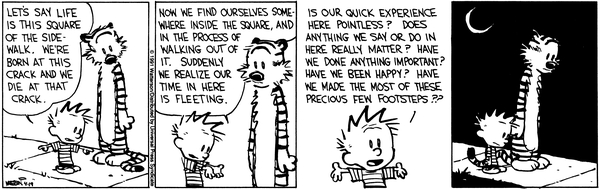
    If I had to adapt that to places and people, I could say that the creator might feel insignificant if we could discover all of it in a lifetime. However, the collective advance of humanity is not a complete solace when it comes to the individual’s existential angst. As one of my fave Calvin strips go

    until next time, insignificant choices too?