
Category: Social Media

  • Brands, Identity and Consistency

    So, Google+ kindly consented to host brands and organisations on the platform (announcement) and immediately gave examples of pages already available. These include Pepsi, WWE, Burbery and so on. The typical ways most brands have approached their new Google+ page is to use the features of the network (mostly Hangouts) to reasonably good effect, in addition to using the platform for content distribution and in a few cases, even displaying their employees. This last one was an interesting use case and has potential, I thought, and better than Facebook’s fanpage Admin version.

    When I read the announcement, I immediately thought of brand identity. In the initial days of Google+ launch, the circles feature that allowed users to compartmentalise their different identities created a little flutter. It helped that, at that point, Facebook’s options for achieving the same ends were pretty well concealed. The visual identities of the brands on Google+ remain consistent with other online and offline platforms and so far, so do the tone and activities.

    I have a different identity for different sets of people I deal with. Work, Friends, Family, Acquaintances, Twitter connections etc. How I behave with them and what I share with them varies too. (though there are overlaps)  I thought about this from a brand’s perspective. My relationship with a brand is different from the one that another person has. (use cases, context etc) And if I do have to share this relationship, what I’d share and the way I would share it would also vary among my own different audience sets.  In a world where the consumers are moving towards a fluid identity, do brands have to consider one too?

    In the real world, brands sometimes tweak their identity according to geography. This was reasonable and worked fine in an era of mass media. With the internet, the whole world would easily see the changes across geography. And the end consumer could ask questions too. He/she even expects the brand to communicate like a human. If we consider different networks as different geographies, with peculiar consumption patterns (of information, for starters), does the consistency that brand currently focuses on become a constraint? Considering that different platforms have different advantages and are used for different objectives, how fluid can the brand and its communication be, on the web and off it?

    until next time, identity crises
  • Gamification – Level 3

    I ended last week’s post comparing the previous season’s buzzword ‘social media’ with gamification, and the need for brands to evolve their own way of utilising it. Though it’s easy to find a huge number of case studies that have been generated on the use of social media by brands to interact with consumers, the amount of material available on how the internal organisation has been wired to implement this, is relatively less.

    At a broad level, both consumer facing social media and gamification are ways to interact with consumers and engage them better. But though a single function in the organisation might be handling this interface (I think the vast majority of organisations have not evolved to the advanced social media frameworks), its effectiveness depends on coordination between functions.

    I read JP Rangaswami’s excellent post on Gamification and the Enterprise, on how the consumer and  the enterprise are changing and that new problems require new approaches and advocates a look at game design to solve these. I also read a counter-post by Sigurd Rinde which argues that gamification, dashboard and search are signs of enterprise failure. The disagreement seemed more to be on semantics, if you check the comments on Sig’s post.

    Both agree that extrinsic rewards based gamification is not the way to do it. Not that my agreement much in the debate, but I do agree. 🙂 To me, extrinsic rewards seems like a way to reward a process for its own sake, but intrinsic rewards might significantly work better to ensure that the intent is the bigger focus.

    Which brings me to implementation. Usually, social media outposts happen first and then organisations scramble to make processes and frameworks out of it. This is probably because the social networks enable customers to have a conversation about the brand anyway without its having any say in the matter. In the case of gamification, though, there is a requirement to build game dynamics, mechanics and aesthetics and it seems that this would have to be done by the brand. That leads to a choice.

    So should an enterprise first use gamification on the consumer side, finding ways to marry customer intent and business objective and then attempt this in the enterprise to ensure that employees work towards achieving these ‘ways’? Or should they identify business objectives and gamify the enterprise to ensure they are met and then attempt this on the consumer side, so employees can work on making the ‘ways’ smoother to execute? Or build both in parallel? I am swinging towards the first option. You?

    until next time, end game, for now

  • Fake my life

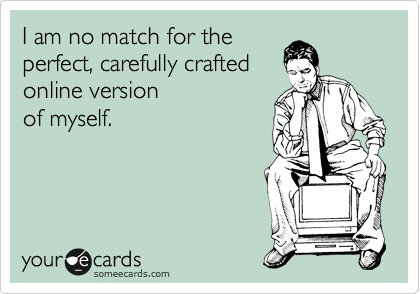
    Funny Confession Ecard: I am no match for the perfect, carefully crafted online version of myself.The perfect life, that’s what I called it – the phenomenon that has spread across the two social networks I frequent. Facebook Photos is nothing new and has come up here as a subject for discussion earlier. But its rise has been meteoric, just like the social network. The best vacations, the coolest friends, the hottest parties, the snazziest gadgets, seems everyone can haz it. 🙂 Twitter is not far behind. People, almost like brands, out to show their best side. Made for Facebook/Made for Twitter/ Lies of Life, call it what you will. Of course condolences would pour in if someone had a distressing update. Either outrage against the wrongdoer if any, or at least a +1 to show solidarity. Unfollow, unfriend you’d say, but these are not bad people, they just have a perfect life. 🙂 Unfortunately, the networks work as emotion aggregators too, forcing me to vent once in a while. [image source Check it out for more awesomeness :)] And yes, I generalise. 🙂

    I have wondered about the motivation. Maybe we like to share happiness more than sadness by default. Maybe sadness is a private thing we choose only to share with dear ones. (do you think there’s a social network idea there? A mutant version of Path) Maybe the algorithms ensure I see only the happy ones. Or maybe it’s indeed true that our vanity stops us from showing that we have been humbled, beaten, saddened by a human hand or a twist of fate.

    A few minutes after I tweeted about the perfect life, I got a message on the blog (deleted now) from an old dear friend S, who had gotten in touch after quite a while. In the long years before a virtual home, when a real diary was a lifesaver, hers would probably be the name that was mentioned most, before the rise of the  thenceforth omnipresent D. 🙂

    S isn’t on twitter, so she would have no idea of the coincidence. She was happy about the progress I was making, doing the things I love to do and generally having fun. And that led me to wonder if I, in my own limited way, was also feeding the perfect life network. So here’s setting the record straight. In case you see my vacation photos, restaurant visits and general attempts at humour and think that the story begins and ends there, you couldn’t be further from the truth.

    As many of my posts would indicate, I have multiple ‘missed life crises’ – singer, author, theatre actor, h3ll, even cricketer, and perhaps a few more too, all skills I have either displayed to some degree or think I possess. 🙂 I think way too much for my own good and am forever irritated at the inequity of life (in terms of those more unfortunate) and not being able to do much about it. I am constantly trying to shed baggage and sometimes failing miserably. My feelings of insecurity would be legend if they were a published work. Thankfully D exists. There is more, but that’s enough fun at my expense. The silver lining is that I’m learning through it all. Meanwhile, all I’m trying to say is that the grass on the other side is probably photoshopped. If it’s not, they’ve probably worked hard to make it this way. And we can too, if we try. Please smile now, and mean it. Or I’ll have to ask you to Like the post 😉

    until next time, open source happiness

    PS: It was only recently that I gave off my fakemytrip.com domain to mygola. I had bought it thanks to an irritating status on FB, and had a 4sq based idea around it. 😀

  • Gamification – Level 1

    Yes, it is quite the shiny new object in the marketing/enterprise conversations around the web. One of the positives is that there are always new and updated resources in addition to some well thought out perspectives from advocates as well as naysayers on its applications on the consumer facing side, as well as the business side. For starters, I quite liked this ‘Gamification and its discontents’ deck (via Tom Fishburne’s post on gamification) that is meant to serve as a primer before marketers set out to apply ‘gamification’.

    But though it’s very early days in terms of a structured approach to the concept of gamification, I’m quite upbeat on it. One of the primary reasons for that is its inherent application that has been happening throughout my life so far. The education system’s ranks and grades (performing x task well earns you y points) not only decide entry into schools, colleges, universities and the progression there abut also gets to dictate a lot of ‘real’ social experiences within (standing among peers, popularity) as well as without. (the varying reactions to the answers to ‘Where/what do you study’? in a social gathering) Many systems have even learned how to factor in different kinds of activities – say, sports and academics, as well as types of pedagogy. A constantly evolving ‘rank’ is built over time and the badges earned and the places they’ve been earned at also have a hand in the work stage that happens immediately after education.

    From landing the first job to designations that happen later, we continue living in a world of points and badges. In fact, I had tweeted some time ago that gamification already existed in the enterprise in the form of designations. The badges also continue to affect real life through the other reward -the salary we get, which is a function of what we have done so far as well as what we are doing. Other acquisitions from that (car, house, vacations, contacts in the phonebook) decide social standing and open further ‘game’ opportunities. I can visualise life as one gigantic gameplay with said and unsaid rules. The badges and rewards were a system unto itself, until our own evolution made us rethink this. The result has been a linkage to a larger life purpose for many of us. Some of us do this within the existing structures, while others make their own niche/walled structures and rules. But that’s a different post. Meanwhile, unlike most other games, there’s only one life, and that’s what probably makes it more exciting. 🙂

    When social networks came into our lives, we first had fun connecting with friends and potential friends, and then immediately sought to apply gamification by comparing number of friends and followers, #ff, recommendations, lists, circles and so on. Also arrived continually evolving systems to measure our activities – as a factor of presence, reach and credibility across networks – Klout, PeerIndex and Kred, for example. Increasingly, they will impact and even integrate with our ‘real’ game. My point is that we seem to inherently understand gamification and more often than not accept this. Hence, my belief that well thought out applications – consumer or enterprise, have a good chance of succeeding.

    I just realised that the ‘introduction’ itself has been a long drawn one. So I’ll wait till next week to share my thoughts on application.

    until next time, game on

  • Idea Maturity Models

    One of the blogs which almost always manages to give me fresh and interesting perspectives is Ribbonfarm. A recent post which caught my attention was ‘The Milo Criterion‘. Though not well versed in Lean Startup principles, I think I managed to get the gist of the post. (The comments were a completely different ballgame though!) So, Venkat’s Milo Criterion states that products must mature no faster than the rate at which users can adapt.

    Though it did remind me of the product life cycle – consumer life cycle thought from sometime back, I thought it also served as a good filter in another, probably simpler, line of thought – the adoption of social media by brands and enterprises. As a reasonably early adopter of services, there are several times when I have wondered how organisations could allow themselves to miss out on obvious potential. As I worked more with brands and clients, I became more objective (or probably pragmatic) and realised that it wasn’t always a lack of understanding or perspective that held brand custodians back.

    This is not just for consumer facing applications, but internal ones too. So I wondered whether organisations had somehow internalised the Milo criterion and the attitude towards social media was just a manifestation. I somehow couldn’t digest that though. Meanwhile, my recent experiences have pointed me to another factor – effective communication. I’m wondering if the Milo criterion would still apply if the ‘audience’ is always appraised of the intent and is constantly educated on the ‘why’ of the intent. Thankfully, my current line of work allows me abundant testing opportunities, and I intend to make full use of it.

    until next time, Milo’s and my highs 🙂

    Bonus Read : Will you become Irrelevant?